
BY EMILY MIBACH
Daily Post Managing Editor
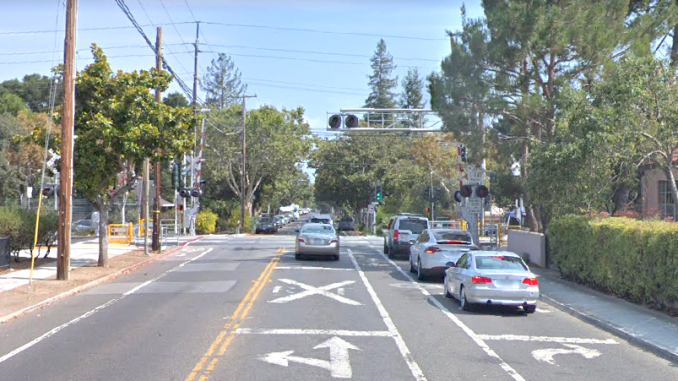
Palo Alto City Council tonight (May 11) unanimously decided not to close the Churchill Road rail crossing to cars after students and parents asked for the closure due to recent suicides on the tracks.
Instead, council agreed to keep funding guards at the rail crossings, as deaths have not occurred at the tracks since they have been hired, and to expedite plans for a quiet zone – where trains will not be forced to blast their horns when traveling over where the rail and road intersect.
The quiet zones will free residents and students at Paly from the “haunting sound of train horns, a continual reminder of our tremendous loss as a community,” Councilwoman Julie Lythcott-Haims said.
All seven council members said they wanted to balance the safety of all residents with the possible track closure. Councilman Ed Lauing pointed out that by closing the Churchill crossing, some 714 bicyclists trying to get to and from Palo Alto High School would be rerouted an extra mile, likely forcing them onto Embarcadero Road, which he said is unsafe on many levels.
Lauing then detailed an encounter on Embarcadero, where he and another driver waiting at a light were nearly hit by another car who zipped across two lanes of traffic to turn into Town and Country Village, across the street from Paly. Lauing said if someone had been in the bike line, it likely would have resulted in a death for the hypothetical cyclist.
Other council members agreed, saying that since the track watch program is successful thus far, to not risk endangering additional lives by forcing cyclists and pedestrians onto Embarcadero or other streets where frustrated drivers, no longer able to cross at Churchill, will be speeding through.
Lauing, Lythcott-Haims and others said the decision to keep Churchill open was not in favor of those who said they’d be inconvenienced by the road closure, but instead to preserve additional young lives by not putting them in danger during their school time commutes.
“Our successes are invisible. We will never know how many lives we will save. But our failures are not. We feel them every time we lose another young life, and we’ve lost far too many in this city,” Vice Mayor Greer Stone said.
Some council members tonight also talked about how suicide has touched their lives, Councilman Keith Reckdahl said a friend in college died by suicide.
Stone talked about how a former Paly classmate of his died a few years after they graduated from high school, changing Stone’s life trajectory, resulting in him joining the city’s Human Relations Commission and ultimately becoming a high school teacher and councilman.
Mayor Vicki Veeker said growing up, she had the same birthday as the youth choir director’s son at her family’s church.
“We ended up at the DMV on the same day for our licenses, since we were eligible on the same day,” Veenker said. “He told me to be safe out there.”
But a few years later, he had died by suicide.
“I felt a kinship with him, and he was gone,” she said.
Then her eldest daughter went to Paly during the first suicide cluster, and her younger daughter during the second.
The city has debated closing the crossing for years, but the conversation gained urgency after the death of student Summer Devi Mehta, 17, on Feb. 3.
In a letter to council, Mehta’s father Nick Mehta said the crossing provided an “easy means for her to impulsively act at a low moment.”
“It is too late for my daughter but it is not too late for others,” he wrote.
Council hired security guards to watch each of Palo Alto’s four railroad crossings on Feb. 23.
The one-year contract costs $1.7 million, split between the city and the Palo Alto Unified School District.