
BY STEPHANIE LAM
Daily Post Correspondent
Palo Alto City Council is throwing its support behind an enormous housing proposal near Town and Country Village, but asking the applicants to tweak their plans to accommodate for the area’s heavy traffic.
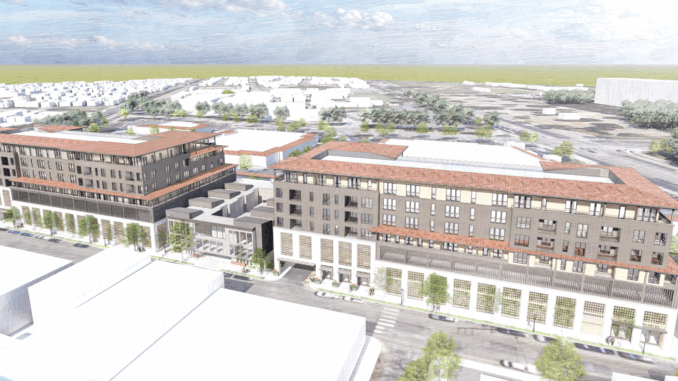
During the council’s meeting tonight (Feb. 2), council unanimously OK’d a proposal by Ellis Partners to create two seven story structures that will add 158 new apartments and 315 parking spaces at 44 and 88 Encina Ave., in the parking lot behind the shopping center.
The meeting is part of a larger process to eventually rezone those parcels from commercial to mixed used housing use. The developers can take council’s suggestions from tonight and incorporate them into a formal application, which will need to undergo city and state-approval before anything can be built.
Mayor Vicki Veenker said Ellis Partners will need to keep a “close eye” on traffic, as the site is located along two busy streets, El Camino Real and Embarcadero Road.
The suggestion was echoed by Councilman Greer Stone, who said the nature of the location will cause “spill over’ from cars looking for parking in the area.
“It seems really challenging, given the nature of the neighborhood,” he said.
Councilman Pat Burt added that if Encina Avenue will be used as a gateway entrance to Town and Country, the area will need signs to make it known.
The 158 unit development has drawn criticism from locals in the past, who say the influx of housing will disrupt their neighborhoods. The council already approved plans to build 10 town houses at 70 Encina Ave.
The 44 and 88 project is allowed by a California Law called the Builder’s Remedy, which allows developers to bypass local zoning and general plan rules to build housing, so long as a portion of them are affordable.
During the meeting, a speaker named Jonathan G. said retail traffic in Palo Alto is low and he understands why the city is changing zoning rules and “loosening regulations” to accommodate for more housing.
Jonathan said he hopes the council will consider the safety of shoppers and retail workers, and consider how a project might interfere with local protests, who frequently demonstrate at the corner of Embarcadero Road.
Other locals at the meeting said they appreciated the project. Resident Adam Schwartz, who spoke on behalf of Palo Alto Forward, said the pro-housing organization is in “strong support” of building homes in the area.
Schwartz said the location is near buses and trains, stores and “most importantly” jobs.
This project will make a traffic nightmare even worse, but saying that it will impede protests at Embarcadero and El Camino is an argument for the project, not against.
Yep!
Thank you to the Palo Alto City Council for its preliminary support for new homes at Town & Country!
Mayor Veenker, what is the city’s plan to monitor and mitigate traffic growth through the entire lifecycle of this project? By the time the units are fully occupied and the impact is truly felt, these developers will have moved on, leaving future City Councils to clean up the mess. We cannot ignore that this is a major thoroughfare for Stanford, the medical campus, and Palo Alto High School. Why isn’t the city doing more to reclaim local control from developers who use the ‘Builder’s Remedy’ to bypass our infrastructure realities?
Why isn’t the city doing more to reclaim local control? Because the most funding for city council candidates is from developers, Palo Alto Forward, YIMBY and other deep-pocketed organized groups, not from local residents who are always outspent.
A city plan to monitor ans mitigate traffic growth? Surely you jest.
This is Palo Alto where it took 6 years of Casti hearings to even address the issue of how to monitor the Traffic Demand Management program and who was going to be responsible for counting vehicles. They were still unclear on whether or how penalties for non-compliance might be imposed when Casti’s expansion was approved.
Remember it took Palo Alto eight long years to fix the traffic light timing of the Paly pedestrian traffic light — mere feet from the other T&C / Paly vehicle light — to shut it off when no students were there — weekends, late nights, vacation.
And how did they address this? They awarded the then-transportation manager Jaime Rodriquez a consulting contract for city-wide traffic light timing after he left his city job under pressure.
With billionaires, skilled workers, banks, tech and oil companies, all fleeing the state, California policy makers are turning to the real estate industry to bolster California’s faltering economy. These housing projects are to the real-estate industry what collateralized debt obligations full of worthless sub-prime mortgages were to the financial industry. Junk housing projects bundled into and obscured by a long list of high quality amenities (schools, parks, rec facilities, transportation, etc.) all built over decades by local taxpayers. This is California’s new economy… low wage workers, building junk housing for low-skilled workers, funneled into the state by policy makers desperate to shore up California census numbers from being eroded by the cascading brain drain of high-skilled workers from the state.
The shopping center is already a nightmare for parking and safely driving through. What do you think will happen to the businesses there when we stop shopping because you’ve made it impossible. Paly students, as of recently, park at the center making very few spaces available. You will be putting our much needed shops out of business.