
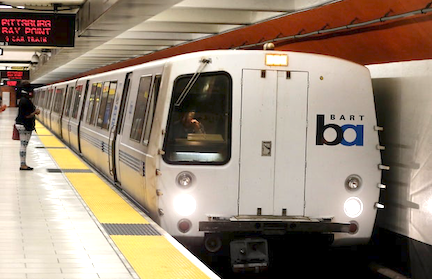
Organizers with the Connect Bay Area Act, a regional sales tax measure for public transit, collected 305,895 signatures across five Bay Area counties, well above the 186,000 required threshold to place it on this year’s ballot.
Voters in the counties of Alameda, Contra Costa, San Mateo, San Francisco, and Santa Clara will vote this November on the sales tax measure Senate Bill 63 — more commonly known as the Connect Bay Area Act — that would create a new source of funding for several public transit agencies facing budget deficits.
In Santa Clara, San Mateo, Alameda and Contra Costa counties, a “yes” vote means the sales tax will go up by a half cent on the dollar. In San Francisco, where voters are more pro-tax, passage will result in a full cent increase.
The Connect Bay Area effort was funded mainly by Salesforce, Genentech, Meta, Herzog Contracting Corp. and Uber. By funding a sales tax, which everyone would pay, it would reduce the odds tech companies would be taxed to pay for the cost of taking their workers to their jobs. Contractors such as Herzog would benefit from construction contracts paid with money from the new tax.
The state legislature passed SB 63 in 2025 after being introduced by state senators Scott Wiener, D-San Francisco, and Jesse Arreguin, D-Berkeley. It authorized placing a regional sales tax measure on the November ballot.
End-run around two-thirds requirement
In California, a voter-approved regional measure for a new sales tax would normally require a two-thirds majority approval if the Legislature directly places it on a ballot. Transit advocates, however, chose to collect signatures to make the sales tax a citizen-initiated ballot measure that would lower the threshold to a simple majority of votes cast.
Organizers with Connect Bay Area, the campaign to pass the measure, said the number of signatures collected “proves there is broad and deep support across the region for public transit.”
Campaign spokesperson Jeff Cretan said in a press release that the group used a mixture of grassroots volunteers and paid personnel who would station themselves outside places of business, transit stops and major events across the region.
Connect Bay Area co-leader Lian Chang said over 1,000 people contributed to getting the necessary signatures for the ballot measure.
“We’re blown away,” said Chang in a press release. “This is the largest grassroots signature-gathering effort in the history of the Bay Area, and represents thousands of hours of time from people from all backgrounds and all corners of our five-county region to protect this thing — transit — that matters so much to us, and to millions of Bay Area, voters, even if they don’t know it yet.”.
Rep. Mullin supports it
Congressman Kevin Mullin, D-San Mateo, said the measure would help keep the Bay Area moving and affordable for residents.
“Public transit is a cornerstone of our economy and an essential public good that keeps our region affordable for residents,” said Mullin. “Connect Bay Area will protect the public transportation service we all rely on while ensuring strong accountability so every dollar delivers reliable, safe transit.”
The announcement comes after the Metropolitan Transportation Commission approved the first phase of the Financial Review Process, an audit by independent firm Nelson/Nygaard that found Alameda-Contra Costa Transit District, BART, Caltrain, and the San Francisco Municipal Transportation Agency implemented over $1 billion in cost saving measures since 2019.
Cost-cutting recommended
The report made recommendations for further savings and cost-cutting measures. Now with the measure set to be on the ballot, the second phase of the review will go further into depth into each agency receiving funding to ensure responsible spending and places where improvements can be made — as required by SB 63.
The Connect Bay Area campaign said it will take up to a month to verify the signatures in each county. — BCN
CORRECTION: The Sobrato Organization wasn’t among the companies that contributed to Connect Bay Area. This version of the story has been corrected to reflect that fact.
Great news! I’ll be voting “yes” in November for more funds for bay area mass transit.
It’s so sad to see a once great state fall into disrepair and not understand what is going on.
As a 5th generation Californian who fled with my family over a decade ago, what I foresaw has become true.
Taxpayers and businesses have fled California because of taxes, regulations and government overreach.
The tech industry including AI will soon leave the state which is the only thing holding up the “economy”.
More money won’t increase the number of people who ride buses, trains and BART. More money means fatter pay checks and lavish pensions. I’m voting ‘no’. When I see more than two people on a Sam Trans bus I’ll rethink my opinion. But right now, throwing money at these transit systems is a case of throwing good money after bad.
I will be voting no on this ballot issue. There are 22 distinct and separate transit districts in our area. Each with their own layers of administrators, administrative assistants, board members, security and on and on. If these were consolidated into a manageable number, the cost savings would provide the needed financial support. Remember that responsible governance requires elected officials to approve budgets within their financial resources and not create financial resources to justify their budgets.
I’ll be voting no. I’m tired of subsidizing Alan’s transportation between Palo Alto and San Francisco and tired of these “transit systems” serving as a pretext and excuse for connected real-state developers to enrich themselves by strip-mining the amenities from our community with oversized under-parked junk architecture.
I’m all for a robust mass transit system, but it infuriates me to see empty CalTrain cars and SamTrans busses running up and down the Peninsula during the non-rush hour times. It seems like the transit agencies make zero attempt to operate efficiently with their funds, and simply schedule resources on time intervals. I would feel better about increasing my taxes (for a system I can’t use) if there was some mitigation and reasonable attempt at efficiency.