

This story was originally printed in the Saturday, Nov. 15, print edition of the Daily Post. If you want to read important local news stories first, pick up the Post in the mornings at 1,000 Mid-Peninsula locations.
BY ADRIANA HERNANDEZ
Daily Post Staff Writer
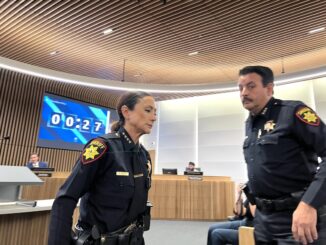
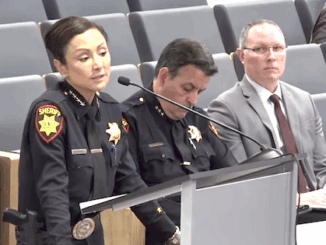
Proceedings in the civil grand jury’s accusation against fired San Mateo County Sheriff Christina Corpus, which could result in a verdict prohibiting her from ever holding public office again, are on pause until next year, a prosecutor said.
That’s in order for some of her other court battles, specifically the ones where she’s fighting her firing, to be resolved, said District Attorney Steve Wagstaffe.
Corpus’ attorneys have been fighting her firing in front of two judges, federal Judge Vince Chhabria and San Mateo County Superior Court Judge Nina Shapirshteyn. Those two cases, the federal and state Superior Court lawsuits, have created an overlap with the civil grand jury case in which she is accused of retaliation and nepotism.
San Mateo County Superior Court Judge Mark McCannon decided Thursday to continue the Superior Court case until next year. During that period, he will decide whether to recuse the District Attorney Steve Wagstaffe’s office from taking the case to trial since he was also the administrator of the civil grand jury. Corpus’ attorneys claim Wagstaffe’s office has a conflict of interest due to its dual role as both civil grand jury administrator and prosecutor.
Wagstaffe has said his office has been looking into whether to file criminal charges against Corpus and her former chief of staff Victor Aenlle based on allegations that were made in a 400-page report the county commissioned from retired Judge LaDoris Cordell that was released last year.
Wagstaffe said Friday that his office is interested in the case, but isn’t actively pursuing it.
Wagstaffe said his office has spoken with the Attorney General’s office many times to determine whether his office ought to be recused, and he said they have given him a green light to proceed.
A hearing is scheduled for March 5 to make a decision if the DA’s office should be recused in hopes that a decision has been made on whether or not Corpus will be reinstated, Wagstaffe said.
The civil grand jury has brought four “accusations” against Corpus for failing to disclose her close relationship with Aenlle, for firing former Assistant Sheriff Ryan Monaghan in retaliation after he talked to Judge Cordell, reassigning former Capt. Brian Philip for refusing to start an internal affairs investigation into Sgt. Javier Acosta, brother to sergeant’s union president Hector Acosta, and for arresting deputy’s union president Carlos Tapia for alleged timecard fraud. Wagstaffe’s office declined to file charges against Tapia.
If she is convicted of any of the accusations, she will be unable to hold public office in the future.

Our personal life is our business.
Sure, as long as you aren’t improperly spending taxpayer dollars on someone or something in your personal life.
Kinda like Trump?
This woman is a disgrace to the Sheriff’s Department and it’s employees, she should be prosecuted a barred from ever holding office again.
She was in charge of being sheriff at the time my best friend was murdered, due to her there were no investigations in my friends death which she died of blunt force trauma to the head
At least the Civil Grand Jury’s Accusation proceedings are underway, albeit no Civil Grand Jury Accusations were sought against Aenlle nor Perea, both of whom were appointed to their positions. The ongoing proceeding sounds like justice. Yet what is far less clear, and has not been publicly commented upon by Mr. Wagstaffe, is just how his extended “…looking into whether to file criminal charges against Corpus and her former chief of staff Victor Aenlle…” follows the law and upholds the rights of the victims. Prosecutorial discretion is one thing; there should be zero tolerance for public corruption involving criminal malfeasance, as was displayed throughout the Corpus Administration.
I’ve heard about Marcy’s Law. I thought Marcy’s Law was enacted in California in 2008. If Marcy’s Law in California provides victims the right to be treated with fairness, respect, and dignity throughout the criminal justice process, how does one-year pass without a full investigation conducted after the Board’s referral to the DA? False imprisonment of several law enforcement officers sounds easily like felonious conduct.
How can Wagstaffe indicate that his office is interested in the case, but isn’t actively pursuing it? Have public records requests been done by the Post for any of those Attorney General’s office communications Wagstaffe mentioned? Are there misdemeanor statutes of limitations that Wagstaffe has allowed to expire before filing criminal charges? I think many members of the public expect criminal charges to be forthcoming without any further delays.
I hope the estimable Ms. Hernandez and other staffers will be good enough to clarify something: While digging into all of the legal issues in l’affaire Corpus, I’ve tried to find a source in state law for this claim, oft repeated, that a conviction on any “accusation” charge brought under Government Code §3060 bars the removed officer for life — and not found any. It’s definitely not anywhere in GC §§3060-3075, which appear to be that entire body of state law.
So, where is that decreed? Thank you.
California Elections Code Section 20
Chris R.: I already knew that a felony conviction (within particular categories) renders anyone ineligible for future state or local elective office. However, an “accusation” verdict of removal under GC §3060 is not even criminal, let alone felony criminal, but rather administrative — and definitely does not meet the criteria in EC §20.
Thus, my question remains.
Mr. Moen, I’d suggest you try a review of Government Code (GC) §1097. I am of the opinion that Judge Emerson’s holding triggers the application of §1097 GC. You are free to agree or disagree.
In pertinent part, Judge Emerson wrote, “At page 20 of the NOI, County asserts, ‘Sheriff Corpus has violated [conflict of interest laws] with respect to her treatment of Mr. Aenlle, with whom she enjoys a close personal relationship, including by hiring and employing him at public expense in positions for which he is not qualified, by seeking promotions and salary increases for him, and by retaining him in those positions notwithstanding the fact that the County Executive and others advised Sheriff Corpus that doing so was improper’” (pp. 5-6).
The §1097 GC provides that those convicted of such conflicts of interest violations are, “forever disqualified from holding any office in this state.” Multiple other decisions clarify that “convictions” need not be criminal in nature alone and Judge Emerson’s holding should suffice.
“Former Resident”, I am reading GC §1097 right now, and appreciate the reference.
GC §1097 as written does not trigger on conflict of interest in the _broad_ sense, but rather specifically on “making or being interested in contracts, or from becoming a vendor or purchaser at sales, or from purchasing scrip, or other evidences of indebtedness” despite being an officer or person prohibited by law from such involvement. It also (clause b) punishes “willfully aiding or abetting” a person thus prohibited from that economic activity.
Retired Judge Emerson, serving as Hearing Officer in the Removal Hearing, did of course agree, in his advisory opinion, that the Supervisors’ Notice of Intent justified removal on several points, including conflict of interest shown by Corpus placing her private, personal interests above her official duties, through repeated favoritism towards her friend Mr. Aenlle. This was the first part of section “I. Grounds for removal relating to Victor Aenlle”, in pp. 5-10.
However, one, that was not dealing in contracts, vendor relations, purchasing, or creating debt instruments by someone prohibited from doing so, nor was it aiding such a person. So, I cannot see that GC §1097 is relevant to that part of Emerson’s advisory opinion. Two, I really have no idea whether a non-judicial advisory opinion would suffice to establish that prohibition in state law even if it included a finding within GC §1097’s scope, which this one didn’t. (You think “yes”, and I am not disagreeing, but don’t know whether that is right or wrong.) Three, you’ve addressed a different question from the one I asked:
Ms. Hernandez and other reporters have been claiming that a future unanimous verdict for removal in the 25-CIV-04846 People v. Corpus case, initiated by the grand jury “accusation”, would bar her from office permanently. They did not contend that she’s already barred from office by retired Judge Emerson’s findings.
Ms. Hernandez and other reporters’ claim is plausible. I merely would like to know what law says that. GC §1097 doesn’t, and in fact doesn’t reference “accusation” Superior Court proceedings at all. And, to repeat what I already pointed out, to my knowledge DA Wagstaffe has never made the referenced claim, so telling me to ask him for the legal reference behind the reporters’ claim is simply inane.
Mr. Moen, your assertion that, “However, one, that was not dealing in contracts, vendor relations, purchasing, or creating debt instruments by someone prohibited from doing so, nor was it aiding such a person” may neglect to recall, or consider, the two contracts that Corpus provided to Aenlle. The first contract Corpus procured with Aenlle was as the Sheriff-elect, and is referred to as Exhibit 3 of the Cordell Report. The second contract Corpus procured with Aenlle was as the Sheriff, and is referred to as Exhibit 6 of the Cordell Report.
In addition, as the Sheriff, Corpus created two employment positions for Aenlle when she was the Sheriff; think of the positions as debt instruments. One was as an Extra Help position (see Exhibits 9 and 10 in the Cordell Report). The second employment positions was the unclassified Sheriff’s Executive Director of Administration that Aenlle occupied until Corpus removed him from it during a Board meeting in a failed attempt to appoint Aenlle to a fifth position, that of Assistant Sheriff. That would be a total of four, or five, total debt instruments in violation of conflict of interest laws; two to three while Corpus was the Sheriff.
Respectfully, whether you initially recognized it or not, §1097 of the Government Code is very relevant to that part of Emerson’s advisory opinion and a bar to Corpus becoming elected in California again. That was my opinion; I could easily be incorrect as I am not a lawyer. I also mentioned that multiple other decisions clarify that “convictions” need not be criminal in nature alone and Judge Emerson’s holding should suffice; you may have overlooked, ignored or not researched that aspect of my attempt to help you understand. Again, I could be incorrect.
As I wrote, you are free to agree or disagree, just as you are free to do additional research. It’s up to you. It was not I who direct you to ask anyone for the legal reference behind the reporters’ claim. I had simply thought you were trying to understand the sometimes unclear assertions in the stories that generally concerned a bar from holding a future office for Corpus. Journalists, like all authors, do not always see how their stories read and a cross-reference may have been missed. It happens. It’s still a good story.
Thanks for Adriana Hernandez for wonderful reporting!
This is what she was charged under.
If Rick has a problem with it, he should sit down with DA Wagstaffe and after the meeting, Wagstaffe will issue a new indictment based on Rick’s research.
[beginning of statute, verbatim]
2024 California Code
Government Code – GOV
TITLE 1 – GENERAL
DIVISION 4 – PUBLIC OFFICERS AND EMPLOYEES
CHAPTER 7 – Removal from Office
ARTICLE 3 – Removal Other Than by Impeachment
Section 3060.
3060. An accusation in writing against any officer of a district, county, or city, including any member of the governing board or personnel commission of a school district or any humane officer, for willful or corrupt misconduct in office, may be presented by the grand jury of the county for, or in, which the officer accused is elected or appointed. The grand jury presenting the accusation may also be the additional grand jury impaneled pursuant to Section 904.4, 904.6, or 904.8 of the Penal Code. An accusation may not be presented without the concurrence of at least 12 grand jurors, or at least 8 grand jurors in a county in which the required number of members of the grand jury is 11, or at least 14 grand jurors in a county in which the required number of members of the grand jury is 23.
(Amended by Stats. 2012, Ch. 134, Sec. 1. (SB 1357) Effective January 1, 2013.)
[End of quoted portion]
Rick is incorrect in stating that this is an administrative action. It has the full force of state law. If Rick wants to look up the case, the docket number is 25-CIV-04846. Then, if he wishes to speak to Wagstaffe about it, he can call the DA’s office at (650) 363-4677 and make an appointment.
“John Marshall’s little buddy”, I’ve already carefully read §§3060-3075. Nowhere therein can one find any provision that a person removed from office per GC §3060 et seq. is thereby barred from future public office, for life or otherwise. Ms. Hernandez and others have said such is current state law, and that certainly may be true, but my question was, and remains: Which state law?
It’s a simple question. No, I don’t wish to speak to Steve Wagstaffe about that. For one thing, to my knowledge he’s never so claimed.
When I said it’s administrative law, I meant: Well, a removal under GC §3060 isn’t a criminal conviction under criminal law, nor is it an infraction under criminal law. Nor is it a tort under common law. Normally, one would call that administrative law, by default. Saying it has “full force” doesn’t actually say anything, but OK. Fine. Not at issue.
If you wish to claim some other name than “administrative” applies better, I’m distantly interested in what that would be, but said detail is really not the point of my question, now, is it? Remember the question?
So Rick, why aren’t you calling Wagstaffe to let him know he’s made a terrible mistake?
Former Santa Clara County Sheriff Laurie Smith, who was tried and convicted on a grand jury accusation under the same statute as Corpus, is probably saying to herself, “Why did I spend all this money on expensive and experienced lawyers when I could have hired Rick Moen?”
Yeah, he’s a regular Perry Mason.