
BY ELAINE GOODMAN
Daily Post Correspondent
After splitting the city into seven voting districts to avoid getting sued, Redwood City council is now considering opposing a bill in the state legislature that would again raise the specter of voting-rights lawsuits.
The Redwood City council tonight will consider taking a position on Senate Bill 1164 by Sen. Sabrina Cervantes, D-Riverside.
Supporters say the bill is needed to protect California voter rights as federal voting protections have been whittled away.
But opponents say that if the bill passes, even cities that have moved to district elections could face constant legal threats over their district maps and other election issues.
Redwood City switched to district city council elections in 2019 after receiving a letter from Malibu attorney Kevin Shenkman, who threatened to sue the city. Shenkman argued that at-large elections were making it harder for Latinos, who made up 39% of the city’s population at the time, to win seats on the Redwood City council.
Los Altos too
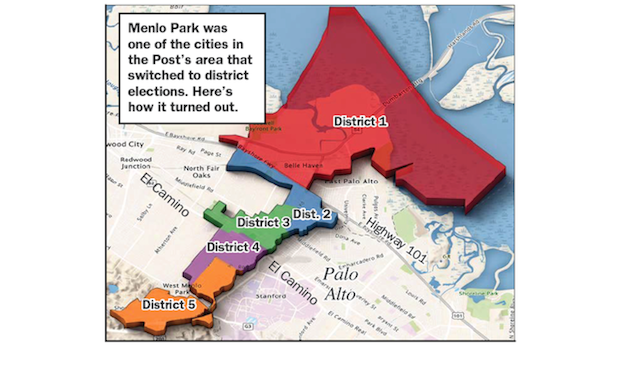
Other cities found themselves in the same boat. Menlo Park switched to by-district council elections in 2018 after receiving a letter from Shenkman. Los Altos received a similar letter and will hold its first by-district council election in November.
In cities with district elections, voters only get to choose a candidate for one council seat, rather than helping select all council members as is the case in at-large elections.
Under existing state law, cities that switch from at-large to district elections are safe from lawsuits based on the California Voting Rights Act.
But that would change under SB 1164, which would amend California’s Voting Rights Act of 2001.
A city that moves to by-district elections could still face challenges to its districting or redistricting plan under SB 1164.
“Cities that did exactly what the 2001 act demanded, converting to district elections, often at significant cost, are thrown back into the litigation pool the day this bill takes effect,” the California Public Policy Group said in an SB 1164 analysis. “The bill’s first targets will be the jurisdictions that complied, not the holdouts.”
Organizations would be able to sue a city over alleged voting-rights violations, even if the group wasn’t representing a particular resident of that city, CPPG said.
Locked into council districts
The bill also includes a new rule in which cities that moved to district elections would be locked into that decision.
Someone who sends a letter threatening a lawsuit that prompts the city to make changes would be eligible for $25,000 in attorney fees and up to $50,000 in other costs. The cost of responding to such a letter can be much more, running from $150,000 to $500,000, Assistant City Manager Michelle Poche Flaherty said in a report to council.
According to the League of California Cities, SB 1146 would apply to almost any “election policy or practice,” which could include polling sites or voter outreach programs in addition to district maps.
“Jurisdictions could face repeated legal scrutiny of their district maps, including pressure to revise them multiple times within short periods,” said the League, which opposes the bill unless it’s revised.
A response to Supreme Court ruling
During a July 1 hearing before the Assembly Elections Committee, bill author Cervantes said the U.S. Supreme Court had been “chipping away” at the federal Voting Rights Act of 1965, including the court’s “shameful decision” in April in Louisiana v. Callais. The court found that the state’s 2024 congressional map, which created a second majority-Black district, was unconstitutional.
“Many of the safeguards against vote dilution, voter suppression and voter discrimination (that) have protected Californians for generations are effectively no longer in place,” Cervantes said.
SB 1164 aims to bolster the California Voting Rights Act, which now only addresses discriminatory at-large elections, she said.
Kristin Nimmers with the California Black Power Network pointed to a 2022 scandal involving a leaked recording of a secret meeting of Los Angeles City Council members, where racist remarks were made during a redistricting discussion.
More recently, Nimmers said, the city of Huntington Beach tried to require voters to show their ID at polling places – an effort that a state appeals court shot down.
“These examples confirm that we still face threats of discriminatory redistricting and efforts to pass laws that suppress voter participation,” Nimmers said during the committee hearing.
The Elections Committee passed the bill and forwarded it to the Assembly Appropriations Committee.
The state Senate passed the bill in May on a 29-9 vote.
“Jurisdictions could face repeated legal scrutiny of their district maps, including pressure to revise them multiple times within short periods,” said the League, which opposes the bill unless it’s revised.
Enough is enough, the CA Democrat led legislature is out of control on this. And the way the CA voting rights act was written, allowed Shenkman to make thousands of dollars off of cities, even those that complied. We never needed district elections in the first place. Look folks, as a nation, we elected a black man as president and even re-elected him. Black people only make up about 15% of our population, so the only way Obama got elected was there were a lot of white people voting for him. For our city council elections, believe me, when it comes to people’s homes, children’s schools and neighborhoods, they will vote for a person who will carry out their wishes, not because of their color or race, contrary to what the Democratic Party says.