
This story has been updated to include additional fundraising numbers that were not available when the story was first published on Sept. 25.
BY BRADEN CARTWRIGHT
Daily Post Staff Writer
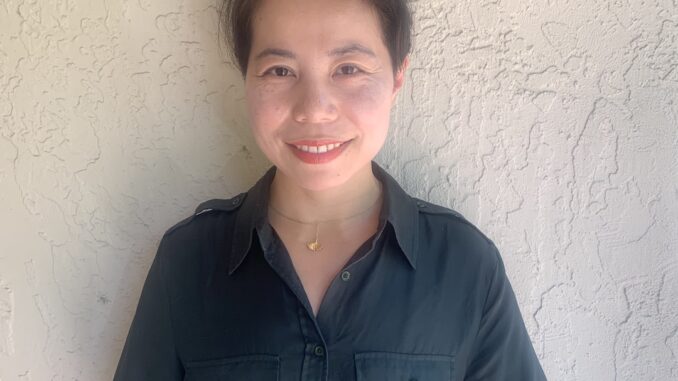
Palo Alto City Council candidate Yudy Deng has raised $166,128 – smashing city records and nearly doubling the total of her closest opponent.
Deng is relying more on out-of-town donations than the rest of the field. She’s had 41 of 135 donations come from Palo Alto, according to her latest fundraising report. (Read her report here).
Planning Commissioner Bryna Chang is in second with $85,118 raised through Sept. 19. She’s collected 107 of 139 donations from Palo Alto residents, her report shows.
Democratic Socialist candidate Raymond Goins has raised $1,200.
Dr. Gary Gechlik and software engineer Brian Hamachek reported no fundraising.
Three seats are up for grabs, with ballots going out on Oct. 5.
Deng has far surpassed past fundraising leaders. Councilman George Lu raised $49,958 at this point in the last election, and Lythcott-Haims raised $69,561 in 2022.
Deng is endorsed by Lu and Lythcott-Haims.
Deng said she asked for donations from friends from college, the nonprofit sector and her old home in Bellevue, Wash. She said most of her friends are tech engineers, attorneys or people she knows from nonprofit work.
“Nothing suspicious,” she said in an interview on Sept. 9.
Deng is on the Parks and Recreation Commission and chief development officer for the Society for Heart’s De-light, a nonprofit focused on engaging Chinese immigrants in the South Bay.
This is an obscene amount of money. And the majority of vast majority of it is from out of town businesses and people seemingly wanting to buy influence via Deng who don’t live here and can’t vote.
This needless amount of money is literally unprecedented in any Palo Alto council election in our history.
Deng even has PAC money.
The other candidates are all within the typical fun range for our city elections.
This sets a terrible precedent, with feeling pressured to raise more and more money to keep up with someone like this candidate.
That is bad for democracy and bad for Palo Alto. Her behavior and bad judgment does not merit our votes.
Well put. I agree.
Money is ruining politics! This is an unseemly amount of money to spend on a council race. And so many donations from out of town! I want to see local support and a person with the depth to win on their ideas – not the pocketbooks of companies, state politicians, special interests or developers. Please follow the money before casting your vote.
By the way – when a political candidate tells you there is “nothing suspicious”, there is something suspicious.
I would prefer if she had a longer track record in Palo Alto. A few months on Parks and Rec isn’t enough. And then all this money from people who are a complete unknown in this community. Something is going on here that we haven’t been told about.
Ms. Julie supports Deng? Someone else please.
If Julie supports you, you won’t get my vote.
Julie Lythcott-Haims also endorsed Ed Lauing.
She did? Julie’s name is missing from Ed Lauing’s very iong endorsement page listing endorsements by current and former officials as well as community members.
In case that was an omission, I did a search and neither AT nor a regular search found any evidence that Lythcott-Haims endorsed Lauing.
Maybe you can explain
Not true. It’s a huge negative that Yudy Deng would accept a Julie Lythcott Haims endorsement. Julie Lythcott Haims abused her power to take advantage of a Stanford student when she was a Dean, and hid her misbehavior until her victim finally told her painful story. Shame on Yudy for accepting this endorsement.
NOT TRUE. Lythcott-Haims is not listed as an endorser on Ed Lauing’s website.
There’s absolutely no evidence that Julie Lythcott-Haims endorsed Ed Lauing. Check his endorsements on his website and/or do your own search.
Scott, you must have forgotten we know how to search.
It’s worth acknowledging that 100% of all the candidates who are raising money are raising money from out of town. If you think trying to do this is categorically wrong, then you shouldn’t vote for Chang, Lauing, Deng, Veenker, or Goins.
Once we decide not to eliminate people on that basis, it’s worth asking: what does success in out of town fundraising mean? Is Deng working harder than Chang? More persuasive than Lauing? Better at formulating strategy or running an effective organization than Veenker or Goins?
It’s well enough to hate the game, but we should think twice before stigmatizing success at it.
I realize there’s an ancient strain of Palo Alto groupthink holding that out of town fundraising is bad. That’s a symptom of a larger “Palo Alto is an Island” mentality, which creates blind spots for solutions and only survives by going unchallenged. Breaking out of groupthink is also a fine leadership quality.
I’m very glad the Post is continuing to track this issue each campaign season. Thank you Dave!
There are no good reasons for large amounts of out-of-town money to try to influence elections whose policy choices apply only in-town. But there are plenty of bad reasons.
It’s telling that if you look only at in-town donations, Deng is no longer the largest recipient.
A Trojan horse in a suit
Saying someone who raises massive amounts of out of town money is no different than someone who raises a small amount is an interesting statement. The outside folks who are trying to buy influence in Palo Alto are most likely developers who want upzoning while minimizing affordable housing. Also Deng did not do much on Parks & Rec and was not championing local issues or helping out residents.
Deng appears to be naive about local and general politics. Perhaps she has never heard of Whitman and Steyer who tried to buy the office of governor and failed. Joining the Rotary and PTA is laudable as is being on the Parks and Recreation Commission but what does Deng stand for? She declines to state a definitive view on plastic turf versus grass and the pickle ball versus the tennis courts items. Constituents want commissioners with informed positions who are not tentative and weak.
Her loudest supporters in this campaign are Palo Alto Forward with George Lu and JLH shouting her name from the rooftops. This lobbying effort is developer territory which Deng embraces. So who are the outside Palo Alto donors?
Deng does make it her business to support Flock which reveals her comfort with surveillance and data shared illegally to federal government agencies.
Palo Altans need to vote for candidates who care about our town and are not fronting for outside interests.
Firstly, running for a city council member position is non-partisan, so I’ve really never been able to understand why the all the Democratic party orgs endorsements were necessary. Secondly, out of town monies especially when it is at approx. 70%, then one has to question — why? Is Palo Alto for sale?
Calling concern over out-of-town fundraising “groupthink” is inaccurate at best.
In a small city like Palo Alto, local elections should reflect the needs and priorities of Palo Alto residents. When a substantial share of campaign funding comes from outside the community, it is reasonable to ask whether those contributions reflect local priorities or the agendas of outsiders.
Foreign funding raises an even more basic question: why should foreign nationals or foreign interests have any financial influence over who governs Palo Alto? A local election should be accountable first and foremost to the people who actually live here and will live with the consequences.
This isn’t about making Palo Alto an island. It’s about keeping local elections locally accountable.
Questioning outside influence isn’t groupthink. It’s basic democratic accountability.
“Questioning outside influence isn’t groupthink. It’s basic democratic accountability.”
Indeed. Or at least was basic accountability until the last few years.
Now litmus tests have become common and dissent meant you lost your federal job, when politicians can blatantly offer to bribe voters to vote for them, to threaten officials who refuse to do vote recounts to satisfy the whims of aspiring dictators, when goons threatened you and your family for disagreeing, where public officials can now threaten law firms, companies, museums, the press etc etc etc with impunity.
Maybe we should buy Scott some newspaper subscriptions and history books so he can study up on democracy.
The Eileen Wang case should be a wake-up call for every California voter.
Wang, the former mayor of Arcadia, has pleaded guilty to acting as an illegal agent of the People’s Republic of China. According to federal court documents, she worked with Chinese government officials to publish requested material and report back on its reach. Her former fiancé and campaign adviser, Yaoning “Mike” Sun, was previously sentenced to four years in federal prison for acting as an illegal foreign agent. Wang is scheduled to be sentenced on October 6 and faces up to 10 years in prison.
The important lesson is not to judge people by their ethnicity, nationality or immigration history. It is to demand transparency from anyone seeking public office.
The Arcadia case also raises a legitimate question: if Wang had never been investigated and prosecuted, how far might her political career ultimately have gone? Federal prosecutors alleged that Sun and his Chinese government contacts were interested in cultivating Wang as she advanced politically. We cannot know what offices she might have pursued, but the possibility illustrates why foreign influence in American elections deserves serious scrutiny.
That brings us to Palo Alto.
Yudy Deng has raised $166,128 for her City Council campaign through September 19, nearly twice the amount raised by her closest reported opponent. Only 41 of her 135 reported donations came from Palo Alto, meaning a substantial majority came from elsewhere. Deng has said that many of these donors are friends from college, the nonprofit sector and her former home in Bellevue, Washington.
Deng has also publicly stated that she immigrated from China in 2011 and moved to Palo Alto in 2018. That fact, by itself, proves absolutely nothing about her loyalty or intentions. Immigration status or Chinese heritage should never be treated as evidence of wrongdoing.
But voters have every right to ask questions about campaign financing and political networks — regardless of the candidate’s background.
Who exactly is financing the campaign? Where do the major donors live? What organizations are contributing? Who are the people and organizations behind those committees? What relationships exist between major donors, endorsers and the candidate? And are all required campaign-finance disclosures complete and accurate?
Those are reasonable questions for any candidate receiving an unusually large amount of money from outside the city.
The Arcadia case demonstrates why voters should not wait until prosecutors uncover a problem years later. Transparency and scrutiny are supposed to happen before someone receives political power, not afterward.
So the question for Palo Alto candidates is simple:
Will you voluntarily provide voters with a clear accounting of your major donors, outside political networks and relevant affiliations — and will you commit to full transparency throughout your term if elected?
Palo Alto voters have both the right and the civic responsibility to ask tough questions. Asking those questions is not xenophobia. It is democracy.
Comparing Deng and Chang’s local donor counts is useful. The dollar totals from each location would make that comparison more meaningful.