
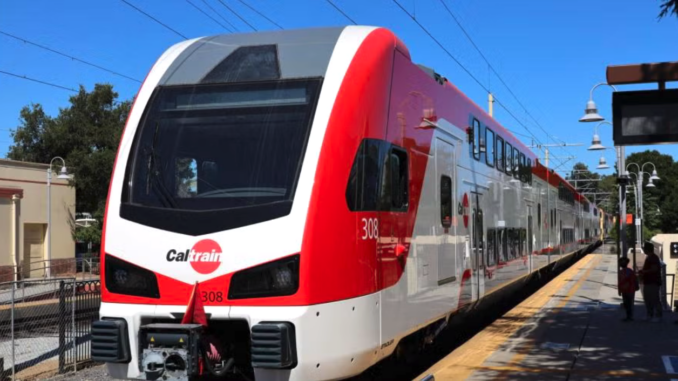
A Caltrain hit a car at the Alma Street and Churchill Avenue crossing in Palo Alto yesterday.
Nobody was in the car at the time of the crash around 6:40 p.m., according to police radio transmissions.
Caltrain has put out announcements alerting riders to expect an hour-long delay.
Last week, a train hit an unoccupied car at the Alma and Palo Alto Ave. crossing on Oct. 28. No one was hurt in that crash.
Thanks for reporting this. I know that Caltrain tries to keep train collisions secret, and the media, for the most part, goes along with the secrecy edict. I’m glad the Post doesn’t go along with that and provides the news.
I believe that Caltrain doesn’t ‘try to keep train collisions secret.’ I believe they don’t like to broadcast when they hit a pedestrian on the tracks because these are to a large degree suicides. Similarly to the Golden Gate Bridge and other ‘popular’ spots, they work hard to not encourage those in distress or with psychological strains to ‘trigger’ on such news, and perhaps be inspired to follow suit.
Frank, can you give one example of a copycat suicide on the Caltrain tracks?
How long have you lived in Palo Alto? The student suicides at Palo Alto High School have been a chronic problem. I believe there was one more since Caltrain and local press have done the right thing by not reporting the reason for the stopped train. Caltrain’s fatality rate is down. Despite this, Caltrain did have a run of suicides in mid-2026: 7/1/26 in San Mateo, between 3rd and 4th Avenue, 7/3/26 at the Millbrae Station, and 7/10 in Gilroy near Farrell Avenue. Look at SAVE.org “Reporting on Suicide”. The first rule they list is “Avoid describing or depicting the method and location of the suicide”. Caltrain and local press (other than this publication) are doing the right thing.
Where were the 24-hour tax-payer funded train track safety monitors? How is this possible with the guards sitting in the chairs, failing to stop cars from ending up on the railroad’s tracks twice in one week? Maybe it’s time to end this jobs program and have the workers do something just as productive, like digging holes and then filling them up again.
The safety monitors were there. Unfortunately, they are mere mortals and can’t lift cars off the tracks–the article clearly says the car was empty.
Grant, that wasn’t the question. Can you name one railroad suicide of a teen in Palo Alto that was a copycat?
Just one.
You can’t because all of the suicides are weeks apart from one another, so one certainly didn’t trigger another.
Experts have discovered that the last five teens in Palo Alto who took their lives on the train tracks were undergoing sex change procedures. The suicides stopped completely after Stanford Medicine closed its gender-affirming care clinic for teens in June 2025.
[Portion removed — Terms of Use violation. We’ve seen no proof of the statement that was made.]
“Observer”, your comment is utterly abhorrent and ill-informed. First of all, check your facts before you flout the death of teens. Literal adolescents. Since the closing of gender-affirming care clinic, there have been two Palo Alto teen deaths. Are you living under a rock, or are you choosing to be ignorant?
Beyond that, to insinuate that restricting access of gender-affirming care to teens stops suicide is absurd. Do you have any clue why suicides are happening in Palo Alto in the first place? Even then, giving teens access to care that helps them become more secure in their identity will grant them reprieve, at least in the short term. Even if you believe that gender-affirming care is mentally harmful for teens, that’s a huge jump in logic to make.
Then, you claim that copycat suicides aren’t a thing. Have you looked at what the quantitative research says? Even anecdotally, it’s clear that Palo Alto suicides occur in bursts.
Who are you, an “Observer”, to spread such derisive fire on a topic that has resulted in the literal death of the very group a society is supposed to protect most closely? Shameful. Absolutely shameful.
Paly student, the facts dispute your claims.
1. No Paly or Gunn students took their lives after the Stanford gender affirming care clinic and surgery center closed. The people who died on the Caltrain tracks after the closure in 2025 were a 67-year-old Morgan Hill man on September 10, 2025 and a 47-year-old Palo Alto man on November 6.
2. You state, “Even anecdotally, it’s clear that Palo Alto suicides occur in bursts.” Again, untrue. Look at the deaths by date if you disbelieve me. For example, in 2024, deaths took place on January 31, February 8, March 4, June 24, July 17, August 5, August 21, September 10, November 6.
There were no bursts of suicides, where one person was triggered to take their own life immediately after hearing about another death. If your statement were true, why wasn’t there a “burst” of deaths after the January 31 suicide? Or after the June 24 suicide, for example.
You’re just repeating a myth about copycat deaths that has circulated in this community for a long time. Repeating that myth lets the politicians and community leaders off the hook. They’ll say, “There’s nothing we can do about this other than to silence the news media.” But that attitude makes it more difficult to get to the root cause of these deaths. Don’t you want to know the answer to that question? Or has Paly stopped teaching critical thinking?
1. [Portion deleted — Terms of Use violation, No. 5] I vividly the direct aftermath of that suicide that occurred this year: the sobs of students on campus, the hushed voices, and the whispers that the student who took their own life had publicly posted a suicide note. Do you have any clue what that note said? The fact that you don’t even know that that suicide happened is telling. The student who took their own life plainly stated that their decline in mental health, was, to a large part, because of the demonization of transgender students and gender-affirming care by the presidential administration.
2. Do you know how suicide clusters work? “A suicide cluster is a group of suicides or suicide attempts that occur closer together in time, space, or both than would normally be expected in a given community or setting.” — CDC. That doesn’t mean one suicide happens, and then another one immediately follows the next week. No one is asking news publications to stop disclosing the death. I also disagree with that approach. The issue is in the manner in which they disclose said suicides. Why don’t you go ahead and read the quantitative studies on copycat suicides?
Not sure you read the same suicide note that I saw, but Summer did mention DJT and the demonization of trans people. But she laid most of the blame on Principal Brent Kline and PAUSD itself. The note is out there, if you want to search for it.
I am aware of the purported suicide note, but I thought it was best not to bring that up since it would likely lead to a discussion about whether it was actually written by the victim or someone else. As you probably know, there was a lot of skepticism about the authenticity of the note. It’s unusual for children to leave suicide notes, and it’s even more unusual for them to make political points in their note. The kind thing to do is leave that subject alone. Think about the victim’s family before you dredge this up.
Your definition of a “copycat” suicide is convenient. Initially you said, “Even anecdotally, it’s clear that Palo Alto suicides occur in bursts.” And now, after seeing the dates of these deaths, you’re saying suicides occurring in the same place can be copycats, even if they are months or years apart. You’re contradicting yourself and you’re changing the meaning of the word “copycat” to suit your argument. As you get older, you will find political activists will change the definitions of words to strengthen their arguments. Don’t fall into that trap. While I can tell you’re emotional, you should always seek the facts in any situation.
It looks like you’ve run out of arguments, so I bid you farewell.
Tragically, the last Paly student who died was a boy whose mother was raising him as a girl. It was very cruel to raise a young person that way.
On its face, it is virtually impossible to prove that a suicide was a copycat, because the person is gone. The underlying causes for each event are deeply personal. However, the fact that suicides have sometimes occurred in clusters suggests that the action could be inspired by others. A lot of what we learn and do in life is from watching others. When people speed, some others may feel it’s okay to do that. When students see other students cheat on an assignment, they often think why not. Same with fashion and trends. That’s just human nature. And it is stronger among youths, who often feel the need to draw attention to themselves (albeit in a tragic way).
To me this fact, and the occurrence in clusters is sufficient to indicate that there are copycat suicides. See also: The Werther Effect.
From the CDC: “News coverage is less likely to contribute to suicide contagion when reports of community expressions of grief (e.g., public eulogies, flying flags at half-mast, and erecting permanent public memorials) are minimized. Such actions may contribute to suicide contagion by suggesting to susceptible persons that society is honoring the suicidal behavior of the deceased person, rather than mourning the person’s death.”
I think asking for proof of copycat behavior overlooks these possibilities. When suicidologists state this is a problem (after interviewing people who have survived suicide attempts) we should certainly take it seriously.
Among the Caltrain youth suicides, you say that they have “sometimes occurred in clusters.” Can you tell me when people died in clusters? For instance, in 2024, deaths took place on January 31, February 8, March 4, June 24, July 17, August 5, August 21, September 10, November 6. Looking at a calendar, none of those deaths seem to have occurred in a cluster.