
Read Liccardo’s letter HERE.
This story was printed first in the Palo Alto Daily Post on Thursday, Sept. 24. Since then, our competition has picked it up, rewritten a few paragraphs and tried to pass it off as new news. Then they have the gall to ask you for donations to pay for their plagiarism. To read important local news stories first, pick up the Post in the mornings at 1,000 Mid-Peninsula locations.
BY NORAH SHEPPARD-HUTCHINS
Daily Post Staff Writer
Congressman Sam Liccardo, who represents Menlo Park and much of the Mid-Peninsula, asked the U.S. Department of Treasury yesterday to look into potential sanctions against 80 Willow Road property owner Vitaly Yusufov and his father.
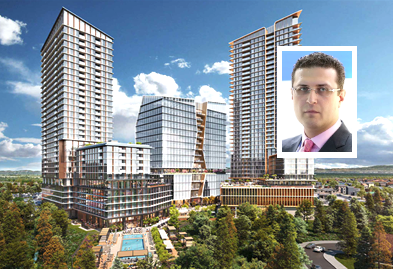
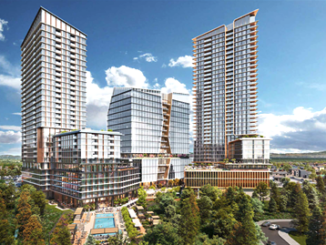
A sanctions designation could stop development of Yusufov’s 39-story tower at the former Sunset Magazine headquarters in Menlo Park.
“Public sources raise serious questions about Vitaly Yusufov’s ties to the Russian government and individuals linked to organized crime, warranting immediate review by the Office of Foreign Assets Control (OFAC), the Committee on Foreign Investment in the U.S. (CFIUS), and, ultimately, consideration for sanctions,” Liccardo said in his letter to Treasury Secretary Scott Bessent. Vitaly Yusufov bought the seven-acre property in 2019 through his LLC, Willow Project. He plans to develop the site into 665 apartments, a hotel, office space and a preschool across three towers, with the tallest going up to 461 feet.
Yusufov faces sanctions in Ukraine, while his father, former Russian Energy Minister under Russian President Vladimir Putin, Igor Yusufov, also faces sanctions in Ukraine and in Canada.

Vitaly Yusufov was a business agent for former Russian President Dmitry Medvedev, Liccardo said in his letter. Yusufov purchased the Wadan shipyards shipbuilding company in 2009 for 40.5 million euros after Medvedev and former German Chancellor Angel Merkel brokered a deal, according to the New York Times.
The acquisition was financed by Gennady Petrov, leader of the Tambov-Malyshevskaya organized crime syndicate, and Aslan Gageic, or “Dzhako the Bloody,” another organized crime figure who is connected to 56 contract killings, Liccardo said.
National security raised
Liccardo argues in his letter that because the property is in Silicon Valley, with many major tech companies in the vicinity, Yusufov and other possible owners should be looked into due to national security concerns.
“Given the very high concentration of defense tech, artificial intelligence, and quantum computing companies and research centers in the region, we believe federal agencies should review the property, its ownership, and its financial backing to ensure Kremlin officials and their proxies cannot obtain sensitive information about critical U.S. companies and their employees,” Liccardo said in his letter.
In May 2018, Yusufov requested buying the 80 Willow Road property from Deutsche Bank for $72 million. Some bank officials were worried about the appearance of doing business with Yusufov and his ties to Putin, according to the New York Times.
A New York-based Deutsche Bank executive committee tried to halt the transaction, citing the potential reputational damage it could do to the bank, according to the New York Times. The decision was overruled by a committee in Europe. After the decision on the sale was overruled, an employee of the bank filed a suspicious activity report to the U.S. Treasury, according to the Wall Street Journal.
Sebastian Kraemer-Bach, a spokesman for Deutsche Bank, told the New York Times that the bank did due diligence on the sale and didn’t find evidence that it would violate money-laundering laws or sanctions.
Liccardo also cites in his letter that the Financial Crimes Enforcement Network warned in a Jan. 25, 2023, alert that, “sanctioned Russian elites and their proxies are likely attempting to evade sanctions by exploiting vulnerabilities in the U.S. commercial real estate market.”
“Given the reported ties to U.S. adversaries and organized crime figures, as well as the development’s proximity to companies and infrastructure critical to our national security, we urge OFAC to immediately review Vitaly and Igor Yusufov for potential sanctions designation and urge appropriate federal agencies to review the ownership, financing, and development of 80 Willow Road,” Liccardo said.
Liccardo’s spokeswoman Izzy Connolly told the Post that the office is exploring other avenues on the matter to strengthen their case.
This letter comes a week after Liccardo voted against a Russian sanctioning bill.
Liccardo was one of 152 Democrats in the House to vote no on the Lindsey O. Graham Sanctioning Russia and Iran Act of 2026 on Sept. 16. The act includes imposing sanctions on Russian President Vladimir Putin, top officials in his administration, family members and oligarchs.
Liccardo said he opposed the bill sanctions because President Donald Trump is most likely to use the bill to impose tariffs.
“I have consistently supported Ukraine as a member of Congress — including urging long-overdue military support against Russia — so I found it deeply frustrating to have to vote against the Russia sanctions bill,” Liccardo said in a statement yesterday.
The act also imposes property-based sanctions against Russian financial institutions, foreign vessels that transport certain products from Russia, such as coal and authorizes 100% tariffs on importers of Russian oil and natural gas.
Trump has demonstrated no willingness to impose any sanctions and the bill gives him more authority to “expand his chaotic scheme of tariffs, which have made daily life unaffordable for millions of Americans, launched trade wars with our closest allies, and disrupted supply chains for our leading employers,” Liccardo said. in the statement.
Liccardo tied together two different issues — sanctions and tariffs. He voted against sanctions because of the threat of tariffs. Now he is responding to constituents’ complaints about 80 Willow by trying to get one individual, Yusufev, sanctioned. He should be sanctioned, no question, but does Liccardo have any points with the Trump administration? We’ll see. It’s a sure thing Bonta doesn’t.
Tariffs against what? Russian oil? They shouldn’t be able to sell that anywhere. Wonder why Liccardo had such a hard time figuring that out?
I’m happy to read that Liccardo is going to push for sanctions. But the letter is just the first step. He’s got to do some arm twisting in DC to get this done.
Great that this horrible project could be halted with this maneuver but what’s to stop another developer from acquiring the project and proceeding with some variation of Yusufov’s plan? The real problem is Prop 79 and “builders remedy” which Bonta and Liccardo both support. The Party is joined at the hip with California’s real-estate industrial complex. With the oil, defense, aerospace, technology, and entertainment industries all leaving the state, California is leaning on a business model that dates back to the foundation of Los Angeles in a desperate attempt to keep the economy going… large scale real-estate scammery.
Absolutely. The “builders remedy” is a key part of the Democrats’ housing policy, but it’s terrorizing many communities, including Menlo Park. And then there’s Portola Valley and Woodside that aren’t designed for the kind of development the state is demanding. It’s a one-size-fits-all approach.
Huh ? The version of builders remedy that this project vetted under, was signed into law by George Deukmajian, a Republican governor, back in 1990 when housing affordability started becoming a bipartisan challenge.
The big issue is that it’s FINALLY being enforced this cycle, for the first time, so we’re starting to see the unintended consequences like this project that creates far more jobs that it can house.
Just because Deukmajian signed it back in the Middle Ages doesn’t mean finally implementing it is a Republican idea. If you don’t like the Builders Remedy vote Republican. It’s that simple.
Sorry, but you can’t hide from the fact that Republicans voted and signed it into being, because there was a housing problem. But is on current Dems and Republicans to fix it now that we see the obvious mistake – It allows for housing projects like this monstrosity that imports thousands while only delivering hundreds of homes.
Republicans aren’t calling any of the shots in California right now. The legislature has a Democratic supermajority, the governor and all other top officials are Democrats. When’s the last time a Republican held office in the Bay Area? It’s been quite a while.
“Council approved its 2023-2031 housing element on the day of the deadline, 4-1, with Combs opposed.” — Daily Post, Sep 19, 2026
This project is the direct result of council not approving the housing element.
@ Hehim & Muncier You guys just don’t get it. The real-estate industrial complex controls BOTH parties in California. Look at your choices in the governor’s race. Steve Hilton’s connection the to Real-estate industry is obvious. Xavier Becerra owes most of his $7,000,000 personal fortune to real-estate. Becerra is a landlord. He owns five residential properties and rents four of them out. One of the properties goes for $60,000/yr. The California Association of Realtors has supported Becerra with $2,800,000 and Becerra has raised another $500,000 from big time real-estate developers like Rick Caruso, Kilroy Realty, Saban Properties, The Irvine Company, Lotusland, Build Group, etc. Becerra supports Prop 79, “builders remedy”, and has promised to prosecute cities that don’t comply. Nancy Pelosi has an ownership interest in the hideous Sales Force building in SF. Paul Pelosi is a multi-millionaire real-estate financier. Feinstein’s husband was a billionaire real-estate developer. Gavin Newsome’s stake in PlumpJack Estate Winery, Odette Estate Winery, and CADE 13th Vineyard, are real estate holdings as much as they are business assets. Gavin’s current father in law (Ken Siebel) co-founded Maier & Siebel Real Estate Investment Advisors. Scott Wiener (author of prop 79) has raised more money from the real-estate industry than any other politician in the California legislature…