
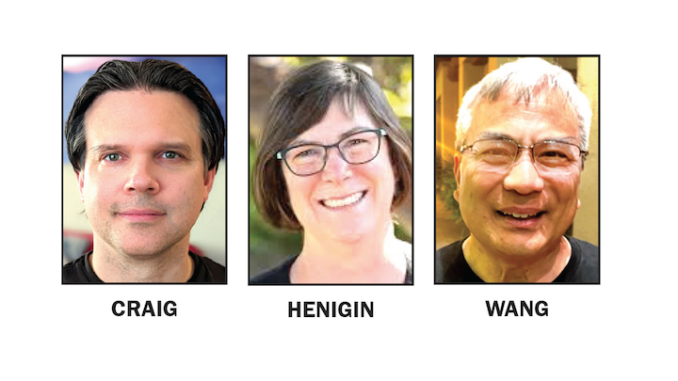
BY BRADEN CARTWRIGHT
Daily Post Staff Writer
A Palo Alto school board candidate who was a teacher’s aide recruited student interns and solicited endorsements from her school district email address, records show.
Board policy and state law ban candidates from using public resources to campaign, with punishments ranging from a $1,000 fine to three years in prison.
Candidate Linda Henigin accepted responsibility for sending the emails yesterday.
“I really should’ve taken that off to my personal email,” she said in a phone interview.
Henigin’s opponent John Craig called the emails shocking, disturbing, unethical and illegal. He said he feels like his campaign is at a disadvantage because Henigin appears to be backed by the district. Henigin reached out on Jan. 27 to teacher Rachael Kaci, who runs the district’s work experience education program.
“I will definitely want to have student interns on my campaign,” Henigin said.
Another employee suggested Henigin should keep the students to doing research, not working on the campaign.
Henigin ended up having two student interns, who received class credit and were supervised by Henigin. Each of them worked for Henigin for about 40 hours, emails show.
Henigin worked as an aide at Duveneck Elementary School. She asked Principal Brittany Gardner for permission to send out an announcement that she was running for school board on June 2, and Gardner said yes.
Henigin told her coworkers she’d be back in January if she loses, and she can’t be employed by the district if she wins. She gave her coworkers her campaign email address.
Four employees wrote back with excitement that Henigin was running, including psychologist Erika Gardiner and teachers Kathleen Thibault, Judy Cloud and Sophia All.
“I am crossing fingers for you and that you find a place on the Board: the residents of PA, the students, the families and PAUSD would be LUCKY to have you,” psychologist Erika Gardiner said.
“I will be hoping that the run for school board goes well. Wish I lived here to vote for you,” Thibault said.
Henigin replied on June 5 and asked her coworkers to endorse her on her website.
“You could use the same message you wrote to me in the endorsement:)” Henigin said.
Gardiner said she would endorse Henigin once she’s formally retired so there’s no conflict of interest. Her name is now included on Henigin’s list of endorsers.
District spokeswoman Lynette White said Superintendent Jason Glass is aware of Henigin’s emails, which were produced in response to a California Public Records Act request by Craig.
“District policy and state law prohibit employees from using district resources, including district email, to support or oppose any candidate or ballot measure. Employees may take part in political activity on their own time and at their own expense,” White said in an email yesterday.
The district addresses complaints about employees using district resources through its personnel processes, which are confidential, White said.
“The district applies these rules the same way regardless of the candidate or measure involved. All staff will receive a reminder of these requirements before ballots are mailed,” White said.
In an interview yesterday, Craig said he requested the emails after seeing the district post a slide deck with an ad for Henigin’s campaign looking for student volunteers.
The district removed the ad and opened a review after getting a complaint on Aug. 21, Glass said in a letter to the editor.
In an interview, Henigin said candidates looked for volunteers in the slide deck from 2024, and she provided the ads.
Craig said he feels like he’s at a disadvantage because Henigin has access to government resources and connections.
Craig said he feels like he’s at a disadvantage because Henigin has access to government resources and connections.
“This is not a level playing field,” Craig said. “If a school employee and union member can use public funds and public resources and the PAUSD brand, then that suggests there’s support for her. That’s not how democracy is supposed to work.”
Jose Nuñez, San Mateo County Community College District’s former Vice Chancellor of Facilities, was indicted by a San Mateo County grand jury on felony charges. Among these charges was the misuse of college district resources and staff to run a political campaign for a college trustee.
Linda Henigin, an instructional aide employed by PAUSD, seems to flout the law just like Nuñez. It sums up the entire PAUSD establishment of the last 10 years- they view compliance of the law as entirely optional. Rules for thee, but not for me. That’s what privilege looks like.
I urge everyone to vote for the grass root candidates Avery Wang and John Craig, who put students and families first and is not backed by the district, the union, the political parties and the insiders. No quid pro quo with special interests from these guys.
Linda Henigin’s explanation that she “should’ve” used her personal email totally misses the point: she illegally used her insider status to recruit students for her own campaign, then supervised them while they earned class credit.
This is about judgment and the abuse of power. Linda even thinking that it’s okay to recruit students using her school resources shows incredibly poor judgment. Even worse, this shows a deep lack of understanding about kids, the trust they place in their teachers, and how much students will do to please their teachers. That’s the definition of power abuse: using your power to get people to do things because they trust you want to please you.
On top of that, what Linda did was illegal. Calling this an email a “mistake” minimizes that altogether.
There are really only two options here: Henigan didn’t know the law, or she knew the law and willfully broke it. Either way, she has shown horrible judgement when it comes to students and has lost my vote.
This story only reinforces why I already have serious concerns about Linda Henigin’s candidacy.
A school board is supposed to provide independent community oversight of a public institution. Yet we now have multiple instances in which district resources have benefited Henigin’s campaign: first, campaign intern recruitment appeared on PAUSD’s Schoology system, and now district employees used district email to recruit students for her campaign. Henigin says she did not ask the district to send this email, and I have seen no evidence that she personally directed either incident. But that doesn’t make the pattern irrelevant. When one candidate repeatedly benefits from access to the very institution she is seeking to govern, voters should be asking hard questions about boundaries, fairness and institutional independence.
Those concerns become more significant when viewed alongside the rest of her record.
Henigin has criticized another trustee for engaging in what she called a “permanent campaign.” Yet her own campaign has now benefited from district infrastructure in ways her opponents apparently have not. At a minimum, that is an uncomfortable contrast.
She is also strongly aligned with the teachers union. Teachers absolutely deserve a voice in our schools, but their union exists to represent district employees. The school board exists to represent the public and oversee the district including budgets, staffing, compensation and labor relations. Especially while PAUSD faces serious financial challenges, I want trustees who approach that relationship from a position of unmistakable independence, not candidates whose strongest institutional support comes from the employees they will help oversee.
Then there are the substantive educational disagreements.
Henigin has said she is generally on the side of de-laning and has argued that general-education classrooms should be the default placement for students. When parents raised concerns about academic rigor, she pointed to PAUSD’s success sending high-achieving students to prestigious universities and argued that students who are not reaching their potential deserve greater attention.
Why should this be an either/or proposition? PAUSD should absolutely help struggling students. It should also challenge advanced students to reach their full potential. Equity should mean meeting children where they are, not pretending that children with profoundly different academic needs are best served by eliminating meaningful differentiation.
And then there is Ethnic Studies. Henigin was an outspoken supporter of making it mandatory and argued that students are “hungry” for conversations about power.
That is precisely where I fundamentally disagree with the educational philosophy she represents. Students should learn about slavery, racism, discrimination, immigration, antisemitism and the experiences of minority communities honestly and in depth. But I do not believe schools should teach children to interpret history, society or one another primarily through a prescribed framework of race, identity and power. Education should expose students to competing ideas and teach them how to think critically, not hand them an ideological lens and then call the result critical thinking.
Any one of these issues might be dismissed individually. Taken together, however, they tell me something important about the kind of governance Henigin would bring to PAUSD: close alignment with existing district institutions, support for educational policies I believe risk sacrificing differentiation in the name of equity, and an ideological approach to curriculum with which I fundamentally disagree.
The latest district-email controversy doesn’t create those concerns. It reinforces them.
PAUSD needs trustees willing to challenge the institution they govern,
not become an extension of it.
We actually have candidates who can meet this moment: Avery Wang and John Craig. Both emphasize academic rigor, fiscal accountability, transparency, and independent oversight. PAUSD needs trustees who will challenge the institution when necessary, not simply reflect the priorities of the groups within it.
And for the record, I’m not campaign staff, a paid advocate, or affiliated with any candidate. I’m simply a concerned Palo Alto resident with three kids, and the future of PAUSD is deeply important to me.
Wow – another one for the establishment.
Henigin supported the DiBrienza – Austin administration, and delaning with disastrous results to students. Do we want more of the same?
Henigin supported an unvetted and unbudgeted ethnic studies roll out (which undoubtedly contributed to a $33 Million deficit). Do we want more of the same?
And then, the district supports her campaign – wow. Were there consequences for this?
Recruiting students at school in violation of the law intended to protect students. How are we supposed to believe her after this?
We can do better than another privileged establishment insider.
I find this deeply troubling, particularly because this is not an isolated issue. I do not support Linda Henigin for the PAUSD Board, and the pattern of conduct described in this article raises serious questions about judgment, boundaries, and respect for the rules that should apply to everyone running for public office.
The use of a PAUSD email account to solicit campaign endorsements is especially concerning. Henigin herself acknowledged that she should have used her personal email, while the District has stated clearly that staff may not use district resources to support or oppose a candidate.
I am also troubled by the student-intern issue. According to the reporting, two PAUSD students ultimately worked approximately 40 hours each on Henigin’s campaign and received class credit for that work. That deserves serious scrutiny, particularly when the original campaign solicitation was made through a district work-experience program.
There are also legitimate questions about how Henigin has characterized her professional background. The Daily Post has reported that she worked as a classroom aide at Duveneck and did not hold the single-subject credential required to teach math as a standalone subject, despite describing herself on the ballot as a “math teacher/mother.”
And yes, she is polished at candidate forums and delivers well-rehearsed answers. That is precisely why I think voters need to look beyond the presentation and pay attention to the record.
I am concerned about electing someone who has been closely connected to the existing district establishment, including supporting Don Austin, and whether that would simply continue the same old, same old. But most importantly, this should be about conduct, transparency, and judgment. Voters should be able to expect the same rules and standards to apply to every candidate — particularly when one candidate has a direct relationship with the school district itself.
Linda Henigin’s campaign’s repeated, unfair benefit from district resources (as described in this article) demonstrates a troubling lack of institutional boundaries and independence. This issue is compounded by her strong alignment with the teachers union, which I believe compromises her ability to objectively oversee district finances and labor relations. Furthermore, I fundamentally disagree with her educational philosophy – her support for de-laning risks sacrificing academic differentiation, and her backing of mandatory Ethnic Studies imposes an ideological framework rather than fostering genuine critical thinking. Ultimately, PAUSD needs independent trustees who will challenge the status quo, which is why I support Avery Wang and John Craig for their commitment to academic rigor, fiscal accountability, and institutional oversight.
“… with punishments ranging from a $1,000 fine to three years in prison”
How did the Santa Clara Democrats endorse this corrupt at worst, or sleazy at best, part-time elementary instruction aide??? While Democrats want to clean up the corrupt Trump mess, they endorse a corrupt Henigin to look after our children and their futures. YUCK … the smell of corruption is seeping from the Democrats.
The Santa Clara Dems should withdraw their endorsement to save their integrity. Clean thy self.
I think three years in prison would be about right. I’d be fine with that.
I think Beau said everything that needs to be said. I agree with him 100% We need trustees who are independent and not endorsed by the unions, who have their own representatives. Checks and balances, so none of the favoritism that has been demonstrated so far in Ms. Henigin’s campaign, will seep into board decisions.
Democracy dies in corruption and incompetence.
Please vote for John and Avery.
Linda Henigin used her PAUSD email in campaign-related communications, and two students ultimately worked roughly 40 hours each on **her campaign for class credit**. PAUSD itself says district resources may not be used to support candidates. It is illegal. It is also deeply unethical.
More broadly, it raises the question of whether a candidate who comes from within the system, is closely aligned with it, and has benefited from district connections can provide the independent oversight and much-needed change PAUSD needs. Henigin has aligned herself with the old-guard board and prior superintendent, is a union member, and is supported by the unions. Will she represent students’ interests independently?
Henigin has also publicly aligned herself with much of the educational philosophy that has dominated PAUSD in recent years. She has said she is generally on the side of de-laning, which objective data shows has failed, harming our most vulnerable students in particular. She also supported making a very controversial and divisive version of Ethnic Studies mandatory for the youngest high-school students, replacing World History.
Under the old-guard board, administrative costs doubled, while the teachers’ union has at times pushed interests that conflict with those of students, including resistance to accountability. The elected board is supposed to represent students and the community, not the administration or employee groups. Yet prior boards too often engaged in self-promoting exercises while accommodating institutional interests.
**Data and evidence have contradicted the philosophy that treats education, and even student wellness, as a zero-sum game: as though appropriately challenging one child somehow harms another.** We have seen advanced opportunities opposed explicitly on “wellness” grounds. At the direction of a prior board member, the Gunn principal and three staff members spoke against students requesting greater opportunities and challenge, arguing that opportunities for some would disadvantage others. The Paly Education Council made a similar argument.
On wellness, instead of acknowledging and addressing core problems behind the student mental-health crisis: bullying, lack of respect and inclusion, and lack of trust in administrators and other adults at school, the district diverted attention and resources elsewhere.
We have also seen what happens when an elected trustee challenges the prevailing institutional view. After Rowena Chiu questioned the Ethnic Studies mandate, there was an attempted board rebuke, she was removed from committee assignments, district employees called for her resignation, and PAUSD later conducted a costly investigation of her (coming back empty!) that was largely unknown to the public.
This history makes independence, transparency, respect for dissent, and respect for the diversity of our students and community unusually important in this election.
This latest episode therefore deserves more than “I should have used my personal email.” The larger questions are about ethics, legality, and independence: Why were students doing campaign work for class credit? Why did one candidate have access to opportunities unavailable to her competitors? And in a district where leadership has too often placed student interests last, can a trustee who comes from inside the institution bring the change PAUSD needs?