
(Read Corpus’ request for a temporary restraining order here.)
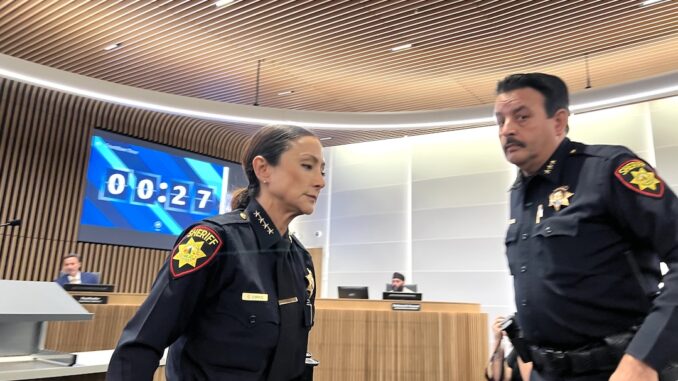
A judge has rejected San Mateo County Sheriff Christina Corpus’ request for temporary restraining order to halt the county supervisors from deciding whether to fire her.
Corpus’ lawyers brought their request to Superior Court Judge Nicole Healy on Monday. The county supervisors’ legal team had about an hour’s notice of the hearing. The public and press received no advance notice of the hearing.
The county’s lawyer, John Nibbelin, is expected to discuss yesterday’s hearing at today’s Board of Supervisors meeting.
Typically when a person seeks a temporary restraining order, they’re asking for the court to prevent the defendant from taking an action until a full hearing on the matter can be held.
Corpus is trying to delay or stop the process that was begun in March with voter approval of Measure A, which gives the Board of Supervisors the ability to fire a sheriff for cause with a four-fifths vote. The supervisors are now moving forward with that process, sending Corpus a notice last week, listing the allegations against her.
Corpus is accused of corruption, including conflicts of interest, nepotism, retaliation, intimidation and making racial and homophobic slurs. She ordered the arrest of the deputies union president, who had been critical of her, on charges the DA later threw out. She fired her assistant sheriff after he spoke to a retired judge who was investigating corruption in the sheriff’s office.
Corpus has denied the allegations and said she is facing discrimination from the county government’s “Good Old Boys” network because she is the county’s first Latina sheriff.



Goodbye, CorPISS! The number of lives you’ve affected, including your own, is truly unbelievable. Everyone except for Victor and your peculiar sister Patricia—who claims it’s just hearsay that you two are sisters—seems to notice this. Funny that I didn’t mention your attorneys; they know you’re in the wrong and seem at a loss on how to defend you. You’re not disputing the contents of the report; you’re questioning the legitimacy of this election. MOVE ON!!!! Your ex-husband, your children, and the entire community want you to leave. Your attempts at delays, injunctions, and legal maneuvers aren’t working. Just go to the ranch with Victor and try to find some happiness.
It’s his wife’s ranch -family trust. They will have to move elsewhere..
Glad the judge ruled the way she did. Imagine if she had stopped the process based on a quickie hearing like this, with no evidence? Time for Christina to face the music.
Judge Healy had already applied a deft hand to this issue, when she ruled on January’s case #25-CIV-00244, “Sheriff Christina Corpus, an individual, v. County of San Mateo Board of Supervisors; Mark Church, in his official capacity as Chief Elections Officer & Assessor; and Does 1-10, respondents” — asking injunction against the special election.
In that case, a “Petition for Writ of Mandate and Complaint for Injunctive Relief”, Corpus claimed Measure A being calendared for March 5, 2025 instead of a statewide general election was improper, and that the Board should not have been allowed to vote on putting Measure A on the ballot, and cannot be fair quasi-adjudicators in the future, because it alleges Corzo and Mueller are biased. Also claimed Measure A violates Corpus’s rights under the Public Safety Officers Procedural Bill Of Rights (PSOBRA).
Judge Healy did not agree, observing that the statutes cited requiring use of a statewide general election apply to cities or to city/counties (of which one only exists, San Francisco City & County), but not to county charter amendments. Healy declined to inquire into Board members’ motivations, and also pointed out that future actions of the Board are not ripe for judicial review. Most intriguingly, as “Former Resident” pointed out in a recent comment to The Daily Post, Healy found that PSOBRA protections could not be injured by the Measure A election, because, citing as precendent a case where Sonoma County had reprimanded its sheriff and the sheriff sued for PSOBRA violation, the county is not the sheriff’s employer.
I look forward to reading Murphy, Pearson, Bradley & Feeney’s contentions and Judge Healy’s remarks in the new case. The former are, um, creative, at least the public-facing ones: At the recent Board of Supervisors meeting to approve the Notice of Intent to Remove, those lawyers used their 10 minutes of public comment to push, among other novel legal theories, violation of the “due process”, “ex post facto”, and “bills of attainder” provisions of the US Constitution. I whispered to the gal sitting next to me that they really ought to reach for the trifecta by also talking about quartering soldiers in Sheriff Corpus’s house in time of peace, denying the writ of habeas corpus, and issuing letters of marque and reprisal — Constitutional Bingo.
Good folks at The Daily Post: Do you have the case number? I’m not yet finding this one at S.M.C. Superior Court’s case search. By contrast, the January unsucessful request for TRO in front of Judge Healy is right there.
Monday’s case at S.M.C. Superior Court now has a (very skeletal) case record, as case #25-CIV-04319 . Title is “Sheriff Christina Corpus vs. County of San Mateo Board of Supervisors, et al.” (“Et alii” are County Executive Mike Callagy and Assistant Clerk to the Board Sukhmani S. Purewal.)
However, there’s literally nothing else in the online case record, other than Sheriff Corpus having gotten waived the $435 court filing fee. Such teases. I was hoping for more unlikely appeals to US Constitutional prohibitions. How about domestic and foreign emoluments or titles of nobility, guys? Reach for the skies!
We can hope details will be backfilled.
Don’t go away “happy” Christina, just go away! The end of your incredibly horrible tenure is near.
All that and now she’s trying to duck a civil grand jury (and recuse Wagstaffe from doing his job). Good luck with that Christy. You’ve destroyed your career, reputation, and relationships with your friends and family and left a stain on the proud history of the Sheriffs Office. Use your time wisely…like packing your trash, taking a midnight Uber to SFO and fly off to some third world dump hole where you can live out what remains of your pathetic life.
The assertions in the moving papers (cases 25-CIV-04319 and 25-CIV-04325) filed with the Court on behalf of Corpus to escape consequences for her and her cronies apparent acts of public corruption, appear insightful and quite imaginative. Those petitions filed by Corpus’ counsel seem to be desperate acts, generally premature, that appear to ignore the rulings of Judge Healy concerning the inapplicability of POBAR to Corpus as an constitutional, elected official, and the overall state of both the facts and the law as they relate to these matters.
The filings appear imaginative in that they speculate who is doing what in the various lawful processes underway. For example, no foundation is set concerning how Corpus’ Counsel knows what investigators and assignments, within the DA’s office, have been made for both the criminal and civil avenues of recourse underway, with which Corpus now finds herself inescapably confronted. Corpus’ Counsel seem to obfuscate factual professional statements and findings as synonymous with biases, prejudgments, animus and prejudice by public servants conducting investigations. It is a wrongheaded presumption to infer that all public servants act in the same intentionally corrupt manner Corpus and her cronies appear to behave. The moving papers cite few meaningful and properly supportive cases or laws connected to their central points. Instead, the arguments offer multiple qualifiers such as, “upon information and belief” and “can violate”, exposing what is actually unknown to the authors and what may be, instead of what is unquestionably so.
I support the Daily Post hyperlinking both petitions to aid public understanding of those legal actions in related articles. The Petitions are insightful reading, indicative of Corpus’ clear intention to be non-transparent and to escape responsibility for her rein of corruption.
The media again sticking there nose in and saying it’s a freedom of speech. The good old boys and the judge should be punished for failing to do things illegally. [Obscenity deleted] the media!
Because of SFBA #CensorshipCabal since 1993-1994- Voters and Taxpayers do not have the facts. Major conflict with DA Steve Wagstaffe dating back to 1990’s SMCO judges because of Judge Susan Greenberg as Commissioner 11-12/2012. Included Grand Jury in 11.24.2024 and 5.24.2025 411 emails. Is Sheriff Corpus being targeted because of my 4/2022 email to Sheriff 1993-2007/BOS Don Horsley over denial of fair trial rights to Mohammad Haroon Ali 2/1999 per my discovery of a letter on disc 4.17.2022? Was retired judge LaDoris Cordell a Hired Gun given her many conflicts linking SCCO and SMCO Courts dating back to 1993? These are some of the issues that may make Sheriff Corpus, others suing SMCO, very rich because of decades of corruption they keep trying to cover up.
Get a grip Lisa, your rambling nonsensical post it is a bizarre attempt to deflect from reality. The good people of San Mateo County are focused on the present and getting this corrupt nut job out of office.
As always, I respect “Former Resident’s” analysis, but notice a fine point about inapplicability of POBR (and PSOPBRA) to the relationship between Sheriff Corpus and the county: Judge Nicole Healy, in her February refusal to halt the Measure A election (case 25-CIV-00244), analyzed Sonoma County Sheriff Mail Essick’s failure in the Court of Appeal to enjoin their Board of Supervisors from reprimanding him, and pointed out Sonoma County was “not Essick’s employer” — that “reprimands must have employer-driven consequences – affecting promotion, advancement, or pay, and potentially leading to discharge. Written reprimands of peace officers are ‘punitive actions’ only because they ‘may lead to the adverse consequences… at some future time’ by the department issuing the reprimand.” This is relevant to POBR (and PSOPBRA) because each is “primarily a labor-relations statute”.
In February, the analogy to Corpus v. Supervisors was a close match, such that Corpus’s POBR rights were plainly irrelevant to whether the March special election should be halted or not, and Judge Healy so ruled in her Order Denying Petition of Mandate and Complaint for Injunctive Relief.
But is that still equally clear, after the county charter amendment went into force? Discharge at the Supervisors’ bidding, the employer-driven consequence par excellence, is now on the table, as it wasn’t then.
I’ll leave the lawyering to the actual attorneys, but this may explain in large part DA Wagstaffe’s caution about preventing POBR (or PSOPBRA) being used to halt or delay the Measure A proceedings.
With respect for the posts here and elsewhere, my research indicates the Sheriff is unquestionably a constitutional, elected official, not an individual employee of the County. The Government Code (§25303) explicitly states that the Board of Supervisors is responsible for supervising the official conduct of county officials, including the sheriff. I believe the Notice of Intent served on the Sheriff specified “conduct unbecoming”. Measure A provides guidance for the removal of anyone in the position of San Mateo County Sheriff, presently that is Corpus yet it could be any successor(s) of hers, through the conditions and sunset period specified in the Measure.
The fine points of any statutes are arguable, that’s what courts are for and how attorneys make a living arguing interpretations of statutes. I agree with the position articulated by Mr Nibbelin, that counterbalancing the involved statutes clearly supports the path the County has taken, especially as now repeatedly affirmed by the Court. Just because Corpus’ Counsel composes official sounding word-salads, does not make them either true nor accurate; they are mere arguments intended to sound convincing.
That was supposed to be “Sheriff Mark Essick”. (Damn you, autocorrect!)
My calling the issue seeking to block Sonoma County from reprimanding its sheriff was not quite right. As with Corpus, some Sonoma County employees who were not peace officers and the Chair of the Board of Supervisors had hired an outside firm to conduct an impartial investigation into a complaint against Sheriff Mark Essick. Three months later, a local newspaper requested the final report under the Public Records Act, and Essick sued under POBRA (Public Safety Officers Procedural Bill of Rights Act, Government Code Section 3300 et seq.) for declaratory and injunctive relief against to prevent release. This was denied on grounds of the county not being Essick’s employer; rather, the voters directly were. Thus, the court ruled, the report’s criticism of Essick could _not_ be found to be a “reprimand” under employment law, and thus releasing it thus could not violate POBRA.
A good summary & analysis by law firm Liebert Cassidy Whitmore (“LCW Legal”) can be found online entitled “Sheriff Could Not Block CPRA Request For Investigation Records Because He Was Not A County Employee”.
Concerning any “ex post facto” arguments presented by Corpus’ Counsel, the term quoted is Latin, meaning “after the fact.” The ex post facto statutes of the state and federal constitutions generally prohibit governments from passing laws that retroactively impose criminal liability or punishment, for actions that were legal at the time a person or group took them. Also, law retroactively imposing a greater criminal punishment is an ex post facto law. Yet the procedures in Measure A are unquestionably not criminal in nature.
The SMC Civil Grand Jury does not appear to be investigating ex post facto criminal conduct of the sheriff in their analysis of returning a §3060 Government Code Accusation against her or her cronies. Measure A does mention criminal activity to a limited extent, yet not relative to any criminal punishment. A Criminal Grand Jury may well investigate Corpus and her cronies for apparent corrupt acts in the kidnap and detention of DSA President Tapia under color of law; this is yet to be seen. That may be done after a new Grand Jury is impaneled for service over the next 12-months.
Corpus’ Counsel’s arguments concerning any legal ex post facto deficiencies of the Board of Supervisors actions to investigate Corpus are clearly without merit or legal foundation. I would imagine similar reasoning would have been used in the ruling of the Court on the Petition submitted.
That’s right—San Mateo County Sheriff Christina Corpus’ attempt to block her potential removal has hit a legal wall.
“Former Resident”, I don’t want to over-dwell on this, but was suggesting the reason for DA Wagstaffe’s caution about claimed POBR and PSOPBRA, laws that keep officers’ personnel records confidential, lies in the specifics of Essick v. County of Sonoma.
Sheriff Mark Essick had sued to halt a newspaper’s CA Public Records Act request for an outside investigator’s written report looking into a harassment complaint, claiming (1) PSOPBRA’s confidentiality guarantee blocked CPRA release of that report, and (2) claiming it was a “personnel record” or report/finding of a public complaint against a peace officer.
The Court of Appeal affirmed the trial court’s denial of Essick’s plea, disagreeing with both claims. Critical to claim 2 was the court’s finding that Essick had failed to show that the county was his employer, as we’ve both observed, but let’s look closer at the court’s reasoning:
“Not only does the Board of Supervisors lack power to hire the county sheriff, it lacks power to fire the person in that office as well. The Board of Supervisors, acting on behalf of the County, has no power to appoint or terminate the sheriff. Nor does the Board of Supervisors have disciplinary power over the county sheriff.”
Opinion goes on to say that the report could qualify as a “reprimand” within the scope of PSOPBRA only if they “have employer-driven consequences—affecting promotion, advancement, or pay, and potentially leading to discharge”. That is identified as the test for whether PSOBPBRA has any application.
For Mark Essick and the Oppenheimer Report to Sonoma County, that test failed, because Sonoma County had no power to affect his promotion, advancement, or pay, and potentially leading to discharge. Similarly, prior to April 2025, Christina Corpus would not be able to wield PSOPBRA rights against the county — because no power to affect her promotion, advancement, or pay, and potentially leading to discharge.
In other words, my reading is that those powers are the criterion, not who is deemed the “employer”.
But arguably the addition of Measure A to the county charter might enable Corpus’s lawyers to raise PSOPBRA (or POBR) objections to county CPRA (or other) disclosures, because suddenly the county does have powers potentially leading to discharge.
During the June 5th special Board of Supervisors meeting, which I attended, DA Wagstaffe referred briefly to such matters, and, while doubting Sheriff Corpus’s objections to release of the Notice of Intent to Remove and underlying Keker Report would be upheld, preferred to sidestep that _possible_ objection by releasing those materials to the public only after the whole Measure A process concludes.
I think that’s the nature of his reasoning, and it sounds tactically sound from here in the cheap seats.