
BY BRADEN CARTWRIGHT
Daily Post Staff Writer
The majority of Palo Alto City Council wants to allow eight-story buildings on the southern end of the city — taller than the city’s historic height limit but well short of the 20-story buildings offered by planners.
Councilmen Ed Lauing and Pat Burt said tonight (April 6) they would stick with six stories because they’re worried about traffic around San Antonio Road, where the city is planning for thousands of new homes.
“It’s already gridlock,” Lauing said tonight (April 6).
Councilwoman Julie Lythcott-Haims was open to high rises up to 20 stories along Highway 101.
“I’m more interested in going up to get the units we need from height and create more spaces for parkland and trees,” she said.
Vice Mayor Greer Stone said eight stories, or 90 feet, is “probably the magic number here.” He said 250-foot buildings would be out-of-character with the surroundings.
“It’d be a significant policy change in the city — one I’m not willing to embrace,” Stone said.
Councilman Keith Reckdahl, Mayor Vicki Veenker and Councilman George Lu agreed with Stone about going to 90 feet around San Antonio Road, with some openness to going taller than that.
Palo Alto’s tallest building is a 15-story, 237-foot office center at 525 University Ave. City Hall is 122 feet.
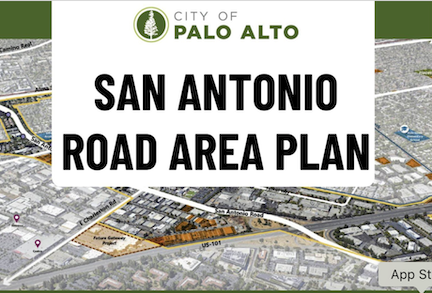
Depending on the new height limit, the city is planning for 3,800 to 7,400 new homes over the next 25 years in a 275-acre planning area around San Antonio Road.
The 90-foot option makes the most financial sense for developers because they can use wood to construct eight-story buildings, and high rises use steel, Senior Planner Robert Cain said.
Several south Palo Alto residents wrote to council to ask for a 60-foot limit and complain that housing will be concentrated near them.
Council approved a 50-foot height limit in September 1973, city records show. But new state laws over the last decade have forced the city to allow taller buildings, particularly when developers include subsidized housing.
Developers have already turned in plans for eight-story buildings at 788 and 800 San Antonio Road.
Council members tonight also discussed creating parks, bike lanes and retail for future residents.
“Overall this is a really bad place to live right now, but I think down the place it could be a really great place to live,” Reckdahl said.
What about parking? How many parking spots per unit?
God forbid Crescent Park or Old Palo Alto (goodness no!) have any construction. South Palo Alto should take all of the new homes. What generosity from the city council!
Traffic nightmare. Nothing will move.
While the proposed eight-story development offers an opportunity to address housing needs (which is questionable), the current plan appears to overlook a critical infrastructure reality: parking displacement. For a project of this scale to succeed without degrading the quality of life for existing residents, the following adjustments are suggested:
With 175 units, a standard suburban overflow is inevitable if the council relies solely on “transit-oriented” ideals. It is suggested a tiered parking requirement that ensures at least 1.4 stalls per unit. This prevents the surrounding residential blocks from becoming an “overflow lot” for the new complex, preserving street access for current homeowners.
To accommodate the necessary parking without losing the “open space” the council desires, the developer should be encouraged to utilize a podium-style design.
The Concept: Placing the residential units atop two levels of integrated, screened parking.
The Benefit: This maintains the eight-story density goals while ensuring all resident vehicles are housed within the building’s own footprint, rather than on the curb.
If the council is intent on reduced parking minimums, the developer should be required to fund a Residential Parking Permit (RPP) program for the adjacent three-block radius. This ensures that the existing neighborhood isn’t penalized for the city’s density goals.
175 units mean a constant stream of delivery and rideshare vehicles. The city must mandate dedicated off-street loading bays. Without these, the eight-story height will lead to constant double-parking and traffic bottlenecks on San Antonio Road, creating a safety hazard for pedestrians and emergency vehicles alike.
Density without a dedicated parking strategy isn’t “urbanism”—it’s a recipe for local gridlock. By requiring the developer to internalize their parking needs through a podium or subterranean garage, the city can achieve its housing targets without compromising the neighborhood’s functional infrastructure.
@Former… Residents will have more than 1.4 cars per unit. The number of cars each unit owns will expand until the available parking in nearby neighborhoods is saturated. Private parking spaces do nothing to alleviate the burden resident’s cars will place on the already overburdened stock of retail and public parking spaces. Private parking spaces sit vacant and unavailable to the public while the residents of this complex are out abusing the existing stock of retail and public parking spaces. “Urbanization” is a real-estate scam. Architects and planners are just PR flaks for the real-estate industrial complex.
Given the mountain of evidence that has piled up against minimum parking mandates, I’m surprised to hear any planner, even a former one, suggest imposing them.
A few years ago, UCLA Professor Donald Shoup wrote, “In The High Cost of Free Parking, which the American Planning Association published in 2005, I argued that parking requirements subsidize cars, increase traffic congestion, pollute the air, encourage sprawl, increase housing costs, degrade urban design, prevent walkability, damage the economy, and penalize people who cannot afford a car. Since then, to my knowledge, no member of the planning profession has argued that parking requirements do not cause these harmful effects. Instead, a flood of recent research has shown that they do cause these harmful effects. Parking requirements in zoning ordinances are poisoning our cities with too much parking.”
I wrote about some of that evidence in a June 24, 2021 op-ed in the Daily Post headlined, “City’s parking laws raise housing costs.”
Managing curb parking, using prices and/or permits, is a far better alternative. That can be, and often has been, done in ways that ensure that current residents can continue to park on their neighborhood streets for free. It can also be done in the ways ensure that on-street parking remains readily available. Over the course of my career as a transportation planner, I’ve worked with many cities to do that.
Given all the evidence showing that minimum parking mandates worsen congestion, pollution, and numerous other ills, why inflict them on Palo Alto?
Shoup’s argument is silly. Parking requirements do not punish people who can’t afford cars. Cars are not that expensive. You can get a descent second-hand car for $4K-$5K which is a bargain compared to the the alternative. Caltrain is very expensive. Much more expensive than a car for people with families. Bottom line… if you can’t afford a car, you can’t afford transportation and should probably be living in an area with a lower cost of living.
Urbanization is aa real-estate scam. Extracting more from a neighborhood than you contribute is how the big money is made. Urbanization is the process of converting commonwealth into personal wealth. Architects and Planners are tools of the real-estate industrial complex. Blaming cars for everything is easier than looking in the mirror.
NIMBYs!