
BY BRADEN CARTWRIGHT
Daily Post Staff Writer
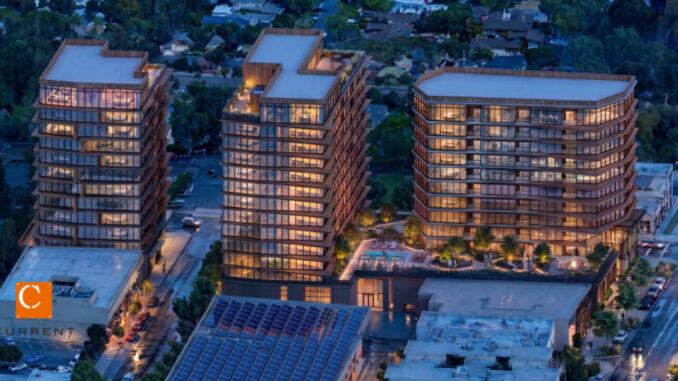
Palo Alto City Council was split 4-2 tonight (May 18) on moving forward with allowing three towers reaching 14 stories in height on top of Mollie Stone’s Market on California Avenue.
The proposal is three stories shorter than developer Chris Friese’s original application but includes less parking and 28 fewer subsidized apartments.
The shorter proposal was negotiated by Councilman Ed Lauing and Vice Mayor Greer Stone, who said they did the best they could without any leverage.
“You don’t always get everything you want in a negotiation,” Lauing said.
That’s because Friese invoked the Builder’s Remedy, a provision in state law that requires cities to approve housing developments when they were late on their housing plan.
Friese’s Builder’s Remedy proposal had 17-story, 11-story and seven-story buildings with a total of 382 apartments, including 77 subsidized units and 290 parking spaces.
Stone said the proposal was a hot topic during his 2024 campaign, and he heard residents wanted to reduce the height.
So Friese’s negotiated proposal has a 14-story and two 12-story buildings with 390 apartments, including 50 subsidized units and 266 parking spaces.
“This helps the surrounding residents with shadows,” Lauing said.
Councilman Pat Burt said he doesn’t like that the negotiated proposal results in less subsidized housing.
Friese said he could get “considerably higher” rents on upper floors, according to similar projects in San Francisco.
Friese and his team at Redco Development were good negotiators, Burt said.
“And I don’t blame them for it, but I don’t think we came out with a net (gain) for the community with that tradeoff,” Burt said.
Councilman Keith Reckdahl agreed with Burt that the Builder’s Remedy proposal “is the lesser of the two evils.”
Councilwoman Julie Lythcott-Haims agreed with Stone and Lauing. Mayor Vicki Veenker was absent, and Councilman George Lu, who was initially on the fence, was the swing vote.
The property at 156 California Ave. will be added to the city’s housing plan. Freise will go through a courtesy review with the Architectural Review Board before coming back to council later this year, Planning Director Jonathan Lait said.
Residents of the Evergreen Park neighborhood said they’re worried about parking overflow and traffic on Park Boulevard.
“It is still a huge, massive structure which looms over the neighborhood,” resident Michael Eager told council.
Housing advocates Steve Levy and Scott O’Neill said they support the development.
The negotiated project peaks at 144 feet. The tallest structure in the area is a 135-foot communications tower on top of the city’s new police headquarters at 250 Sherman Ave.
Palo Alto’s tallest building is a 15-story, 237-foot office center at 525 University Ave. City Hall is 122 feet.
Horrible project for that location. Imposed by illegal actions that violate the state charter and the rights to self governance given to cities over land use among other things. The state should have adjusted the housing allocations by half when the admitted to a doubling error in their calculations years ago. How can we trust our democratic leaders when they systematically take away our rights?……and resulting in less affordability.
This project and the builders remedy project in Barron park will harm real people and our rights to self governance. Power grab by our legislators in Sacramento.
So, they negotiated something that was worse than what the developer originally proposed? “includes less parking and 28 fewer subsidized apartments” Wow, they negotiate like Trump.
Thanks Keith and Pat for No votes.
At times it’s important to call out the unacceptable rather than putting lipstick on a pig.
Thank you to Councilmembers Lauing and Vice Mayor Stone. Because of the State’s builders remedy law, the city had no choice but to approve this project. It was either 17 stories or 14 stories. I prefer the shorter option and it has a nicer design. Pat Burt mislead the voters in his 2024 campaign. He promised he would reject the 17 story proposal and this was his chance. If Councilmember Lu didn’t support this project, we would be stuck with a 17 story tower.
Builders remedy and SB79 are basically a license for the real-estate industrial complex to strip-mine value out of California’s most desirable communities. Sadly most of our state representatives are real-estate attorney’s, or in some way dependent on contributions from real-estate developers to fund their political campaigns. With so many other industries fleeing the state, our elected leaders, desperate to bolster the economy, are increasingly leaning on California’s legacy industry to keep the state’s economy rolling and their friends in the real-estate industry wealthy… large scale real-estate scamery… now newly disguised as progressive politics.
Thank you to our city council for voting to move forward with hundreds of new homes across the street from a train station and down the block from restaurants.
I’m incredibly excited to see more dense housing in areas where people can walk to transit, jobs, and shopping. Cal Ave businesses are desperately in need of customers. Our transit systems are in desperate need of more fare-paying passengers. Local businesses need workers who live locally and don’t have to commute 2+ hours to get to the office.
This project will put brand new units with some amazing views in a perfect location. I’m so happy to see this move forward!
Everyone that lives near a road lives near “transit”. If you can’t drive or don’t want to own a motor vehicle, call an Uber, Lyft, Waymo, or one of the other burgeoning on demand ride share services. Most of our roads have sidewalks and many have bike paths so you can also walk, pedal a bike, or ride an e-scooter. There is no shortage of “transit”, and it is closer to you, and more convenient than Caltrain. Caltrain isn’t a transit system. Caltrain is little more than an amusement park ride that addled boomers support so they can feel virtuous while connected real-estate developers strip-mine the amenities from their community.
The price of a trip from Palo Alto to San Francisco’s 4th & King CalTrain station, one-way:
– $8.50 on CalTrain.
– $27 by car (that is, 37 miles multiplied by the IRS reimbursement rate of 72¢ per mile for driving one’s personal vehicle).
– $47 on Uber, not including tip (I just checked).
Many people, including many Palo Altans, prefer the less-expensive method of travel from Palo Alto to work in San Francisco.
The $8.50 Caltrain figure doesn’t include the taxes everyone is forced to pay to support Caltrain’s operations and switch the trains to electric. Electrification came in over budget at $2.7 billion.
As for ridership, people vote with their feet. In 2019, Caltrain says its ridership averaged roughly 63,597 weekday passengers. Caltrain counts riders twice, when they get on in the morning and again when they go home at night. So the actual ridership figure was 31,798.
The combined population of San Francisco, San Mateo and Santa Clara counties is 3,485,466.
That means that less than 1% of residents used Caltrain when its ridership was the highest.
Now, five years after the pandemic, Caltrain is struggling to regain its ridership. Last year, Caltrain reported its average weekday ridership was 29,754. Again, they’re counting bodies twice … when they get on in the morning and when the go home at night. Actual weekday ridership (the number of people taking the train) in 2025 was 14,877.
So maybe Caltrain is the superior method of getting to and from San Francisco. One wonders how long it will take for the public to agree.
Yes, mass transit is subsidized. And, so is driving. Every year, California governments spend billions of dollars on roads and highways from sources other than gas and vehicle taxes.
[Portion removed — Terms of Use violation. Please don’t post links.]
Yes, more people in the bay area drive to work than use mass transit. This demonstrates the need to spend more public funds on mass transit, not less. More spending on more mass transit routes and more frequent service will help more people get out of their cars and onto trains and busses. This would reduce the destructive greenhouse gasses created by driving.
New views at the expense of existing housing that the towers will shade.
There is no guarantee that any future tenants in the building will shop locally or use Caltrain to commute.
Fairytales!