
BY BRADEN CARTWRIGHT
Daily Post Staff Writer
Palo Alto City Council tonight (April 20) grappled with the transitions between taller downtown buildings and neighborhoods with single-family homes.
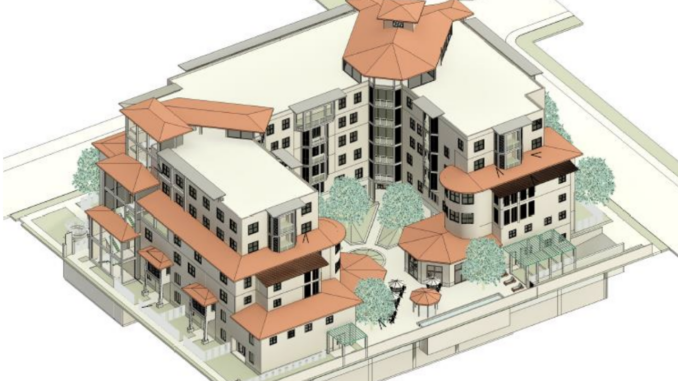
Developer Prabhas Kejriwal wants to build a seven-story building reaching 92 feet in height at 910 Webster Street, between the 10-story Channing House and one-story homes.
Neighbors including former Yahoo CEO Marissa Mayer have pushed Kejriwal to shrink the building.
“The proposed density is simply too much for this location. The proposed structure is too tall and would loom over nearby single-family homes,” said Mayer, who lives around the corner on Addison Avenue.
Neighbor Deborah Dooley said she would lose sunlight on her property from 4 to 8 p.m.
“A project of this scale will fundamentally alter the character of this neighborhood,” neighbor Catherine Cohen said.

The 70-unit building would replace a two-story apartment complex that has 24 units.
Councilman George Lu and Councilwoman Julie Lythcott-Haims supported the project tonight.
“I’m pleased to see something this beautiful as downtown in-fill,” Lythcott-Haims said.
Councilmen Keith Reckdahl, Ed Lauing, Pat Burt and Vicki Veenker said the location is good for more housing, but they want to see the neighbors get more sunlight.
“This is not a transition. This is just a wall,” Reckdahl said.
“Be polite to your neighbors,” Lauing said.
“I like the direction, I just don’t think we’re quite there on the form,” Veenker said.
Vice Mayor Greer Stone said he doesn’t like that Kejriwal will tear down 24 apartments, where rent is around $3,500, and replace them with more expensive units.
“It’s frustrating to always hear apartments be treated as temporary dwelling units. They’re homes, and for some, these homes carry sentimental value,” said Stone, who has rented an apartment in Palo Alto for 10 years.
Lauing encouraged Kejriwal to include more subsidizing housing in the project.
Tonight’s meeting was a chance for council to give feedback on the plans before Kejriwal submits a formal application.
I live one-tenth of one mile from 910 Webster Street. I hope our city council finds its way to approving a net gain of 46 new homes at this spot (70 in the proposed building minus 24 now there). Yes in my back yard.
The proposed building will include 12 homes reserved at below-market rates for people earning lower and moderate incomes. True, this is fewer than the 24 existing homes that are naturally affordable because they are older. But study after study shows that the addition of 58 new market-rate homes (70 total minus 12 affordable) will have the affect of stabilizing or even reducing rents for homes in the surrounding area at all price points. This evidence shows that the laws of supply and demand apply to the housing market: more supply leads to lower prices.
Our city is making strides towards building new homes for new neighbors along San Antonio Road and El Camino Real. This is good. We should also be building new homes in University South, where our new neighbors will have ready access to jobs, amenities, and transit.
The idea that intervening in the market proves the free market works is absurd. Subsidized artificial supply has unintended and often disastrous consequences. Does anyone remember the mortgage backed securities scandal? Government created an environment that encouraged lenders to give mortgages to people who could not afford mortgages. Wall Street built a financial Jenga tower on the foundation of these weak mortgages. It was fun for a while, record profits, record home ownership, but then our economy collapsed. The same thing is going to happen in Palo Alto. The real-estate industrial complex is just like Wall Street. A bunch of greedy hustlers trying to make a quick buck and get out of town before the $h!t hits the fan.
Overly restrictive zoning as in Palo Alto is a government intervention in the market that creates artificial scarcity. Upzoning is a reduction of that regulation, which gets government out of the way and lets the market self-correct by increasing supply. This is not a subsidy.
Corporate landlords like the status quo, because it lets them charge higher rents from tenants who have fewer choices.
Corporate real-estate developers love state intervention in local zoning because it clears the way for them to harvest assets from the local community that the developer did nothing to build. Consider two identical dwellings. One in the Nevada desert and one in Palo Alto. If you were a Real-estate developer which one would you build? The one that needs you, as the developer, to build hundreds of millions of dollars in amenities? Or, the one where you can exploit hundreds of millions of dollars worth of amenities already built with other people’s money? To paraphrase Daniel Day Lewis in “There Will Be Blood”: developers are drinking Palo Alto’s milkshake… and corrupted politicians in state government are helping them do it for a cut of the proceeds given in the form of campaign contributions.
The people of California want construction of more homes. So they democratically elected state legislators who enacted state laws that require cities to allow construction of new homes. This is good. We have a statewide homes shortage, which requires a statewide solution in which every city does its part.
Many Palo Altans, myself included, want construction of new homes, so our parents and children can move here to live near us.
To get new homes, we need home builders. In our nation, those are mostly for-profit entities. I have no objection to home builders earning a profit. Nor do I object to profits earned by companies that provide other things people want, like schools and electric bikes. It is inconsistent to object that upzoning will lead to corporate builders earning profits by building homes, but not object that current overly restrictive zoning leads to corporate landlords charging higher rents because of the shortage of homes.
I’m glad we’re finally developing these neighborhoods. Don’t know why we protect a handful of apartments when we can replace them with more apartments–all with rent-control. Let’s build and go high.
More apartments-all with rent control?? Really? In whose dreams will that happen when towns and cities like Cupertino and San Francisco are letting developers reduce their pathetically number of “affordable” homes from 15% to 5%?
The new, higher-priced homes of today become the older, lower-priced homes of tomorrow. The apartments now at 910 Webster Street were once new and higher-priced, but today are “naturally affordable” ($3,000 to $3,500 according to the owner at the council meeting) because they are now older. Palo Alto’s problem is that for decades it has used overly restrictive zoning to freeze its housing stock in amber. Now is the time to course correct.
California law limits how much a residential landlord can raise rent per year, to 5% plus inflation, up to 10%. [footnote] But this only applies to homes older than 15 years. We should regularly be building new homes, so that 15-year old homes regularly cycle in to this legal limit on rent increases.
[Portion removed — Terms of Use violation. Please, no links.]
The proposal here is to set aside 20% of the new homes at below-market rates for people earning low and moderate incomes.
The council is continuing to cooperate with nitwits in Sacramento to turn suburban cities into Manhatton. Its going to wreck California permanently.
Unlike you hypocrites, as a neighboring resident I firmly oppose this, because it will affect my parking, as well as the rent and value of my property. Those of you who support this are cold and cruel, watching the interests of us neighbors being harmed.