
BY STEPHANIE LAM
Daily Post Correspondent
A prosecutor Thursday (Jan. 29) told jurors they should convict five demonstrators for conspiring to break into the Stanford president’s office on June 5, 2024, causing $300,000 in damage.
Meanwhile, a defense attorney asserted that the protesters never intended to cause harm and only wanted to raise awareness about their demands for Stanford to sell its stock in companies that supply the Israeli military. None of the five protesters on trial testified on their own behalf.

The remarks by the attorneys were part of closing arguments in the trial that has taken three weeks.
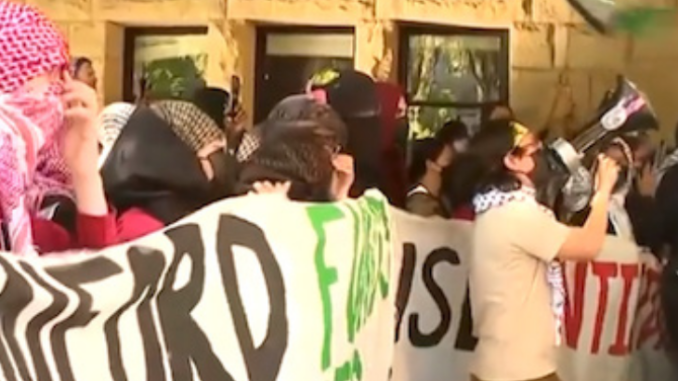
Speaking to jurors in a San Jose courtroom, Deputy District Attorney Rob Baker said they should remember how the protesters planned the occupation weeks before and knew exactly what they were doing. Baker said protesters intentionally took the building to use as leverage for Stanford to comply with their divestment demands.
Witness John Richardson, a protester who was arrested on June 5 and sided with the prosecution to potentially have his charges dropped, said he was a part of a group chat that planned the office occupation along with the five Stanford students on trial — German Gonzalez, Maya Burke, Taylor McCann, Hunter Taylor-Black and Amy Zhai. They discussed ways to break into the office and delegated tasks for each participant, he said.
Baker said jurors should recall the property damage done to the office building. Protesters had splattered fake blood and broke windows, doors and furniture. The damage was put at more than $300,000.
But defense attorney Avi Singh, who represents Gonzalez, insists the occupation was peaceful and only meant to raise awareness about the students’ desire to have Stanford sell its stock in companies that do business with Israel.
Singh said the door barricades set up by the protesters during the occupation were meant to minimize risks of violence and harm. Police body cam video from that day captures how protesters peacefully surrendered when police found them, Singh said.
The closing arguments concluded a trial that ran nearly three weeks in a San Jose courtroom. The witnesses included university patrol officer Jason Barnes, who was present during the arrest and booking of the protesters; Richardson; and Stanford facilities director Mitch Bousson, who talked about the office damage.
If convicted, the group could face $329,000 in restitution and a maximum sentence of more than three years in prison.
Jury deliberations will begin after the remaining defense attorney’s closing arguments today.
The five on trial are all who remain of the initial 12 protesters who were charged in April. Santa Clara County District Attorney Jeff Rosen announced the charges nearly a year after the alleged break-in. Out of the 12 protesters arrested on June 5, three protesters were granted mental health diversion and excluded from a trial, including Isabella Terrazas, Eliana Fuchs and Zoe Edelman. Three others took plea deals, including Gretchen Rose Guimarin, Cameron Pennington and Kaiden Wang.
Jan. 24, 2026 — Defense cites Stanford’s activist history in protester trial
Jan. 26, 2026 — Student protester tells jury about demonstrators’ plans to take over Stanford president’s office
Jan. 10, 2026 — Stanford students go on trial
Nov. 24, 2025 — Three Stanford protesters plan to take plea deals
July 18, 2025 — Stanford protesters go to court, along with supporters
April 10, 2025 — DA charges Stanford protesters with felonies
Jan. 9, 2025 — Fate of students arrested in Stanford protest is in limbo seven months later
June 10, 2024 — Protesters arrested at Stanford identified
Avi Singh should be required to repeat law school in exchange for being allowed to keep his law license. If you run over a child in a crosswalk you don’t get points for saying you never intended to do it.
In your example, if it was unintentional, it may be a civil lawsuit for negligence rather than a criminal case. It could involve huge money damages and still not be criminal. That’s what law school might teach.
You’ve got to be kidding. If Stanford sued these kids instead of seeking criminal convictions their rich parents would pay the damage awards.