
BY ADRIANA HERNANDEZ
Daily Post Staff Writer
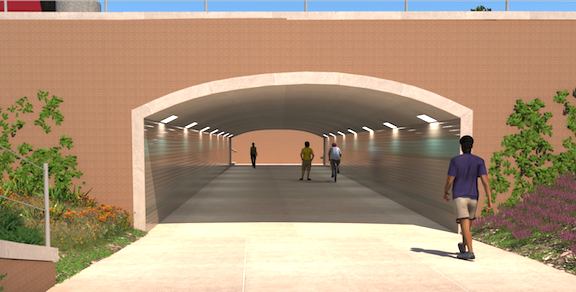
The Menlo Park City Council has decided to move forward with the construction of a $62 million tunnel to connect Alma Street and El Camino Real, despite its “shocking” price tag and funding uncertainty.
Council on Tuesday agreed to spend $7.4 million to finalize the tunnel project design and then seek additional funding to cover the construction shortfall, estimated at $34 million to $43 million, according to Public Works Director Azalea Mitch. The tunnel would go under the railroad tracks to connect Alma Street and El Camino Real, cutting down travel times for pedestrians and cyclists by more than a half mile.
“The price tag is shocking. I think this will become a vital part of the area,” Councilman Jeff Schmidt said.
The city has $22 million set aside for the Middle Avenue tunnel. Council had the option to finalize the design to be shovel-ready while still seeking additional funding, build the project in stages based on available funding or stop the project.
Councilman Drew Combs favored building the project in stages, and compared it to buying a Ferrari. He said if he wanted a Ferrari right now, he wouldn’t be able to pay for it and would need to finance it, which would cost him more.
“If you’ve got the money, some money now or some way to access some part of the project now, then that’s what you take,” Combs said. “That’s the only thing that guarantees that you’ll ever have people in the tunnel or you’ll ever be driving that Ferrari.”
Schmidt agreed with Combs because of the level of uncertainty, and it was unclear what funding would look like. The city has “funding hopes and dreams,” but nothing is concrete, Schmidt said.
Councilwomen Betsy Nash, Jennifer Wise and Cecilia Taylor agreed to shut down the railroad tracks for one weekend, provide bus services when the trains stop, and have short night closures that would last four to six hours. Construction is expected to take 13 to 16 months, according to Mitch.
Sherry Bullock, interim chief of design and construction for Caltrain, said there would be consequences if the city chose to build the project in stages, because it would become more expensive and cause more disruption to train services.
Residents who were for and against the $62 million project spoke to council at the hearing.
“We know every person in the city is not going to use this bike tunnel. Most people get around by car. Is this the best use of our money? It’s not all coming out of the city’s pockets, but I’m a taxpayer. It’s coming out of my pock-ets,” Sue Kayton said.
The city hasn’t considered the cost of maintaining the tunnel and of police patrolling the area, Kayton said.
Homeless people will use the tunnel as a shelter, which will make it less appealing for residents to use, Michael Barclay said.
Katie Behroozi said the project will be useful for future residents because it will be a route from Belle Haven to Oak Knoll.
The tunnel will help relieve the pressure cyclists face while riding through Ravenswood Avenue congestion, Ken Kershner said.
The idea to build a tunnel under the railroad tracks has bounced around for decades, but the most recent plans started in 2016. Council will review the final design of the project in a future meeting and discuss funding options.
$62 million on critical infrastructure – fine, maybe. $62 million on a “nice to have” for cyclists – ludicrous.
What a joke
Does anybody remember the California High Speed Rail boondoggle? How much of the $62M is graft? How much is waste, fraud, and abuse? How much of the $62M is being laundered through construction companies and back into the party?
@Stew, welcome to the cost of unionized construction in high cost California that involves keeping transit in active service during construction. This is an incredible bargain compared to project involving active roadways. The 101 / 87 interchange cost almost a billion in today’s dollars. The San Mateo express lane project cost similar in today’s dollars.
Let’s discuss the key drivers of the $62M cost
• Deeper, longer tunnel to keep trains running: Caltrain required a design that keeps rail operations in service during construction and avoids ramps within their right‑of‑way, which forces a deeper bore (around 20–22 feet down) and a much longer tunnel alignment (roughly 1,000 feet vs. an early ~60‑foot concept). That adds excavation, structure, and mechanical costs.
• Construction under an active railroad: Building a grade‑separated crossing under an electrified, active commuter rail corridor drives up costs due to specialized construction methods, staging, risk contingencies, flagging and protection for Caltrain, and schedule constraints. The cheaper “cut‑and‑cover with 2–4 days of track outage” option was effectively taken off the table because Caltrain prioritized uninterrupted service.
• Expensive materials and methods: City staff have explicitly cited the need for more expensive materials and construction methods with the updated design, which typically means thicker reinforced concrete sections, extensive waterproofing, and possibly jacked box or segmental construction rather than simple open‑cut.
• Scope is more than the tunnel box: The $62M is a total project estimate, not just the tunnel structure. It includes:
• Approach ramps and plazas on both sides (Alma/Burgess side and Stanford’s Middle Plaza/El Camino side).
• Streetscape and mid‑block crossing treatments on El Camino (raised crosswalks, flashing beacons, signage, etc.).
• Utility relocations, drainage and pump systems, lighting, security features, and finishes typical of modern bike/ped tunnels.
• Design, engineering, environmental work, project management, and contingencies layered on top of the roughly $34M construction estimate cited in city communications.
• Escalation and long planning timeline: The project has been in the works since at least 2016–2017, and costs have increased as design has evolved and as construction prices have escalated; staff reports and local coverage note that the updated Caltrain‑driven concept added several million dollars over earlier estimates.
Rough breakdown embedded in “$62M”
• Construction of the tunnel and approaches is estimated at about $34M, while the full project—design, management, contingencies, and associated street/landscape work—brings the total to around $62M.
• Menlo Park currently has about $22M identified, with a remaining shortfall on the order of $34M–$43M that they plan to cover through additional grants and funding.
We’re seeing the fully loaded, escalated cost for a deep, 1,000‑foot‑class undercrossing built under an active electrified railroad, with all design, contingencies, and surface improvements rolled in, rather than the price of just a short cut‑and‑cover box.
I would love to see this come to fruition. It would mean a quick walk from Burgess Park to Safeway to grab some groceries. It would be a safe and fast bike ride for school kids. The tunnel could provide a general ease of movement that does not currently exist to get from Ravenswood to Middle. The price tag is shocking. But it would sure indicate an investment in our community.
San Mateo County paid $580 million to add express lanes to highway 101, whose tax payer money was that?
@David, Your long list of excuses is giving me a case of deja vu, because your list almost exactly parallels the list of excuses we were given for the California High Speed Rail scam.
@Stew, actually, it shows that you lack the skills, knowledge and/or initiative to step in and discuss legitimate issues and problems in California and the whole US when it comes to infrastructure. You just lazily regurgitate words like “graft”, “scam”, “excuses” and “waste”, while ducking when specifics are mentioned. We can an engage when you are willing to discuss any or all of the specifics I have highlighted.
This is about as stupid as when Menlo Park refused to widen its portion of Sand Hill Road due to one council member’s hatred of Stanford. For years when you drove Sand Hill Road it would go from four lanes to two lanes briefly and then back to four lanes. Same mentality is on display here with this ridiculous tunnel.