
BY DANIEL SCHRAGER
Daily Post Staff Writer
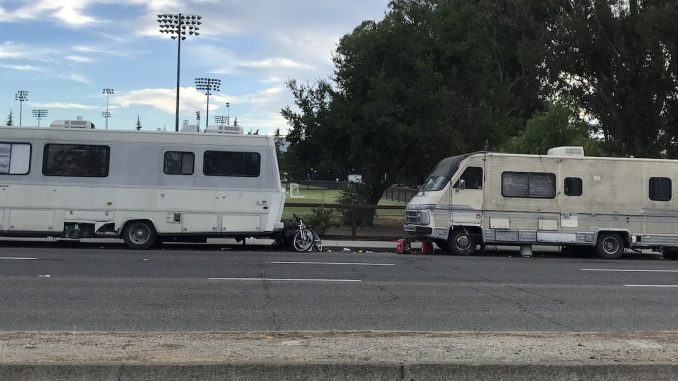
Palo Alto City Council unanimously approved the first phase of a four-part plan to get RVs off of city streets last night (Oct 20).
The first phase includes directing City Manager Ed Shikada to bring back a pair of bans to the council in the next four months, one making it illegal to rent out a public parking space for an RV, a practice known as ‘vanlording,’ and another banning detached trailers and inoperable RVs from city streets.
“We have a sheer volume problem that we have to address,” Mayor Ed Lauing said.
Council will also look to implement additional street cleaning to force RV owners to move their vehicles more frequently or risk being towed.
The proposal also aims to help people find safer and less disruptive places to park their RVs.
“Towing is one thing but towing is not a permanent thing… They come back,” Councilwoman Vicki Veenker said.
Council plans to reach out to businesses and religious organizations with unused parking spots to see if they’re willing to house RVs.
Yesterday’s vote establishes a committee to evaluate whether or not parking laws are being enforced.
During public comment, residents expressed concern that offering more services and safe parking options would encourage RV-dwellers to move to the city.
“My greatest fear is that the proposal is the equivalent to putting up billboards up and down Highway 101, inviting people to move to Palo Alto where they will receive ‘enhanced services,’ street cleaning, sanitation, hygiene police and fire protection and all of the rest, best of all, at no cost. And by the way park wherever you want because we’re not going to be able to enforce it,” Barry K., speaking on behalf of a group of Ventura District residents, said.
Others expressed frustration with the slow enforcement of existing laws, especially on Embarcadero Road and Corporation Way, and the cost of the proposal. The four phases would cost over $7 million, over $4 million of which would go to putting up new parking signs around town with the additional restrictions, and take two years to complete.
“We already have the signage, it won’t work. It’s 200 times more expensive than our budget for towing,” a speaker listed as Noah F. said.
Councilwoman Julie Lythcott-Haims expressed frustration that many of the 28 speakers dismissed the concerns of people living in RVs.
“I respect the valid concerns of business owners and residents who are impacted, and significantly so,” Lythcott-Haims said. “And, I am troubled by some comments that have an undertone of ‘poverty makes me feel uncomfortable and unsafe.’ People speak of ‘the problem’ as if we’re not talking about human beings.”
However, some speakers favored the proposal to offer additional services and safe parking, including Justin Harper, representing a group of people all living out of their RVs.
“It seems to be that there are enforcements and restrictions coming before the services that could actually help some of us get out from the situations that we are currently in,” Harper said. Harper expressed concerns that the safe parking sites would likely be far from Palo Alto’s businesses, making it difficult for RV dwellers to commute to work and save up for permanent housing.
Palo Alto has around 420 homeless residents, according to a survey done by Santa Clara County in January, 73% of whom live out of their vehicles. That’s nearly twice the rate seen in the rest of Santa Clara County. The city has 120 RVs parked on the street with one or more people living inside, according to the survey, along with 29 cars and 19 vans.
“Our problem has festered and exploded,” Councilman Pat Burt said. “We’ve allowed it to get to a crisis point before we’ve begun to really take any significant actions to address it.”
Lauing, who made the motion that eventually passed, said the city’s priority should be getting as many RVs off the street as quickly as possible.
He proposed changing the original proposal to add the provision that council reach out to businesses and religious organizations with extra parking spaces. He also proposed creating the committee to ensure the enforcement of existing parking laws.
“Those two things could be the biggest tools we have right now, today, to start working on that would start to develop, in combination, some kind of scale,” Lauing said.
Lauing struck the street cleaning provisions from his proposal but Councilman Keith Reckdahl asked that they be added back in.
The first phase of the project is expected to cost $707,000.
Last night’s vote was largely based on a proposal from the Policy and Services Committee that included three additional phases.
The second phase would explore limiting RV parking on certain streets, introducing RV permits and implementing a pilot program to provide sanitation services to people living in RVs. The third phase, the city would implement the pilot program and plan additional safe, off-street RV parking sites, while the fourth phase would see the remaining parts of the plan implemented.
Zealous towing would work. The cost of retrieiving a vehicle from the tow yard is high enough to discourage recidivism.
$4,000,000 on more signage and a total annual towing budget of $30,000???
Who’s got the signage contract and are they public? I want to invest in them and the bollard manufacturers.
Any revenue coming in from towing charges / impound fees like other cities charge? How about fines for polluting the storm drains that WE pay for in never-ending utility rate hikes?
Our City Council is incompetent. Just tow them, it’s illegal to park for more than 72 hours. Most RV’s have expired tags. A phased approach, providing services, and taking years will only mean the RV population will increase. We cannot wait to vote most of you out ! Listen to the majority of your constituents, the RV’s need to go !
It would be useful and informative for the DP and other local news sources to make our “leaders” respond to news stories and readers’ comments and questions.
Having them do something more substantive than reflexive and unhelpful virtue-signalling would be a welcome change and might lead them do something useful.
Councilwoman Julie Lythcott-Haims statements are a shining example of how out of touch and tone deaf the city council is. I’ll bet of the RVs were lining the street in front of her home every day and night she wouldn’t be so “compassionate.” If she gets reelected I’l be convinced that we get everything we deserve.