
BY NORAH SHEPPARD-HUTCHINS
Daily Post Staff Writer
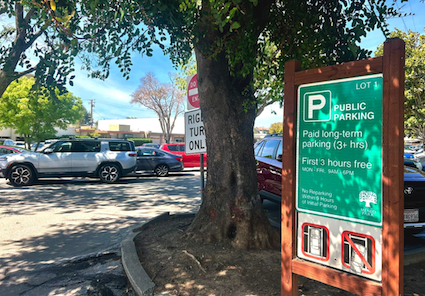
Menlo Park council members said they do not want to reduce the parking requirement or the number of subsidized homes to close finance gaps in three proposals to develop housing on city-owned parking lots.
Council discussed potential ways to close gaps found in a finance report ranging from $19 million to $45 mil lion for three affordable housing development proposals on city-owned parking lots at a Tuesday council meeting.
Council members Jeff Schmidt, Cecilia Taylor and Jennifer Wise said they would like to take both options off the table.
“I looked at the affordable housing as a way to reduce the funding and parking gap, and that felt weird to me.
I mean we still may need to juggle our affordable housing numbers to hit our overall goals, which I think is totally relevant. But to use it to save costs for a developer to then pay for more parking felt weird,” Schmidt said.
Mayor Betsy Nash said she would like to explore charging for parking, but making it so business owners do not have to pay.
Other ideas include a sales tax measure to help pay for new parking garages or an annual fee for downtown business and property owners to fund parking.
Combs open-minded
Councilman Drew Combs said he would not like to take any of the options off the table yet.
However, Combs said some of the options seem unrealistic, including charging for parking, which he’s unsure if downtown is the right place to test out.
The report came just weeks before voters on Nov. 3 decide the fate of Measure P, a citizen initiative that would require the city to get voter approval before developing any of its eight downtown parking lots.
When the city sought proposals for housing on downtown parking plazas 1, 2 and 3, it asked developers to include plans for replacing the 556 parking spaces now there. Menlo Park said the parking needed to be replaced without financial help from the city.
“Even through the RFP (proposal re-quest) process, we discouraged folks from applying if they did not feel that they could present a project that replaced all of the parking,” Combs said in an interview with the Post.
Public’s thoughts
Thirty people spoke during public comment, both in support of the housing developments and against.
“Speaking for the hundreds of people who will be out of a job, the faces who don’t know how to speak their fears, people are already frustrated with traffic and parking here. I’ve already lost clients because of the traffic. We survived Covid in 2020, but we won’t survive this,” Han Li, an owner of a business on one of the parking lots, said in opposition to the proposed housing.
In contrast, John McKenna, a member of the Environmental Quality Com-mission, said the proposed housing in downtown can actually help businesses.
“Inclusive housing brings more people and more customers, which I believe is good for business. A diverse population creates more opportunity for diverse businesses,” McKenna said.
The three housing proposals, unveiled in December, came from Alliant Communities, Presidio Bay Ventures, and Related California in partnership with Alta Housing.
The homes would have different affordability levels, priced for people making 15% to 80% of the area median income. The area median income in 2025 was $130,600 for a single person and $186,600 for a family of four.
That’s my councilman! Anything to avoid taking an actual position.
“we discouraged folks from applying if they did not feel that they could present a project that replaced all of the parking,” I had to read that three times. “Discouraged?” Maybe take a do no harm approach and require the parking to be replaced as part of the RFP. The incompetence of this council is just stunning.