
The Post had this story first on Sept. 5. One of our competitors has rewritten this story and is trying to pass it off as fresh news. If you want all the local news first, pick up the Post in the mornings at 1,000 locations.
BY BRADEN CARTWRIGHT
Daily Post Staff Writer
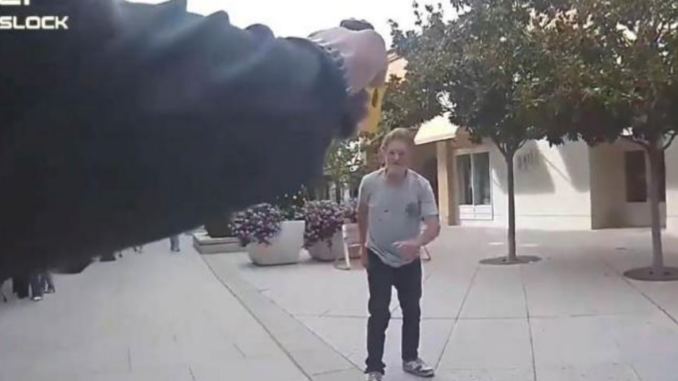
The Palo Alto Police Department has released a video of an officer using a taser on a man at the Stanford Shopping Center, bringing him to the ground and fracturing a vertebrae in his neck.
The video from July 19 shows the man sitting on a bench and arguing with an officer and a security guard after they woke him up and told him to leave the mall.
The man got up, walked toward the officer and threw his hand out.
The officer told the man to back up and asked if he wanted to go to jail.
“You’re going to get tased, dude. You’re going to get tased” the officer said. “Do it,” the man said as he walked faster toward the officer in front of the New Balance store.
The officer shot his taser into the man’s chest, and the man’s body tensed up and fell to the ground. He laid face down yelling on the ground, with his forehead bleeding, for about three minutes until a second officer arrived to handcuff him.
Paramedics took the man to the hospital. Prosecutors charged him with resisting arrest, trespassing and possessing drug paraphernalia.
At the hospital, the man apologized for his actions, City Manager Ed Shikada said in an Aug. 14 email to council.
The use of force will be reviewed by the city’s police auditor, Shikada said.
The police department posted the video online on Aug. 14 without any public notice or announcement.
Assembly Bill 748 took effect in July 2019 to require police departments to release audio and video recordings within 45 days when officers use force that results in “great bodily injury,” including a broken bone.
Palo Alto police last released body-worn camera footage from July 3, 2025, when officers pulled a man off a stolen bicycle and broke his wrist.
Before that, police officers broke the tip off a man’s finger with a rubber bullet on Dec. 23, 2023. The man reportedly strangled his wife and head-butted his son, and then refused to come outside of their home.
This is pathetic… Homeboy has the command presence of a substitute teacher on the last day of school.
Get some grappling under your belt and maybe some TRT.
Welcome to the era of feminized LE.
So to insult the LEO, you liken him to females. Way to go you misogynistic keyboard warrior. Guessing you don’t serve the public in any way, shape, or form? INCEL? Or just a condescending sexist?
Probably just a pro Monday morning quarterback living his best life.
The man acted like a jerk, but he wasn’t physically imposing and he wasn’t armed, so he posed little threat to the officer—certainly not enough to raise a self-defense claim that would justify use of a dangerous weapon like a Taser. Had the first officer avoided stoking the issue and simply waited for the backup officer to arrive, this would not have happened.
As others have pointed out, this was a textbook example of where not to use a Taser: a hard surface where an unbroken fall—as what seems to have happened—could result in serious, potentially life-altering injury. For someone my age, a broken hip could effectively be the end of the line. Fortunately in this case, the man appears to have suffered “only” a broken vertebra in his neck.
But there’s a more fundamental issue here that no one seems to have noticed: the officer was supposedly called to issue an order to not enter Stanford Shopping Center (i.e., he would be “trespassed”). But except in unusual circumstances—which thus far have not been mentioned—California does not criminalize trespass on private property open to the public and makes no provision for a stay-away order. Within limits, a local jurisdiction can restrict trespass on private property open to the public—but Palo Alto has not done so.
As always, there may be more to this that we haven’t been told; if so, tell us. Absent that, we can only go with what we know, and it doesn’t look good.
Being old and unarmed doesn’t give you a free pass to act like a jerkoff and ignore an officer’s commands. You don’t get to escalate the situation and then cry foul when the officer finally takes action.
If he breaks a bone or even dies because of his own conduct and decision to create the confrontation, those are the consequences of his choices… one less problematic entitled person causing a disruption in the world.
He F’d around. He found out. Simple as that.
Ol’ Jeff “Geeser” Conrad is out of touch. The entire purose of a Taser is less lethal use of force to gain compliance. In your view, the officer should have just let some unhinged person keep getting closer to him, maybe disarm the officer and use his duty weapon? The suspect was acting aggressively and approaching the officer. He refused repeated commands and kept advancing in an aggressive manner. Jeff, you need to stick to whatever it is you do and please don’t break a hip in the process.
When an Officer Simon tells you something follow his instructions. No one will get hurt. If the Officer Simon is wrong then let a court to decide. We used to play a game called Simon Says. Schools should teach it under life skills.
[Comment removed — Terms of Use violation.]
Vertebrae is plural, like cacti, so you can’t say a vertebrae. Did they put him in one of those horse collars before transporting him to the hospital?
Whenever I read one of these stories about not following an officer’s commands, I wonder what would happen to me in Mexico or Japan if an officer started barking commands at me.
Seems to me the operative question is whether the man posed sufficient threat to the officer, and about half the commenters seem to think he did not.
The PAPD video indicates that a backup officer arrived a bit under 3 minutes after being requested; surely the first officer could have cooled it for that long—and the man would probably have been arrested without incident other than mouthing off.
Absent a threat to the officer’s safety, failure to respond with alacrity to police orders or hurling abuse at police _is_ pretty much given a free ticket—see City of Houston v. Hill (1987), Duran v. City of Douglas, Arizona (9th Cir. 1990), and People v. Quiroga (Calif. 1993).
There remains the fundamental question of whether there was a valid basis for ordering the man to leave the shopping center. I cannot make that call, but I suggest a careful reading of Penal Code §§602 (all 25 subdivisions …) and 602.1. And perhaps In re Cox (Calif. 1970).
As always, different is never the same. And there may be relevant information that has not been released. The PAPD could end a lot of needless speculation by doing so.
When people like Mr. Conrad play lawyer, they reveal how little they know about the law. The shopping center is private property and Stanford can have anyone removed for any reason or no reason at all.
I’m sure Mr. Conrad is screaming, “This can’t be true.” Oh, but it is true.
Stanford closes its private roads and lands to the public for one day each year to prevent the campus grounds from legally becoming public property through “prescriptive easement”.
Under California property law, if the general public continuously uses private land or roads as a thoroughfare without restriction for a specific period (typically five years), the public can gain a permanent legal right to use it. This is known as an implied dedication or a prescriptive easement.
By blockading the roads, putting up signs, and strictly denying public access for just 24 hours once a year, the university legally interrupts that continuous use. This simple act legally asserts Stanford’s absolute ownership over its private property and protects its right to restrict or alter the land in the future.
I’ve long heard of periodic annual road closures on the Stanford campus, though I’ve not heard the specifics. I’ve not heard of it for Stanford Shopping Center.
There are far easier ways than blocking roads, e.g., Civil Code § 1008. As I recall, Stanford Shopping Center has many such signs, usually in the form of small bronze plaques embedded in the sidewalk near entrances. Many other properties have them as well.
But I don’t think prescriptive easement is the issue here. Private property of course remains private property. But in California, the right to exclude is not absolute on property open to the general public. Again, I suggest folks read the cited statutory and decisional law. Those who don’t want to slog through it all might look at Cox; the statement from Justice Tobriner on page 219—writing for a unanimous Court—is self-explanatory. This doesn’t mean that anything goes; what does is discussed in detail in Cox for those who wish to read further.
There is some decisional law with novel ideas about what constitutes “open to the public”; I’ll leave finding it as an exercise for anyone who’s interested.
I won’t speculate on whether the man’s conduct here crossed the line because we still don’t have the facts. I’m not necessarily suggesting anything except that there are some valid questions. I do at least cite examples from people whose opinions matter rather than just speaking ex cathedra.
Maybe Palo Alto should think about contract with the sheriff’s department. Do we really need to spend 60 something million or can we get a better deal and performance for cheaper.
Keep typing Jeff Conrad. Your lack of knowledge in dealing with mentally unstable and/or people under the influence shows with every post. “The PAPD video indicates that a backup officer arrived a bit under 3 minutes after being requested; surely the first officer could have cooled it for that long” Conrad you are totally clueless. 3 minutes can be a lifetime when dealing with a combative person and the officer doesn’t need “to cool it”. The officers main job on every shift is to go home safely – you wouldn’t understand.
I prefer to focus on the issues rather than petty insults; apparently that’s not the case with everyone here.
The reasonableness of a use of force is necessarily a balancing act between the hazard to the peace officer and that to a suspect. Presumably, the ongoing investigation—and likely review by the OIR—will make that assessment.
I agree that the officer’s initial actions were reasonable and professional—but things went off the rails more quickly than they need have. Louis Cyoher might note that half the folks here seem to see it as I do, so I don’t think the conclusion is foregone.
The careful reader might note that the bulk of my comments have not focused on the reasonableness of the Taser deployment. There’s a valid question whether the officer’s intervention was even lawful, and absent additional information, we cannot reasonably speculate on the answer. If it is determined that the officer’s actions were unlawful, the entire picture changes: none of the officer’s actions were privileged, so the Taser deployment cannot have been reasonable. What might ultimately come of it is another matter: requests for Qualified Immunity usually go something like this: “Do you have a note from your mother saying it was OK to do this. No, we don’t need to see the note. Yes? Granted!” I doubt that’s what Chief Justice Warren intended in 1967, but ’tis as ’tis.
Let’s see what the investigations disclose before jumping to conclusions.