
The Post first printed this story Monday. Other publications re-write the Post’s stories and try to pass them off as original local journalism. But they’re simply engaging in plagiarism, and then they have the gall to ask you for a donation. The Post doesn’t steal its stories and we don’t ask for donations. Here’s the original story that appeared Monday.
BY BRADEN CARTWRIGHT
Daily Post Staff Writer
Two ongoing court battles about how cities regulate RV dwellers have implications for Palo Alto, where residents and business owners are pushing for a citywide ban.
Cities that have successfully regulated RV dwellers, like San Francisco, are offering low-cost housing and other assistance to get them out of RVs, City Attorney Chris Jensen told Palo City Council on Monday.
“So it looks like you’re trying to solve the problem rather than target people,” Jensen said.
Palo Alto residents, frustrated with RV dwellers crowding streets, have said they’re considering a citizen’s ballot initiative to ban RVs if council doesn’t take action.
“Every time the city tries to determine where RVs should be accommodated on Palo Alto streets, another group of residents or businesses is being asked to absorb the impact,” restaurant and hotel owner Stephanie Wansek said in an email to council.
Council last Monday voted to permit around 60 RVs at the edges of the city but didn’t address areas where RV dwellers are most concentrated in south Palo Alto.
No legal guidance
Jensen told council that ongoing lawsuits create uncertainty, and there’s no definitive law that says what Palo Alto can do.
“One real risk is that the city winds up in a situation where it’s the court, and not necessarily this council or this community, that decides how we regulate people living in vehicles in public spaces,” Jensen said.
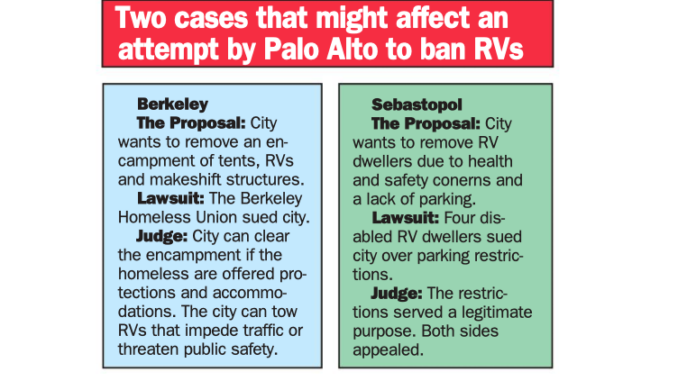
The cities of Sebastopol and Berkeley have waged years-long legal battles over their rules for RV dwellers.
Disabled RV dwellers sue
In Sebastopol, four disabled RV dwellers sued the city in October 2022 after council restricted when and where they could park.
RV dwellers said they live in RVs out of necessity, and they’re being targeted with tickets and towing.
The lead plaintiff is David Allen Yesue, 65, who said he can no longer work because he needs a hip replacement. He used to own a home and a restaurant and coached high school baseball in Sebastopol, but he became homeless in 2020 because of his disability.
“Yesue has a strong social network in Sebastopol — including people who help care for him and take him to doctors’ appointments — and receives all his medical treatment in the city,” said the lawsuit, filed by attorneys from four nonprofits.
The city argued its RV restrictions were passed in response to health and safety concerns and complaints about a lack of parking near one of its main business areas.
“The parking ordinance was our small town’s effort to balance the many interests we serve, to find a solution and not turn away from what was a very challenging situation,” Mayor Diana Rich said in a statement.
Federal Judge Kandis Westmore sided with the city on Nov. 22, 2024, finding the city’s restrictions served a legitimate government purpose.
The RV dwellers and the nonprofits have appealed Westmore’s ruling. Both sides made arguments to three judges in December 2025 and are awaiting their decision.
Berkeley encampment at issue
In Berkeley, the city has been trying to remove an encampment of tents, cars and makeshift structures. The Berkeley Homeless Union sued to stop the city in February 2025.

In an order signed Thursday, Judge Edward Chen said the city can clear the encampment as long as the homeless are offered some protections and accommodations.
Related to RVs, Chen said the city can’t tow vehicles “without first engaging in a good-faith effort to provide reasonable accommodations,” including temporary parking permits, exemptions and efforts to clean up RVs.
Chen said the city can only tow RVs that impede traffic or threaten public safety and convenience.
“Mere noncompliance with parking regulations or inoperability do not suffice,” he said.
Instead of charging RVers $15 a month, they should be charged $1,500 a month to cover all the city services at their disposal. Residents pay handsomely for these services with taxes. Why should RVers get a free lunch. If they are getting a free lunch what incentive do they have to move into permanent housing? I suspect most are very content living as they do.
South Palo Alto residents should not have to content with this type of activity in our neighborhoods, yet the City seems more concerned with issuing homeowners a rigid lecture about a 72-hour parking rule than with addressing the much larger OSV issue itself. Telling a homeowner that a vehicle legally parked in front of their own home must be moved within 72 hours, while overlooking the broader impacts of long-term OSV occupancy, is an upside-down approach to enforcement.
City Manager Ed Shikada, given the significant compensation and responsibility of his position, along with the City Attorney, should be providing the Council with thoughtful, legally sound, and balanced recommendations based on objective data and the tools already available. The burden should not continually be shifted onto law-abiding, tax-paying residents while the underlying problem remains unaddressed.
The comments by the RV dweller who owns land in Santa Cruz and will be using the money he has saved by living in his RV here align with what Neal wrote about many RV dwellers being content to live as they do. And I agree with Tax Payer’s entire post.
Bans may be problematic, but that should not translate to the city overlooking illegal behavior of any sort and not enforcing existing laws. ALL who live here have obligations to the community. Ditto people who work here. It’s really not that hard to be a good, decent citizen.
Echoing Taxpayer and Annette Ross.
I’m very tired of the excuses and the endless stalling on enforcing the laws on our books. I’m especially appalled by our history of city attorneys NOT serving the residents / taxpayers while letting our highly compensated staff and their consultants with no local waste OUR money producing absurd sub-standard work NOT based on reality, community input or any data about the OSV dwellers to qualify them for the income-based housing.
One of our genius “leaders” even called collecting income data an invasion of the OSV dwellers’ privacy when it’s STANDARD practice.
So while our staff fiddles, Bob Marinaro has produced a one-page step-by-step plan to deal with the OSVs, those for whom OSV living is a lifestyle choice vs an economic necessity etc.
Maybe staff, the Mayor, the OSV ad hoc committee and the rest of city council could spend 5 minutes of their precious time reading the one-page NO-BRAINER plan???
PS: Many of us have heard about the CA insurance crisis denying homeowners insurance due to concerns about fire. something staff has evidently missed. Maybe the City Attorney could familiarize himself with CURRENT laws regulating vegetation in high-risk areas and then brief those proposing and supporting sites like Coyote Hill surrounded by dry grass is idiotic and possibly criminally negligent??
If you can no longer work because you need a hip replacement, get a hip replacement. People get hip replacements every day.