
A board of air pollution officials, including Palo Alto Councilwoman Vicki Veenker, will decide today (May 6) whether to stick with plans to ban the installation of traditional natural gas water heaters and furnaces, even though the prohibition will worsen the affordability problem in the Bay Area.
The Bay Area Air District, of BAAD, approved the ban in March 2023, which goes into effect in seven months, on Jan. 1, 2027. A similar ban of natural gas furnaces becomes effective on Jan. 1, 2029.
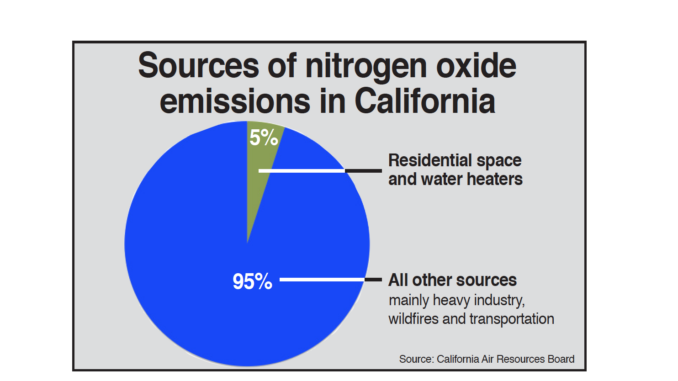
The ban is aimed at reducing the 5% of nitrogen oxide emissions linked to home appliances. Most of the emissions come from heavy industry, wildfires, transportation and agriculture, according to the California Air Resources Board.
BAAD is headed by a 24-member board of directors made up of elected leaders from throughout the Bay Area including Palo Alto’s Veenker, San Mateo County Supervisors Ray Mueller and Noelia Corzo, Santa Clara County Supervisor Otto Lee, Mountain View Councilman Chris Clark and Sunnyvale Councilwoman Linda Sell. While each of the 24 directors is elected to their local post, no elections are held for BAAD’s board. Instead, BAAD directors are appointed.
Since approving the bans, the BAAD board has been getting backlash from property owners and the business community. They argue that the equipment needed to replace gas water heaters and furnaces will cost thousands of dollars — and will drive up housing costs, contributing to the Bay Area’s affordability crisis.
BAAD officials acknowledge that heat pump water heaters cost more — on average $3,500 more by the agency’s estimate — to purchase and install than traditional gas-powered counterparts. But BAAD says consumers can apply for government rebates to lower the cost.
Opponents say that the owners of older homes will have to pay for electric panel upgrades, which, again, will add thousands of dollars to a project.
Opponents also say BAAD has downplayed the cost. Industry data indicates the upfront equipment and labor cost for a new heat pump water heater in the Bay Area ranges from roughly $4,000 to $9,000, while a heat pump HVAC system can run up to $20,000.
Upgrading an electrical panel can add $3,000 to $15,000, and completely rewiring a house can cost upwards of $10,000.
BAAD is one of 35 air quality districts in California. The South Coast Air Quality Management District in Los Angeles voted 7-5 in June 2025 to reject similar water heater and furnace phase-out rules. Board members said they were afraid it would increase the affordability problem.
Other districts across the state have concluded that the cost placed on families does not justify the modest health and environmental gains.
The goal could easily be achieved by just removing all the natural gas powered swimming pool heaters in private and public locations. PAUSD spent over 7 million dollars remodeling pools for a majority of private club use and installed natural gas heaters instead of electric. This allowed extra money to add outdoor night lighting and pool lane lighting (which was slid in after the bond committee approved the remodels) So much for sustainability.
This is ridiculous. And is it legal? I’ll be happy to get the DOJ to sure Palo Alto if I can!
Any member of the BAAD board who votes for this ban should be defeated if they try to run for re-election to city council or county supervisor:
Vicki Veenker
Ray Mueller
Noelia Corzo
Otto Lee
Chris Clark
It is disappointing to see an article that focuses solely on upfront costs without discussing operating costs. For the homeowner/renter what is the cost of electricity for the heat pump vs. buying natural gas from PG&E? The numbers can vary, but these heat pumps are more energy efficient than gas furnaces, which often leads to savings.
Separately, this article gives short shrift to the adverse health consequences from gas furnaces. Stanford and others have done studies on impacts to indoor air quality, especially for children.
The concern about this ban is the upfront cost — the money people will have to pull out of their wallets to convert to all-electric. And if you’re going to do a fair comparison with PG&E, you need to factor into the equation PG&E’s lack of reliability. Do I stick with something that works or do I rely solely on a company that has frequent outages? You’ve got to be peeved at PG&E when they tell you that you can’t charge your EV during the day? At those times, you’ve got to admit that it was a mistake to rely so much on the electric power grid — putting all your eggs into one basket.
For my house, I use solar with a backup battery, which has proven far more reliable and cheaper than PG&E. With a back-up battery you can get through most power outages without any disruption in service.
Keep in mind that if you are a gas user, you are also relying on PG&E for that service. So you are dealing with monopoly pricing to pay them to deliver gas to your home. If there is a service disruption on the gas line, you are pretty much out of luck.
We’re not supposed to have a King, right? Funny how the “no kings” crowd wants to force regulations on the rest of us, like they’re the kings and we’re the peasants. If you believe in “no kings” then act like it.
I’m sure the elites will be able to avoid this rule while the rest of us suffer. I remember several years ago visiting the home of a Mid-Peninsula Regional Open Space director, whose job it is to prevent real estate from being used for housing so that home prices go up. He was essentially a shill for the real estate industry while playing the role of an environmentalist. He always talked about the need for more open space. Then I saw his home. Open space preserves on three sides with a view of the Pacific in one direction and the bay in the other. What a hypocrite.
This is another gov’t unfunded mandate. This will drive more CA residents away and increase the affordability crisis. Anyone who votes Yes on this should be defeated in their next election — send them home to reflect on their poor decision making skills.
You forgot to mention that people who need complicated electrical changes to install a heat pump are easily exempted, not making it mandatory for those cases and for folks of low income status. Please tell the full story – thanks.
As reported on Channel 11 news, there is no accommodation in place for the exemption of such upgrades. All this is the same as building an airplane as it is being flown.
Jocelyn, those exemptions haven’t been approved. The rule, as it stands, provides no assistance to the middle class or poor.