
BY BRADEN CARTWRIGHT
Daily Post Staff Writer
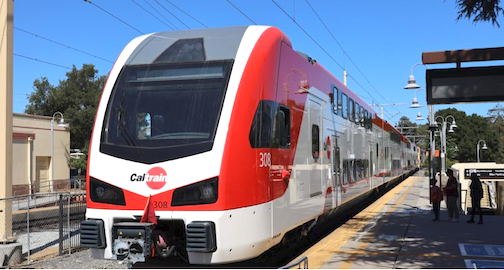
Caltrain will close 10 stations, end weekend service, stop trains at 9 p.m. and eventually wind down operations if a Bay Area sales tax fails on the November ballot, officials said yesterday.
“Caltrain and BART would very likely be looking at shutting down passenger service,” Deputy Director of Policy Development Melissa Jones said. “In that case, the agencies would be focused on maintenance, trying to secure our assets, keep everything safe while we regroup for the future.”
Jones and her team are looking at which stations would close, based on their ridership and location, and other saving measures to start in summer 2027.
Death spiral
Cutting service will drive riders away, reducing fare revenue even further and offsetting most of the cuts, Jones said. She estimated Caltrain would need to shut down within one to two years.
“I believe that (public) transportation without this measure is gone,” San Mateo County Supervisor David Canepa said at Caltrain’s board meeting yesterday.

Caltrain is using a state loan to balance next year’s budget but faces a $75 million annual deficit starting on July 1, 2027, Jones said.
‘Crying wolf’
Palo Alto Councilman Pat Burt said members of the public criticized BART for “crying wolf” on its plan to close stations and cut back service without a tax.
“We all here understand the reality of this, but that doesn’t mean everyone else does,” Burt said. “So how do we message this in away that’s credible rather than sounding alarmist? Even though it is alarming.”
Canepa was more alarmist. He said he wants to raise awareness for the “carmageddon” that would hit Bay Area freeways and to identify which of Caltrain’s 31 stations would close.
“Let’s give people the worst case sce-narios, and let them make the decision,” Canepa said.
Redwood City Councilman Jeff Gee said riders will no longer have a way of getting home from San Francisco Giants games and other events. He worried the Federal Transit Administration will try to take back a $647 million grant from Caltrain that was used to convert from diesel to electric trains, with the condition that Caltrain run more trains.
Eventually Caltrain would have to sell its assets or lease them to a company to run the railroad, Gee said.
Caltrain purchased the railroad from Union Pacific in 1991.
Ridership nosedives
Transit agencies are trying to address a loss in fare revenue that started in March 2020 when offices closed because of Covid. Caltrain’s ridership was at 64% of pre-pandemic numbers in February.
Public transit advocates are gathering signatures to place a half-cent sales tax on the November ballot in five Bay Area counties.
The tax would last 14 years and generate about $1 billion per year, according to the state Senate.
If the measure passes, BART would get $330 million, VTA would get $264 million and Muni would get $170 million per year.
Caltrain would get $75 million, and SamTrans would get $50 million.
Polling
Polls in January 2025 showed the tax had between 51% and 57% support, above the 50% needed to pass.
PG&E, Visa, labor unions and the owners of the Golden State Warriors have donated to the $1.3 million campaign for the measure, campaign finance forms show.
Wake up people!
California under one party rule of the Democrats is circling the drain. Just one more tax increase is all they need, until the next tax increase and the next tax increase.
When the Southern Pacific operated the line, they recognized it was no longer profitable in the 1970’s. When Caltrain took it over in 1985, it was going to be “better”.
In. 2022, Caltrain predicted it would lose $500 Million over the several years. They spent tens of Billions to electrify the system and that was going to solve everything.
And you wonder why people are fleeing California in droves…
We need strong mass transit for a healthy and fair bay area. I hope voters will support new funds for mass transit this fall.
What’s fair about forcing one group of people to pay for the transportation of another group that doesn’t want to pay? What’s fair about making people who are at the bottom or middle of the income scale pay a higher percentage of their income for transportation than the wealthy?
All taxpayers support government spending on roads whether or not they drive a car, and government spending on K-12 schools whether or not they have a child. This is because our our people through their democratically elected representatives believe, properly, that roads and schools are good for society as a whole. Likewise, it is fair for all taxpayers to support government spending on mass transit whether or not they ride a bus or train.
Progressive taxes are better than regressive taxes. I’d rather fund roads and transit with a graduated income tax. Whereas gas taxes, highway tolls, transit fares, and sales taxes are all regressive — everybody pays the same amount, so lower-income people pay a greater portion of their income compared to higher-income people. But we can’t let the perfect be the enemy of the good. Bay area mass transit needs more government funding, and the way voters can achieve this in November is with a new sales tax. I hope everyone will vote for these funds.
Caltrain isn’t the only transit agency needing a huge cash infusion. BART is in even worse shape. The problem is that none of these agencies can give any consideration to cost reduction because their labor contracts can’t be modified. It kind of made sense during the pandemic to have BART lay off workers or lower salaries since ridership was down by more than half. Instead the federal government came in and subsidized BART. Now that the federal subsidy has run out and ridership has only improved marginally of course the system is facing a crisis. A sales tax increase will have to be permanent and it won’t solve the transit financing long term because the unions will demand raises to keep up with the cost of living increase that the sales tax will worsen. Vicious circle.
The other issue with Caltrain is that the politicians who run things around here have designated the Caltrain right-of-way as the final leg of high-speed rail from San Jose to San Francisco. You can do one or the other but not both.
I’m tired of seeing empty trains all day, with full trains during the commute hours. Why run the empty trains? It’s a COMMUTER train, run it only during the hours the cars are full and revenue is up.
Stop enabling wasteful spending!
Remember a few years ago when it was revealed that a BART janitor named Liang Zhao Zhang made $271,000 in a single year while spending countless hours sleeping in a closet while on the clock?
In addition, the BART OIG found multiple instances of time sheet fraud by other employees too.
Bart needs to crack down on the rampant time sheet fraud and wasteful spending before asking for one cent in extra tax revenue.
The deficits seem systemic, would like to know if this sales tax increase will fix the deficits in the long term. Getting tiresome to be guilted into yet another tax increase every 5-6 years.
The problem with these transit agencies? No cost controls. They aren’t free to set salaries and they can’t lay anyone off. How many private businesses could stay in business with those constraints? The media is blind to this.
Caltrain has been mismanaged for years internally and they’ve always come to the state for help and bailouts… meanwhile the state of CA has turned a blind eye to all the “Learing Center” scams that are rampant here… Somalians doing what Somali’s do, lie, cheat and teal (the clan/pirate life) as well the Armenians down in LA/Glendale cornering the Hospice scam. I’m sure the Ethiopians are scamming as well, just look at all the adult men and women living in YWCA buildings and driving nice cars.