
BY BRADEN CARTWRIGHT
Daily Post Staff Writer
Caltrain will close 10 stations, end weekend service, stop trains at 9 p.m. and eventually wind down operations if a Bay Area sales tax fails on the November ballot, officials said yesterday.
“Caltrain and BART would very likely be looking at shutting down passenger service,” Deputy Director of Policy Development Melissa Jones said. “In that case, the agencies would be focused on maintenance, trying to secure our assets, keep everything safe while we regroup for the future.”
Jones and her team are looking at which stations would close, based on their ridership and location, and other saving measures to start in summer 2027.
Death spiral
Cutting service will drive riders away, reducing fare revenue even further and offsetting most of the cuts, Jones said. She estimated Caltrain would need to shut down within one to two years.
“I believe that (public) transportation without this measure is gone,” San Mateo County Supervisor David Canepa said at Caltrain’s board meeting yesterday.

Caltrain is using a state loan to balance next year’s budget but faces a $75 million annual deficit starting on July 1, 2027, Jones said.
‘Crying wolf’
Palo Alto Councilman Pat Burt said members of the public criticized BART for “crying wolf” on its plan to close stations and cut back service without a tax.
“We all here understand the reality of this, but that doesn’t mean everyone else does,” Burt said. “So how do we message this in away that’s credible rather than sounding alarmist? Even though it is alarming.”
Canepa was more alarmist. He said he wants to raise awareness for the “carmageddon” that would hit Bay Area freeways and to identify which of Caltrain’s 31 stations would close.
“Let’s give people the worst case sce-narios, and let them make the decision,” Canepa said.
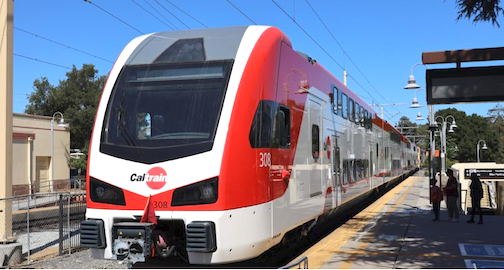
Redwood City Councilman Jeff Gee said riders will no longer have a way of getting home from San Francisco Giants games and other events. He worried the Federal Transit Administration will try to take back a $647 million grant from Caltrain that was used to convert from diesel to electric trains, with the condition that Caltrain run more trains.
Eventually Caltrain would have to sell its assets or lease them to a company to run the railroad, Gee said.
Caltrain purchased the railroad from Union Pacific in 1991.
Ridership nosedives
Transit agencies are trying to address a loss in fare revenue that started in March 2020 when offices closed because of Covid. Caltrain’s ridership was at 64% of pre-pandemic numbers in February.
Public transit advocates are gathering signatures to place a half-cent sales tax on the November ballot in five Bay Area counties.
The tax would last 14 years and generate about $1 billion per year, according to the state Senate.
If the measure passes, BART would get $330 million, VTA would get $264 million and Muni would get $170 million per year.
Caltrain would get $75 million, and SamTrans would get $50 million.
Polling
Polls in January 2025 showed the tax had between 51% and 57% support, above the 50% needed to pass.
PG&E, Visa, labor unions and the owners of the Golden State Warriors have donated to the $1.3 million campaign for the measure, campaign finance forms show.
Be the first to comment