
BY BRADEN CARTWRIGHT
Daily Post Staff Writer
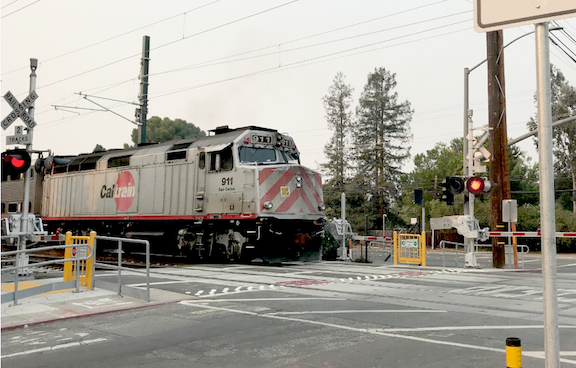
Caltrain officials aren’t a fan of a state bill that would ban the sale of diesel locomotives like the ones that Caltrain shipped off to Lima, Peru.
The Caltrain board voted on Thursday to ask state Sen. Dave Cortese to amend his Senate Bill 30 so that Caltrain’s nine remaining locomotives could still be sold.
Jason Baker, Caltrain’s director of government affairs, told the board that Caltrain would miss out on around $20 million if SB30 passes.
“That’s not an easy hit,” he said.
The board stopped short of opposing SB30 out of respect for Cortese, who represents parts of San Jose, Morgan Hill and Gilroy.
“It’s very severe to use the o-word,” Redwood City Councilman Jeff Gee said.
Exporting dirty energy
Cortese introduced SB30 after Caltrain reached a deal in November to sell its old diesel trains to the city of Lima for $6 million.
Lima will use 90 gallery cars and 19 diesel locomotives to start a new commuter rail line, Caltrain said.
The gallery cars and locomotives were built between 1985 and 1987. They were retired in September when Caltrain switched to electric trains as part of a $2.4 billion project.
Caltrain still runs diesel trains from San Jose to Gilroy and is exploring a switch to battery-powered trains in the future.
Cortese said California should be leading the world in clean energy, not shipping its pollution problems elsewhere.
“Are we not all fighting to decarbonize the same air?” he asked in a statement in July.
“Diesel locomotives shouldn’t be California’s dirty export. This bill keeps them off the rails for good,” Cortese said.
Cortese is chair of the Senate Transportation Committee and was previously on the VTA board.
State Sen. Josh Becker, D-Menlo Park, voted in favor of SB30 on May 28 when the bill moved to the Assembly on a 28-10 vote.
At an Assembly Transportation Committee meeting on July 14, local legislators were opposed — Assemblywoman Diane Papan, D-San Mateo, abstained, and Assemblyman Patrick Ahrens, D-Cupertino, voted against SB30.
The bill needs to go through the Assembly Appropriations Committee, the full Assembly and Gov. Gavin Newsom’s desk before becoming law.
The bill wouldn’t affect the sale to Lima because the transaction is complete, Caltrain Legal Counsel James Harrison said on Thursday.
The bill requires agencies to remove diesel engines from locomotives before they’re donated to a museum. Baker, the Caltrain government affairs executive, said it’s expensive to take out a diesel engine, so he asked Cortese to allow the engines to be disabled but not removed.
Caltrain also wants an exemption if an analysis shows the sale would benefit air quality or reduce emissions. But Baker said he’s met with Cortese’s team and hasn’t had any luck getting changes.
Correct me if I’m wrong, but I thought climate change was a worldwide phenomenon. If so, how does it help the cause to send our diesel-belching locomotives to another part of the earth so that we can have electric trains? Maybe the higher ups at Caltrain think climate change isn’t for real, so exporting polluting engines doesn’t matter? That the only thing that matters is that people think Caltrain is trying to stop climate change.
Lima wants to start a commuter line extending to the East of the city, where the currently only bus service. Sure, diesel locomotives are worse than electric in terms of emissions, but using diesel trains for a commuter line that would pull thousands of personal autos off the road is clearly a good thing.
Many people in Lima ride in high-emitting diesel buses that are really old, others buy used cars and motorcycles, which have way higher emissions – not just greenhouse gas emissions, but also diesel particulates and volatile organic compounds. I remember while I was in Lima for work, the air was brown and had an odor; each time a bus passed by, whether I was walking or on a bicycle, the air became acrid, causing me to cough. Having a commuter rail system would help reduce reliance on these really old vehicles, as each train can carry many more passengers, allowing for a significant benefit (for both air quality/health reasons as well as transportation/congestion/quality of life reasons) even if the locomotives are diesel-powered. A new electric railway system would cost a lot, and take a long time to build (see Caltrain’s electrification process as reference). Heavily-discounted diesel locomotives would help them, a developing country, to start such a system, allowing for quick, yet significant, near-term benefits. It is important to note that we can save many more lives by significantly reducing emissions and reducing asthma-inducing pollutants right now, versus going to zero-emissions in 15 years.
F40PHes are cool and represent AMERICA. I want Peruvians to ride to work and think about AMERICA. At least one of them was used on Amtrak in Red, White and Blue – the same colors of the Flag. It’s not like Peru has meaningful emissions laws anyway, and it’s either this or driving to work in a Chinese car running on low grade lead gas. Perfection should not be the enemy of the good.
There’s more to the USA than Teslas that are not available or even usable in their country.
Those diesel locomotives will take many cars off the roads in Peru. There will be a net decrease in pollution as a result. It is racist to tell Peru that they can only have transit based on what some white guy in the Bay Area thinks.
Stop being so woke. Are cars better than trains? Should we stop selling cars to Peru? This will reduce car emissions in Peru overall.
Paul plays the race card. Standard procedure for liberals who don’t have a persuasive argument. Reminds me of when Pete Buttigieg said roads can be racist.
If buying existing diesel trains helps a developing area launch a mass transit system, it’s a good first step. Lima probably can’t afford new electric trains, it sure wasn’t easy to finance here in the super wealthy Bay Area for that matter. Repurposing existing diesel trains for commuter service is still far better for the enviroment than all the heavily polluting OLD cars it will take off the road in South America.
From the comments I’ve read by people in Lima, the city’s current transportation system consists of thousands of small minivans that don’t meet any emission standards by far. Arguing against a commuter train service in Peru after it successfully ran here for 100+ years just because they it’s not a brand-new electric system is disingenuous.
According to Caltrain’s own most recent statistics, Caltrain only has about 20,000 users out of about 3,3000,000 people living on the San Francisco Peninsula between San Francisco and San Jose. 20,000 is about 0.6% of the peninsula’s population and 2/3 the number using Caltrain BEFORE the $2,500,000,000, $125,000 per user, electrification project.
But none of the numbers matter. Caltrain isn’t there to transport people, or to make money, or to reduce pollution. The reason Caltrain exists is to make real-estate development more profitable. It is just a circuitous a way for the politicians to pay back their benefactors in the real-estate development complex for their generous contributions to the party.
Caltrain’s system-wide electrification and modernization cost $2.44b due to pandemic-related schedule, labor, and supply chain impacts, and included a high-performance state-of-the-art Swiss train fleet with regenerative braking (about 25% of the carbon-free power the trains draw from the grid is pushed back into the grid or other trains during braking), free on onboard high speed WiFI, and power outlets at every seat.
Due to WFH and a wide variety of trip types — some of which are only one-way — and varying numbers of days per week or month that people ride for commute and non-commute reasons, the over 1 million boardings per month are comprised of far, far more unique users than simplistically just dividing the current and steadily growing average of about 40,000 weekday boardings by 2.
“40,000 weekday boardings” — Spoken like a true Caltrain employee or a train buff. Caltrain counts riders twice, once when they get on the train in the morning and again when they go home in the afternoon. So we’re talking about 20,000 weekday boardings, not 40,000.
Electrification cost $2.44 billion, so far. Divide that by the 20,000 daily riders, that’s $122,000 per rider. How many years will it take to get a return on that investment?
Caltrain’s annual budget is $260 million. That comes to $13,300 a rider per year. Assuming a commuter uses the train 260 days a year, that’s $50 a day. So let’s raise the fare to $25 in the morning and $25 in the afternoon. Caltrain would break even. Folks like Adrian would gladly pay that amount to ride the train around.
Passenger rail has never made money in the United States. Amtrak is heavily subsidized. Rail makes money hauling certain types of freight. But it’s a losing proposition for the 3,400,000 people in the three Caltrain counties to get stuck subsidizing the 20,000 people who use Caltrain. The number of people riding Caltrain doesn’t even come out to 1% of the population. I don’t want to subsidize the one-half-of-the-one-percenters. If Caltrain doesn’t work as a business, shut it down. The 20,000 people, if they all got on Highway 101, we’d never even notice it. Caltrain has little impact on traffic.
And? Trump is gonna take away our Federal highway dollars. He will find a way to put up tolls or privatize them, as much of the east coast already does. When 101 costs $50 to use and requires a waymo controller chip, most people will stop driving and prefer to ride. Caltrain is a safe investment as the Federal govt crumbles.
We live in an asset economy now, not a knowledge or service economy. We -Peninsula residents and California citizens- do not own 101 or 280. Trump does. Trump can decide at any moment to charge us for access to *his* property. It is in Project 2025.