
The Post broke this story on Friday morning, May 29. Since then, one of our competitors has re-written it and presented it as their own. Here’s the original. To get local news first, pick up the Post in the mornings at 1,000 Mid-Peninsula locations.
BY BRADEN CARTWRIGHT
Daily Post Staff Writer
A Court of Appeal on Thursday sided with the city of Palo Alto over six police officers who said a Black Lives Matter mural in front of City Hall made them sick.
“Nothing in the mural explicitly embraces any racist or harassing message,” Justices Cynthia Lie, Adrienne Grover and Charles Wilson said in their decision.
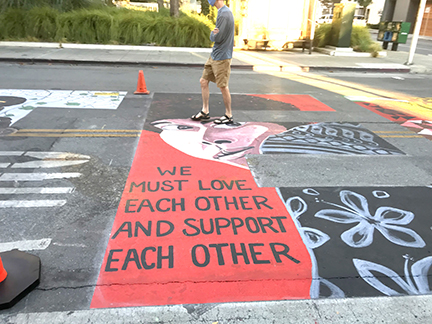
The police lawsuit looked specifically at the letter “E” that included a painting of Assata Shakur.
Shakur was a member of the Black Panther Party who was convicted of killing a New Jersey state trooper during a shootout on May 2, 1973. She died in September as a refugee in Cuba.
Officers said Shakur is a symbol of racist hatred and asked City Manager Ed Shikada to take the mural down.
Shikada told officers in an email that Shakur’s autobiography could “resonate with advocates for systemic change in our justice system” but the city “does not condone violence against our officers nor celebrate Shakur.”
Shikada defended the art as free speech.
“If it were an image of Vladimir Putin or another character, would we be expected to paint it over?” he said in an email to the police union.

The justices yesterday pointed out that officers had to look up Shakur online and said that her image is open to interpretation.
“It does not convey an unambiguous message tethered to violence against police officers, nor to race-based violence,” they wrote in Thursday’s decision.
How it started
The mural controversy goes back to summer 2020 after the murder of George Floyd, when Palo Alto City Council voted to commission a mural on Hamilton Avenue that was 245 feet long and 17 feet tall.
A different artist painted each letter. In the letter “E,” Oakland artist Cece Carpio painted Assata Shakur and the words “We must love each other and support each other.”
Five officers – Eric Figueroa, Michael Foley, Robert Parham, Julie Tan-nock and Chris Moore – sued the city on June 4, 2021, six months after the mural was removed. Officer David Ferreira later joined in.
Impact on officers
Moore said his PTSD worsened after seeing the mural, and he had to go to the emergency room for a spike in blood pressure and medically retire. He retired in August 2021.
Ferreira left work in August 2020 following a worker’s compensation claim and returned in December 2021.
Since then, he said he’s felt the looming stress of a lawsuit and betrayal by the city.
Figueroa first took an injury leave in April 2023 due to stress he felt from the painting. He said he felt like his October 2021 promotion wasn’t celebrated because he complained.
Foley also said his superiors treated him “coldly” in response to the lawsuit.
Officers “feared daily that they would be targeted, attacked or threatened at work because they are non-African-American police officers,” their lawsuit said.
Portrait negated
But Judge Evette Pennypacker said the mural wasn’t directed at police officers and didn’t interfere with their work.
“Some (officers) declare they were uncomfortable and that feeling upset caused them not to be able to work, but these conclusory statements are a far cry from the type of work interruption … as a result of persistent, pervasive racial harassment,” Pennypacker said in her July 2024 ruling in Santa Clara County Superior Court, which was affirmed by the Court of Appeal.
Pennypacker said the language next to Shakur’s portrait, about loving and supporting each other, “negates the promotion of murder” as the officers had suggested.
Council spent $575,000 defending the city against the police lawsuit according to contracts with two law firms.