
BY ELAINE GOODMAN
Daily Post Correspondent
Despite city efforts to reduce the number of RV dwellers parking on Palo Alto streets, the vehicle count has been holding steady or even ticking upward over the last few months, one resident has reported.
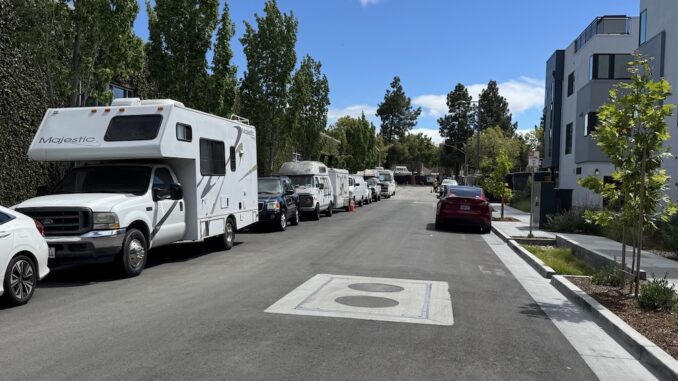
Bob Marinaro rides his bike along Palo Alto streets every few weeks, tallying in a notebook the RVs he finds parked there. While the RVs provide housing for people who might otherwise be homeless, businesses and residents say the vehicles block driver sightlines, take away customer parking and create sanitation issues.
Marinaro said the number of RVs hit a low point of 131 on March 29. But then the number started creeping up, reaching 143 in his June 9 count. In a June 26 count, Marinaro tallied 130 RVs.
“That is better than the numbers in the 200s that we saw last fall, but we have not seen any appreciable decrease in the last several months,” Marinaro said in an email to council members and others to share his findings. “The unfortunate fact is that we have not seen any movement by the City Council in recent months to give us any indication that they are effectively working (on) the issue.”
Marinaro documents the street where he finds the RVs and notes when there’s an RV parked on a street where there were none previously. He emails out his results to about 150 people, typically including photos.
Marinaro’s first RV count was on Oct. 21, 2025, the day after City Council approved a package of measures to address the growing numbers of RVs, which the city refers to as oversized vehicles or OSVs.
In his first count, Marinaro found 220 RVs parked on Palo Alto streets. The number gradually fell over the next five months as the city carried out its OSV plan.
Progress has stalled
But now, according to Marinaro’s counts, progress appears to have stalled or is being reversed.
The city has acknowledged that many people find the RV situation unacceptable.
“Some OSV residents are ‘bad actors’ and their behaviors include angry verbal outbursts, an excessive amount of belongings on the street and sidewalk, and accumulation of trash and unsanitary disposal of sewage, which can attract rodents,” the city said in a past report.
Steps the council approved in October to address the RV issue included ramping up the towing of unregistered vehicles parked on city streets; banning detached trailers from parking on public streets; and prohibiting “vanlords,” who rent out RVs.
Council also formed a committee to focus on the RV issue, consisting of council members Ed Lauing, Julie Lythcott-Haims and Keith Reckdahl.
A report from the committee last month said that from Jan. 15 to May 6, the number of RVs parked on city streets dropped from 191 to 133.
According to the report, 31 RVs were towed from October to December 2025 and 46 RVs from January to April. From January through mid-May, 19 citations were issued related to vanlording.
In other measures, council authorized a one-time deep cleaning of streets in RV parking areas followed by street sweeping twice a month. Vehicles must move to other spaces on street-sweeping days, allowing the city to see if any RVs don’t run.
At the same time, the city is working to expand safe, off-street parking opportunities for RV dwellers, such as the Geng Road lot which expanded last year to accommodate 22 vehicles. An outreach team has worked to connect RV dwellers to food, clothing, and showers, and asked them what they need to move into non-RV housing.
Wasn’t involved in politics before
Even though he’s a long-time resident, Marinaro said he hasn’t been involved in politics before. But this particular issue has sparked his ire.
“It’s just a quality of life thing,” he told the Post.
Since he’s started the project, Marinaro said he hears from businesses and residents about how the RV parking impacts them. In one case, an elderly resident had to go out and knock on an RV dweller’s door at 11:30 p.m. to ask them to turn off their noisy generator.
Marinaro hopes the RV parking issue will get attention during this year’s city council races.
He said more effort should go into finding safe parking for the vehicles or non-RV housing options.
And the city should look more closely at how other cities have handled the RV parking issue, he added.
“Palo Alto has generally been viewed as accommodating” to RV dwellers, he said.
Council is afraid to deal with this problem. They could instruct the police to enforce the existing law — that you’ve got to move your RV every 72 hours or you’ll get towed away. The police figure that, absent any instruction from council, they can ignore the law. They don’t want to have to fight the homeless advocates and other self-appointed activists who would stick up for the people living in these vans. Council, just tell the police to start enforcing the law. It’s that simple. No more excuses.
Palo Alto leans liberal and progressive, and the RV dwellers are taking advantage. You can’t have your cake and eat it too. Of course, the council should tell the police to start enforcing the law, but until the CC is wall-to-wall Republicans (or the city in general) it’s not going to happen. This will only get worse because PA allows it to get worse. One plus one equals two.
My gosh this seems so simple. Just ban RV parking overnight on city streets without a permit. Force the police to do their job and tow violators. Make it expensive to get your RV back once towed. Problem solved.
“Even though he’s a long-time resident, Marinaro said he hasn’t been involved in politics before.” Notice how he didn’t enter politics to advocate for building housing that people can afford. Nope: he entered politics to punish people for living in the only home they can afford, and for pushing them out of those vehicles and onto the streets, where presumably they can be arrested more readily.
@Cynthia, fair enough, but what rents do you envision these RV dwellers could afford, and which developers to you know that will build such affordable apartments.
I suggest you offer your driveway to an unhoused person’s RV, as you feel passionately about the issue. Or is it anyone else’s problem than your own?
Whether Council is afraid to deal with this problem or has other priorities is as much of a mystery as their ongoing failure to respond to the “Enforce The Law” ads that ran in the Daily Post for months or to Robert Marinaro’s weekly status reports tracking the OSVs, their numbers and locations, the complaints from local businesses, sanitary concerns, threats to public safety etc etc… all of which offer clues for where the police could go to enforce the laws on our books.
One would think our “leaders” would be praising this herculean VOLUNTEER effort and grateful that Marinaro’s saving PA the cost of staff /consultant time to duplicate his work at time when PA’s so broke it’s threatening to fire the crossing guards, right?
They can’t claim ignorance since City Council is on Marinaro’s email list — along with 100++ PA residents, businesses, groups, city staff who can all see the photos of the OSVS in situ, read the complaints of PA business people and get a sense of how increasingly frustrated people are by their deafening silence.
One might think our “leaders” would be embarrassed.
On June 18th, a citizen wrote a rebuttal to the city council. This rebuttal should be published. I think that if more people understood the breadth of this issue for both neighborhoods and businesses, a complete recall of the city council would be forthcoming.
It’s simple: city streets were not designed for housing. Period. There are already laws on the books that would solve the issue if they were enforced. But these laws are only enforced in select areas. Which, in my opinion, is unacceptable. Why would one area of the city be more valued than another? We all pay our taxes.
Palo Alto Municipal Code Section 10.44.020 (Standing or parking) explicitly states:
(a) No person shall, between the hours of two a.m. and six a.m. of any day… park upon streets or alleys located within a residential zone or public facility zone any of the following vehicles: (1) Oversized vehicles; (2) Trailers; (3) Camper shells…
(c) Where not inconsistent with the U.S. Constitution or other applicable law, vehicles parked in violation of this section are subject to tow.
The real problem in the Bay Area is that police departments decide what laws they will enforce and what laws they’ll ignore. In Menlo we had an RV move into our neighborhood where it’s illegal to park overnight. The response from our chief? He did not believe enforcement was the solution. I never thought I would hear that from someone paid to enforce the law. But when there’s no accountability they can get away with it.
These are early days in this controversy. The advocates for the RV dwellers are trying to find out how they can profit from protesting. Jesse Jackson would send protesters to a company and demand a check for his Rainbow Coalition/Operation Push to stop the protests. Homeless advocates in the 1980s were expert in getting city grants to do nothing. BLM/Antifa’s leaders made out like bandits getting checks from Fortune 500 companies that allowed them to live in luxurious mansions. We don’t have any of that yet, but just wait. City Council is willing to pay tens of millions of dollars to ensure this problem doesn’t stop them from getting reelected or moving up to a higher office. Open your wallets, stupid taxpayers.
No need to get conspiratorial, that just weakens the argument. And one doesn’t need to be a republican to think logically. Enforce existing laws. Address this issue that is ruining the quality of life for hard working people all over the peninsula, or get out of politics. You are useless otherwise.
Totally agree with DHL. Conspiratorial arguments have no place in this important challenge.
We want you to work here, we just don’t want you to live here. There are always those who will milk the system and they reside on both sides of the political aisle. I just feel for the honest and hard working folks who have no other viable options. I’m sure most, if not all of them would prefer a simple, clean, affordable domicile in Santa Clara County, but it is out of reach. Clearly many ideas have been tossed around, but maybe empty parking lots with added porta potties and a reasonable usage fee to cover the costs? To placate the more conservative types, the city can require proof of employment in Palo Alto as a requisite to gain access. Just a thought, and yes, the devil is in the details.
RVs bring pollution into our neighborhoods. Their exhaust and generator emissions worsen air quality, create noise, and expose residents to unnecessary diesel and gasoline fumes. They also block drivers’ visibility and make our streets less safe. The city council has to do something to stop this right now.
I live in Ventura and after years of RV abuse the broken down vehicle on my block was finally removed and the denizens given vouchers for housing… it was very stressful the garbage the human waste the behavior the fighting… and so sad too. Within a short time frame another OSV has encamped and failed to abide in a timely manner with the laws that are not enforced. So this person moves a block away and then comes back. They run their generator which is how they keep themselves powered. I get it but this is not an RV lot with hookups … it’s a city street. And on another note I don’t know why Maradero and El Camino get extra privileges. The smog guy is back living in his
monster RV and the guy in Lecington has never moved .. not once. He must have some special in at City Hall? Just let us know okay? That RV is a hazard as it blocks visibility at the intersection.
Okay wow the smog guy’s monster trailer is gone! Awesome. He’ll sneak it back in there as soon as he thinks enough time has passed. Just you wait… that’s the pattern. Thank Post for covering this for us.
Our housing shortage is real and complex. Currently, the city takes a half-hearted approach—avoiding the strict bans of neighbors like San Jose or Mountain View, while failing to consistently enforce existing rules. This results in costly, temporary fixes like multi-million dollar signage and quickly-filled relocation spots, creating a perception of unequal treatment across neighborhoods.
We cannot solve this alone. The city should actively collaborate with neighboring municipalities, organizations, and the state on a long-term plan, while simultaneously and consistently enforcing our current rules. We can, and should, do both in parallel.
I’m sure that most people living in their RVs here do not work here. But here’s a solution that would address this challenge, since it’s most potent one homeless advocates use:
1. Issue parking permits in some parking area not a city street for anyone who has a full time job for the city or a business location in the city limits.
2. Install an RV dump station there. Let those with permits use it for free, Palo Alto residents for $5, and anyone else for $25 (the going rate nearby).
3. Bounce everyone else. They are not residents of the city and have no right to turn city streets into residences.