
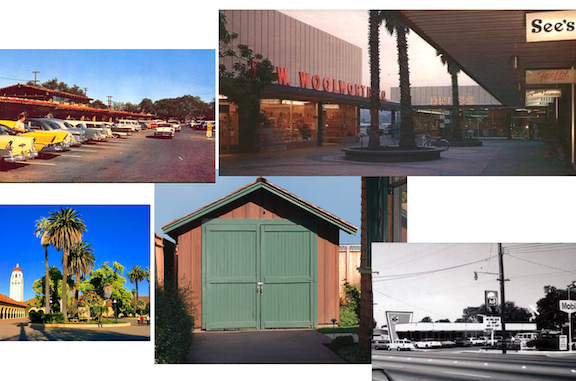
As we celebrate the 250th anniversary of the United States, it’s fun to think back to the history of Palo Alto. Our city dates back 257 years. A lot has happened over the years. Here’s a look back.
1769: Spanish Arrival. Spanish explorers set up camp by a giant redwood tree. They named this tree El Palo Alto, which means “the tall tree” in Spanish.
1844: Juana Briones Arrives. A mother of 11, healer, landowner and entrepreneur, Briones ran a dairy and sold produce to sailors in Yerba Buena in what is now San Francisco. In 1844, she purchased the 4,400-acre Rancho La Purisima Concepcion, now Palo Alto and Los Altos Hills, and ran a cattle ranch. She died in Mayfield, then a community south of Palo Alto, in 1889 and was buried in Holy Cross Catholic Cemetery in Menlo Park.
1863: Railroad Arrives. Railroad service reached the Palo Alto area on Oct. 17, 1863. The San Francisco and San Jose Railroad began its daily passenger trips with limited service to Mayfield. Full line service between San Francisco and San Jose officially opened in January 1864.

1891: Stanford University Opens. Leland and Jane Stanford opened a great college to honor their son. This college brought brilliant people and new ideas to the Peninsula.
1893: School Begins. Palo Alto’s first public school opened in September 1893. It was a temporary two-room schoolhouse on Bryant Street built by volunteers. The school district had formed on March 20, 1893, with 70 students and two teachers.
1894: City Incorporated. The town officially became a city. Leaders wanted it to be a clean place without any bars or alcohol.
1897: Phone Service Begins. Palo Alto’s first telephone company, the Sunset Telephone and Telegraph Company (later part of AT&T), opened its local exchange in 1897. It was operated by a human switchboard and originally set up above Smith’s Cyclery in downtown. In its first year, the company installed around 20 phones, including lines for doctors and newspaper editors. The city used manual switchboards until 1929, when Palo Alto’s first suburban dial service (electromechanical stepping switch) was installed.
1921: Radio Building Opens. Federal Telegraph Company, a pioneer in long-distance radio transmission, built the radio towers and buildings in the Palo Alto Baylands. International Telephone and Telegraph (ITT) bought the property and station in 1930. The site served as a vital coastal station for ship-to-shore communications for many years including during World War II.
1925: Mayfield Joins Palo Alto. A nearby town named Mayfield, roughly where California Avenue is now located, joined with Palo Alto. The two towns had competed for years, but now they were one.
1927: Fire station opens. Palo Alto’s original central fire station opened in 1927 at 450 Bryant St., sharing a building with the police department. The city had previously relied on volunteer services out of an old town hall after the independent town of Mayfield merged with Palo Alto in 1925.
1939: HP is Born. Two Stanford classmates, Bill Hewlett and Dave Packard, started their company in a small garage. Many people say this garage is the true starting point of Silicon Valley.
1941: The 285-foot Hoover Tower at Stanford was dedicated on June 20, 1941. The dedication coincided with the university’s 50th-anniversary celebration. Former U.S. President Herbert Hoover commissioned the building. It was built to hold documents about the causes and effects of war.
1951: Stanford Industrial Park. Stanford opened a special park for new science and tech businesses. This park helped big tech companies grow in the local area.
1953: City Hall opens. The building at 1313 Newell Road, and it served as City Hall until 1970. Then, when a new City Hall opened downtown, the building on Newell became the Palo Alto Art Center.
1957: Boat Harbor Opens: The Palo Alto Yacht Harbor opened in 1957 in the Baylands. In 1980, Palo Altans went to the polls and voted down a measure that would have continued dredging in the harbor. It permanently closed in 1986.
1959: Hospital Opens. Stanford Hospital (now Stanford Health Care) moved to the Palo Alto campus in September 1959. Prior to this, the medical school and hospital operated in San Francisco.
1966: Shrinking Council. Voters approved reducing the number of City Council members from 15 to nine. Since then, the council has shrunk even further. Residents voted in 2014 to reduce the council from nine members to seven, a change that took effect in 2019.
1970: Xerox PARC. The PARC research center opened. Scientists there invented the computer mouse and the modern way screens look.
1970: City Hall opens. On Feb. 10, 1970, the city opens the eight-story City Hall building, at 250 Hamilton Ave., designed by Edward Durell Stone.
1970: Liquor Ban Lifted: A judge overturned old rules that prevented restaurants in town from selling hard liquor, helping downtown become a lively dining area.
1979: Cubberley Closes. Cubberley High School in Palo Alto closed on June 30, 1979 because of declining enrollment.
1983: East Palo Alto incorporates. The predominantly Black neighborhood of East Palo Alto officially became its own independent city, separating from unincorporated county lands.
1985: Super Bowl played at Stanford Stadium on Jan. 20, 1985. The 49ers defeated the Miami Dolphins, 38-16. Joe Montana was the MVP.
1991: Caltrain Takes Over. A government agency, the Peninsula Corridor Joint Powers Board, bought the 51.4-mile railway right-of-way between San Francisco and San Jose from Southern Pacific for $219 million from Southern Pacific.
1999: Google starts. Google moved out of its first garage in Menlo Park and officially started in its first Palo Alto office at 165 University Ave. in February 1999.
2006: Facebook Arrives: Tech companies started flooding into the city, with Facebook moving its main headquarters into the downtown area. In December 2011, Facebook moved to the former Sun Microsystems campus on Bayshore Expressway.
Information for this timeline comes from the Palo Alto Historical Association, the book “Palo Alto: A Centennial History” by Ward Winslow, “Over Time: Palo Alto, 1947-1980” by Ben Hatfield and Barry Anderson, and the Daily Post archives.
Missing from your timeline is the invasion of the homeless. The crimes they commit, the begging they do for drug money, the coddling by naive Palo Altans. And they’re not all homeless. We have a guy in our neighborhood — we call him How-WEIRD — who looks like he’s homeless, defecates on lawns or sidewalks yet lives in a nice two-story house given to him by his parents. How-WEIRD can behave like normal. When lucid, he’ll tell you that he was once a political campaign guru and now runs a phony nonprofit. The next thing you know, he’s diving into a dumpster in search of lunch. The homeless have taken over our town and nobody is doing anything about it, except giving them their spare change.
Jen, if the person you’ve mentioned lives in a house, he’s not homeless. I think I know who you’re talking about. The nonprofit he talks about is real. Is he lucid more often than not? Are you aware if he’s getting any help?
East Palo Alto’s incorporation should not be included in Palo Alto’s history.
Notably absent from the timeline is the founding of Fairchild Semiconductor in 1957 at 844 East Charleston Avenue. Fairchild Semiconductor went on the spawn hundreds and hundreds of companies, both large and small, which were and are the backbone of Silicon Valley.