
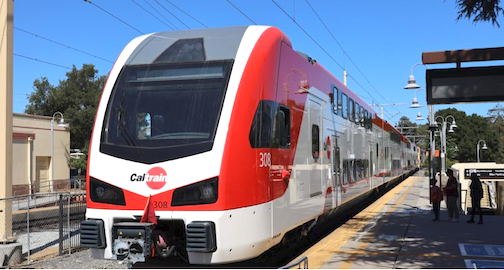
A Caltrain hit and killed a person on Saturday in San Mateo, authorities confirmed today (March 16).
The person who died has not been publicly identified by the San Mateo County Coroner’s Office, pending notification of their next of kin.
The crash occurred near E. Bellevue Ave. around 5:30 p.m.
Caltrain has a policy of no longer telling the public about deaths on the tracks in an attempt to prevent copycat suicides. It is not known whether Saturday’s death was an accident or suicide.
Caltrain reported 10 deaths in 2022, 15 deaths in 2023 and 19 deaths in 2024 — the most in a decade.
Another 10 people died last year, according to a fatality log provided by the agency.
If you or someone you know is having a mental health crisis, help is available. Call or text the 24/7 suicide and crisis lifeline at 988.
Trigger warning: This post discusses suicide.
I attended the PAUSD school board meeting last night, eager to speak, but all public comment slots were filled. In retrospect, I’m grateful. Had I spoken, I would have taken a student’s voice away.
The teens who did fill that room were courageous, vulnerable, and powerful. I heard grief, sadness, and pain—but also anger, resentment, and fear. Beneath their words, I understood something deeper: a wake for their friend’s death cannot exist while a fierce storm is still moving through and around them.
Hear is what I heard from your students:
1. Bullying is a huge problem- though labeling it a ‘problem’ is an understatement and minimizes how it can impact someone. Teens who are bullied have significantly higher rates of depression, anxiety, self-harm, and suicidal ideation. Research shows bullying is strongly linked to suicidality, with some studies indicating more than a fourfold increase in risk. (BMC Psychiatry, 2023; Children, 2023)
2. Wellness Center support has not had a presence. Following their friend’s death, students report that Paly Wellness Center staff have not shown up to provide the needed care and support.
3. Sarah Thermond is a lifeline. The theater program she runs is cherished and critical to the mental wellness of countless Paly students. I heard that Ms. Thermond has single-handedly created a safe and accepting community (and perhaps the only space they feel safe?) . There was worry that she will no longer be leading this program, and that the program itself is at risk.
PAUSD: I plead with you to keep Ms. Thermond in her role and the program intact. Your students have spoken—please listen.
PAUSD is in the midst of its third cluster of student suicides.
Since 2024, five beautiful PAUSD students have died by suicide:
· Anriya Wang, age 16
· Ash He, age 15
· Emily Fiedel, age 17
· James Liam Lin-Sperry (alumni), age 20
· Summer Devi Mehta – age 17
With a $345 million budget, and now three separate clusters of student suicides, I ask PAUSD: Why has the district failed to build an evidence-based, robust, clinically-savvy on campus wellness program? Why has it not yet truly asked its students: What is happening on campus? What do you need to feel safe and supported? Why has it not asked its teachers and staff- What are you seeing and hearing? Where are the biggest struggles, and what are your ideas to help?
Asking is only the first step. Listen and take action.
Questions for the Administration:
1. Does Dawn Yoshinaga, PAUSD’s current Mental Health and Wellness Director (a former school psychologist and principal), have advanced training in adolescent suicidality, safety planning, trauma-informed care, and gender-affirming mental health? Does she fully understand the clinical implications of bullying, transphobia, and minority stress, and does she lead her team with best practices in these areas?
2. Why does this well-funded district rely so heavily on pre-licensed clinicians for their Wellness Clinics, instead of employing a team of licensed, seasoned therapists with specialized training in these critical areas?
The sheer number of PAUSD teens ending their lives should have been an immediate call to action. The district has had the data.
The staggering percentages specifically for gender-diverse students, from the California Healthy Kids Survey (2023-2024, Paly only):
% of students who have seriously considered suicide in the past year:
Grade Male Female Nonbinary
9th 5% 15% 46%
11th 5% 8% 56%
% of students who experienced chronic sadness or hopelessness in the past year:
Grade Male Female Nonbinary
9th 6% 21% 57%
11th 13% 32% 75%
These percentages are not alarm bells—they’re five-alarm fires already consuming lives.
PAUSD, I am asking you to respond. Please do not fail them again.
Lastly, Ms. Thermond thank you for creating joy and a space where your students feel seen, heard, safe, and valued
Sincerely,
Hillary French, PsyD
Clinical Psychologist
___
*To those students who spoke about needed math classes being cut—you made great points, and I heard you too.
*School psychologists typically hold a master’s degree and focus on assessments for learning disabilities. They are not clinical psychologists and often have limited training in evidence-based therapies or clinical specialties like suicidality and trauma.
Wait, Hillary. This suicide happened in San Mateo, not Palo Alto. Why are you trying to exaggerate the Palo Alto problem?
@Hillary. I have read your recent posts across multiple forums that disparage the mental health providers in Palo Alto schools. It is important to understand the impact of these statements.
Messages that suggest school-based providers are unqualified or that services are unsafe can discourage students and families from seeking support at the very moment they need it most. They can erode trust, increase stigma, and create hesitation around reaching out for help. When that happens, students may delay or avoid accessing care, and the consequences are real for both their well-being and their ability to fully engage in school.
We all share the responsibility of creating an environment where students feel safe asking for help. At the center of this is a simple question: are our words helping students feel safe enough to seek support, or are they creating uncertainty? As a psychologist, you know the importance of these answers.
It is also important to clarify that schools do not operate as clinical treatment settings. School-based mental health services function within an educational framework, designed to provide accessible, early support to students. Administrators overseeing these programs are required to hold appropriate California credentials in administration and pupil personnel services. They are the only people legally allowed to supervise and evaluate. In addition, the program includes licensed clinicians and on-site clinical supervision to ensure quality, compliance, and appropriate oversight of all providers.
Our collective focus should remain on supporting students and ensuring they feel safe, confident, and encouraged to access the help available to them.