
Correction: A previous version of this story said that the Palo Alto City Council had approved a $7 million plan for dealing with the growing number of RVs and other vehicles parked on city streets. Actually council hasn’t yet approved any plan.
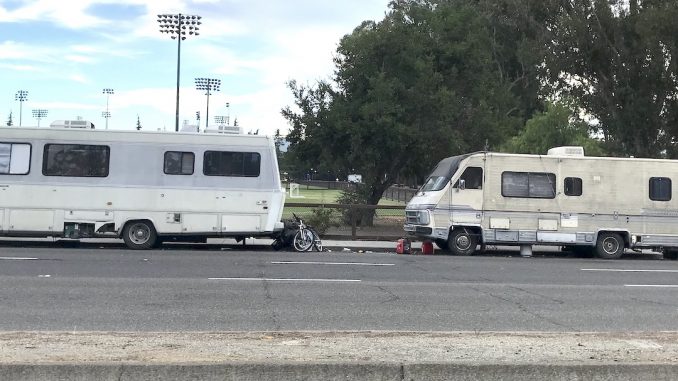
Palo Alto City Council, in an attempt to address a growing number of RVs parked on city streets, at its Dec. 8 meeting will consider a ban on detached trailers and the renting of RVs by so-called “vanlords.”
Council will vote on a pair of ordinances — one that would make it illegal to leave a trailer that’s not attached to a vehicle on a city street and another that would outlaw the practice of renting out an RV parked on the street. Under the vanlording ordinance, it would be illegal to rent out an RV as a living space, store an RV that you plan to lease on the street or charge someone for a street parking spot.
If approved, the ban would go into effect immediately and carry a fine of $500 under a new penalty schedule that’s also on the docket. While the ban on detached trailers would also go into effect right away, police won’t enforce it until two weeks after signs outlining the new rules are posted.
The city, which already prohibits cars from being parked for more than 72 hours, hopes to start putting up signs in December and have the project complete by the spring. Both ordinances are part of council’s push to prevent people from living in RVs on city streets.
At its Oct. 20 meeting, council approved the first phase of a four-part plan to get RVs off the street. The rest of the plan, which was recommended by the Policy and Services Committee, would look at introducing safe RV parking locations and sanitation services to people living in RVs, while banning the vehicles from certain streets and creating new permit requirements.
The Oct. 20 vote created a temporary committee of council members to discuss how to better enforce the city’s existing restrictions.
City hires homeless nonprofit
The city also hired LifeMoves, a nonprofit that works with homeless people to find them stable housing, to notify people living in RVs about the 200-bed HomeKey shelter, set to open in early 2026, and other resources in the arca.
Palo Alto has around 420 homeless residents, according to a survey done by Santa Clara County in January, 73% of whom live out of their vehicles,
“We have a sheer volume problem that we have to address,” Mayor Ed Lauing said at the October meeting.
Residents and businesses have complained that the number of RVs takes away room on the street and parking spots, and that people living in RVs sometimes dump wastewater into city sewers.
Action urged
At the Oct. 20 mecting, 29 people spoke during the public comment portion and the majority urged the city to take RVs off the streets.
If council moves forward with a proposed plan, a report from City Manager Ed Shikada estimates it would cost over $7 million, around $4 million of which would go to putting up new parking signs around town with the additional restrictions, and take two years to complete.
Just enforce the existing laws. If the police need direction, get rid of Shikada and bring in a city manager who knows what he is doing.
They should’ve cracked down a long time ago. The longer you let it go on…
Agree completely. Just enforce the law already in place this should not cost so much to do. Never should have happened in the first place
1) Is the $500 fine a one-time only thing or daily? If the former, the vanlords who charge lots more than $500 a month will just see it as a cost of doing business.
2) “If council moves forward with the other three phases of the plan, a report from City Manager Ed Shikada estimates it would cost over $7 million, around $4 million of which would go to putting up new parking signs around town with the additional restrictions, and take two years to complete.”
$4,000,000 on signs??? Do our “leaders” own stock in signage companies since that seems to be their answer — and their ONLY answer — to whatever problems the city’s having!
The staff and City Council chose to remove the vans from El Camino in front of Stanford where they were creating minimal problems so they could put in bike lane having almost no usage. Those lanes also created serious problems for businesses on El Camino that lost parking near their shops and restaurants. Both issues were completely foreseeable, yet they blundered ahead.
Enforce the law. No need for these hearings. Tell the police to do their job.