
The following story first appeared in the print edition of the Daily Post on Saturday. If you’re not picking up the Post in the mornings, you’re missing a lot of exclusive local stories.
BY BRADEN CARTWRIGHT
Daily Post Staff Writer
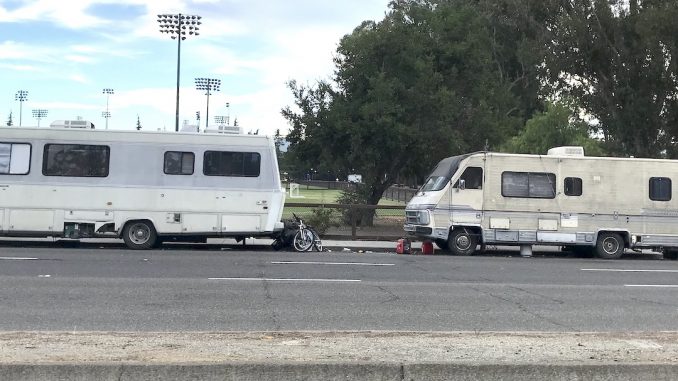
The city of Palo Alto is getting ready to tackle the issue of RV dwellers living on city streets, where business owners and employees have complained about blocked sidewalks and dumping of human waste.
City Manager Ed Shikada has put a lot of ideas on the table – from paving over a baseball field so more RV dwellers have a place to park, to putting filter fabric on storm drains so their toilet waste doesn’t end up in the Bay.
Many of the ideas would need funding, and Santa Clara County won’t contribute because of cuts at the federal level, Shikada said in a report.
“Homelessness is clearly one of, if not the most, vexing societal problems of our time,” he said.
Council may decide to ban oversized vehicles throughout the city or on select streets, but Shikada warned that such a ban would likely result in a prolonged lawsuit like in Mountain View, Pacifica and San Diego. Banning RVs also comes with the cost of enforcement and putting up signs, and RV dwellers will likely relocate to other parts of the city, Shikada said.
The city has seen a sharp increase in complaints about RV dwellers since the spring, Shikada said.
That’s when Caltrans started its re-paving project of El Camino Real that eliminated all parking along the road in favor of bike lanes.
Shikada estimated that Palo Alto has 200 RV dwellers – double from 2023.
RV dwellers are clustered on particular streets around businesses, Shikada said.
These hot spots are Embarcadero Way, Embarcadero Road east of Highway 101, Faber Place, Elwell Court, Corporation Way, East Meadow Circle, Fabian Way, Park Boulevard, Sheridan Avenue, Portage Avenue, Ash Street, Commercial Street, Transport Street and Industrial Avenue.
Heated encounter
One employee at 1007 Elwell Court was taking photos of an RV dweller, who took exception and started arguing with the employee around 9 a.m. on July 29, Lt. Craig Lee said last week.
The employee claimed that the RV dweller crashed into her while driving away in a passenger car. The employee wasn’t injured and both sides had conflicting statements, so police sent the case to prosecutors for review, Lee said.
A group of business owners between Highway 101, San Antonio Road and the border with Mountain View have been dealing with RV dwellers for at least a year.
Bill McLane, owner of Palo Alto Glass at 4085 Transport St., has been going back and forth with police to enforce rules against illegal dumping and parking for over 72 hours, emails show.
‘Not just an inconvenience’
Ramon Moreno, who runs a ballet school at 935 Industrial Ave., said several families have told him that they were uncomfortable and hesitation about bringing their children to class because of the unpredictable and sometimes unsafe conditions around his studio.
“This is not just an inconvenience,” Moreno said. “It poses a direct risk to the wellbeing of the children, their families, my staff and the reputation of our school.”
Shikada said it’s difficult for case workers to convince RV dwellers to give up the flexibility, autonomy and perceived security of an RV for the rules and reduced privacy in shelters.
Shikada raised the idea of adding case workers or offering RV dwellers a stipend to give up their RVs and move to a shelter, although he acknowledged that finding funding would be difficult.
“Buyback programs are an untested novel approach, and their efficacy and full costs are not yet known,” Shikada said in his report.
To address dumping, the city could offer pump-out services or garbage pickup and deploy more street sweepers to problematic streets, Shikada said.
When RV dwellers move, city workers often have to clean up large amounts of debris, including fluid spills and bio-hazards, Shikada said.
Possible parking program
The city is looking at the Baylands Athletic Center, next to the golf course and San Francisquito Creek, as a potential location for 10 to 20 RVs.
The baseball fields are next to the city’s existing RV parking site at 2000 Geng Road, where 10 RV dwellers already live next to portable bathrooms, washers and dryers and a children’s library.
But the Baylands Athletic Center is dedicated parkland, which means voters would need to approve the change in use in an election.
A ballot measure next year would cost about $100,000. Shikada said.
Grading, paving and striping the site would cost about $600,000, and management would cost about $270,000 per year, Shikada said.
The city can also lease a private lot, but no property owners have come forward so the costs are unknown, Shikada said.
Phased approach
City Council’s Policy and Services Committee will discuss Shikada’s ideas on Aug. 25.
Shikada is suggesting a phased approach, starting with more regulations, street maintenance and services like garbage pick-up.
Then the city can expand parking options and limit RV dwellers to certain streets, he said.
Depending on the committee’s recommendations, council will discuss RV dwellers in September or October.
Councilman Keith Reckdahl has said that addressing the RVs situation is one of his top priorities for the second half of the year.
“The city needs to come up with rules to prevent neighborhoods from being overrun and also to prevent undesirable behavior by RV dwellers,” Reckdahl said in an Aug. 8 email. “This is a hard problem that will be nearly impossible to completely solve, but we can’t use that complexity to justify not properly addressing the problem.
Why is this a problem? RV parks litter the country. Why not create new RV parks in the out areas surrounding the Bay Area? Run shuttles back to the cities. But of course these shanty town folks want to live on our streets. They shouldn’t get a say if they’re not paying taxes.