
Correction: An earlier version of this story posted today misstated candidate Charlotte Reed’s position on Measure P. The story has been corrected.
BY NORAH SHEPPARD-HUTCHINS
Daily Post Staff Writer
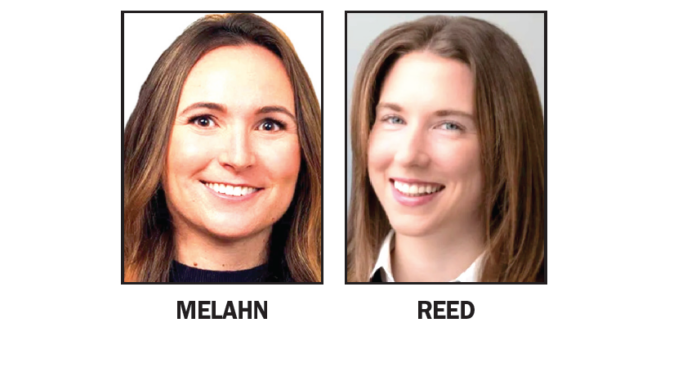
In the upcoming election for City Council, two candidates are running in District 4 to replace Betsy Nash to represent the Allied Arts and parts of central Menlo Park: Charlotte Reed and Laura Melahn.
Charlotte Reed
Reed, 31, is a mother, two-time Grammy-nominated singer and most recently worked in communications at Klaviyo, an AI marketing company.
Reed wants a dedicated commission of residents and local business owners that would prioritize bringing liveliness to downtown.
“Creating a downtown commission can focus on economic development issues, and that commission can offer recommendations to council to keep momentum around improving and supporting our downtown,” Reed said in an interview with the Post.
Menlo Park is in a $2.8 million budget shortfall, which has forced budget cuts, such as a proposal to cancel the Christmas tree lighting to save about $70,000.
“We have seen, especially in the past several months, significant budget cuts to programming downtown,” Reed said. “It’s really disappointing that the city, despite saying that downtown revitalization is a priority, that they’ve cut budget for tree light maintenance, that the holiday tree lighting is canceled.”
Reed also said she would like to explore creating a business improvement district. These districts allow property owners to pay an extra fee to fund localized developments in the designated area, such as street cleaning, maintenance and landscape renovations.
“This is an opportunity where the business community has a financial and leadership stake in the downtown where they have poured all of their time and energy and livelihood,” Reed said. “We as a city need more institutional infrastructure support for our business community.”
Reed said she will vote “no” on Measure P, which would require the city to go to the voters with any plans to redevelop parking lots to build more housing and fix parking.
“I feel we fully need to replace the parking. We cannot build without replacing this parking. Parking is essential to make sure people can access our commercial core, and the developers said they’ll widen the spaces,” Reed said.
Reed said after knocking on about 3,000 doors in her district and connecting with constituents that she has found a big issue in Menlo Park is residents feeling shut out from civic life.
“My background in public relations makes me uniquely qualified to understand how to communicate with constituents in a way that resonates,” Reed said. “Some people like social media, some people want direct mailers that they can pull out of their mailbox. And identifying, as soon as I get into office, the best way to communicate with constituents, to make sure that they are included in civic life, is a priority to me.”
Laura Melahn
Melahn, 41, is on the city’s finance and audit commission and co-created a nonprofit called the Downtown Menlo Fund, which aims to reinvigorate downtown Menlo Park. Melahn created a housing plan focused on exploring ways to deepen the affordability in homes at the already-approved development at the former SRI campus, called Parkline.
Council approved the developer Lane Partners’ proposal to build 800 homes at 333 Ravenswood Ave., which will include 244 low-income and 7 moderate homes, but zero very-low-income housing. In California, a 50% area median income level qualifies as very low income, which means the combined average household income must be $50,000 or less to be qualified.
“That project is already underway; it’s rolling, it’s going to get built. And moving the affordability level from the 60% Area Median Income level down to the 50% AMI level means more accessible homes for Menlo Park,” Melahn said in an interview with the Post.
AMI is planning jargon for Area Median Income, which is the exact midpoint of household earnings in a specific region used by California to measure housing affordability. Half of the households in an area earn more than the AMI, and half earn less. The Area Median Income for a family of four in San Mateo County is $200,800.
Lane Partners recently proposed an additional 282 homes, currently under review by council, which Melahn said gives the city leverage.
Menlo Park is required to permit 740 very-low-income homes between 2023 and 2031, and needs 603 more to reach that number, according to a housing element progress report. Melahn said it would be cheaper and faster to add very-low-income housing in Parkline, rather than at the downtown parking plaza, which three developers have bid to develop on.
“The rent difference between a 60% unit and a 50% unit is about $450 a month. Permanently filling that gap costs roughly $90,000 per home,” Melahn said on her campaign website. “Delivering the same home in a downtown parking plaza consumes roughly $100,000 to $250,000 of public resources, once the land’s value and the parking are counted honestly.”
Melahn said this strategy could also go toward the proposed 670 homes at the former USGS site on 345 Middlefield Road, which projects only 31 being “very low income.” The income levels are not yet locked, and the project is still under review. (In housing terms, “very low income” means a household earning 50% or less of the Area Median Income.)
When asked about Measure P or the rezoning of downtown parking lots, Melahn did not provide a direct answer. She said she is on team “Menlo Park,” where her main focus is not on the vote itself, but what happens after.
“The 2027 interim deadline for our housing element check-in is something we need to be ready for as a city. And we’re not ready, no matter which way the vote goes,” Melahn said. “So my focus is on keeping the city moving forward on a positive path that will keep us compliant with the HCD (California Department of Housing and Community Development) and keep our housing element compliant, so that we don’t get another builder’s remedy project like 80 Willow Road.”
Melahn also aims to revitalize downtown, which she said she has already been working on through the Downtown Menlo Fund.
“We have done a couple of beautification projects downtown to the extent that a small nonprofit can. Our very first project was bringing the holiday flags back to downtown and putting them up and down the street,” Melahn said.
She helped launch a monthly event downtown in July called Fourth Fridays that will be going into the fall and returning next spring, which features live music up and down Santa Cruz Avenue.
“I think that doing more things like Fourth Fridays, building out the plaza in a way that allows it to operate and bring people downtown is another thing we can be doing,” Melahn said.
Melahn also spearheaded a petition to make streets safer in her neighborhood called the Slow Streets Program, which she hopes to continue advocating for if elected.
Be the first to comment