
Correction: The agreed-upon increase for non-teachers in the coming school year is 3.2%, not 5.2%.
BY DAVE PRICE
Daily Post Editor
You know that feeling you get when you get into the check-out line at the grocery and realize you’ve put more things in your cart than you have money to pay for them?
Sheepishly, you have to remove enough items in order to reduce your total so you can cover your purchases. It’s embarrassing to take things out of your cart and tell your kids to put the items back in the store while you wait in line. You feel like everybody is looking at you.
But while it’s embarrassing, the fact is you don’t have the money in the bank to pay for it.
Members of the Palo Alto school board must have had that feeling on Tuesday night when they realized how much their negotiators had agreed to give the school district’s unionized employees.
Exceeds the inflation rate
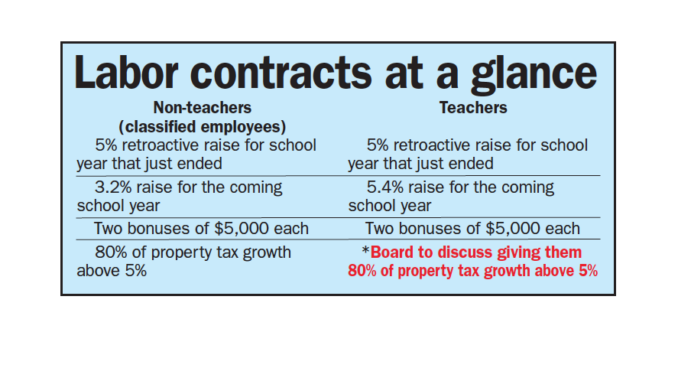
The proposed contract for non-teaching employees — such as custodians, secretaries, aides, etc. — called for a 5% retroactive pay increase for the school year that just ended, and another 3.2% annual increase effective July 1, plus $10,000 in bonuses.
Their raise for the previous school year is above the 3.5% inflation rate for the Bay Area for the 12 months ending June 1.
So those employees came out ahead compared to other blue-collar workers.
But here’s the stunner. For some reason, the school board gave them 80% of all property tax growth above 5%.
The board was ready to give a similar 80% deal to the teachers, but backed off at the last minute.
Teachers will be getting a 5% retroactive pay increase for the school year that just ended, and another 5.4% annual increase effective July 1, plus a $10,000 bonus.
A starting teacher’s salary would go from $91,546 to $101,067 in the new contract. The average salary would go from $130,072 to $143,599, and the top would go from $168,598 to $186,132, plus benefits and bonuses.
Money grab
None of these raises are based on merit. It’s all about how much money the unions can grab.
Perhaps the board stopped short of giving the 80% deal to teachers because they realized it was too generous. Kind of like the person in the check-out line who realizes they can’t afford everything they’ve put in their cart. To pay for everything, you have to put some items back on the shelf.
At Tuesday’s school board meeting, the unions tried to make the case that time was running out for a deal.
Meb Steiner, president of the California School Employees Association, the union for non-teachers, told the board, “We have people waiting for paychecks, for money.”
It reminded me of shopping for a car. The dealer offers you a great deal. But he says that you have to act today because they won’t be offering this great deal tomorrow.
Of course, the great deal would be there tomorrow — and a month from tomorrow. Saying “time is running out” is just a tactic to get you to sign on the dotted line now.
The board had it in their power to walk away from the deals with the two unions. They could have said, “This isn’t what we expected.” The unionized employees wouldn’t go without pay. The board could simply extend the existing contracts until it got a deal it liked.
In fact, walking away from these bad deals would force the unions back to the negotiating table.
Don’t blame Collins and Dauber
When this blunder was exposed, the unions tried to blame former board members Todd Collins and Ken Dauber, who campaigned against the parcel tax, which lost earlier this month.
Truth is, the parcel tax would have only generated $15.3 million a year — far less than the cost of these two generous labor contracts.
In the end, the board passed the contract with the union for non-teachers including the 80% contingency. As for the teachers, the board approved the contract with the 10% raises and $10,000 bonus, but put on hold the 80% contingency until it can be discussed at a future meeting.
Kudos to Dauber, Collins and Chris Colohan, who sounded the alarm over these proposed contracts. We owe them a debt of gratitude.
Editor Dave Price’s column appears on Mondays.
Who is advising the district and negotiating for the board? At this point, we need to assume everyone who works at the district is totally incompetent, not the opposite. Or else, someone is making decisions, and sabotaging the board.
Labor contracts in wealthy areas are often seen as too generous because they are backed by strong local tax bases, competitive hiring markets, and high funding levels, allowing districts to meet or exceed union demands for pay, benefits, and working conditions – all while maintaining high-quality schools. When it comes to schools, it’s the reality of living in a wealthy area.
Cassandra is clueless
Property tax-based funding model. This isn’t breaking news.
Ken Dauber and Todd Collins are not directly responsible for the current PAUSD labor contracts. They are, however, responsible for the tenure of Don Austin and all the baggage that came with it. They hired him and they gave him free reign to enact their agenda of homogenized teaching and grading, softened curriculum, so-called social emotional well-being (Mr. Dauber and his wife concluding that the schools were responsible for student suicides), and the squashing of dissent by oft less than legal means. Luckily strong parents, students, and staff would not be cowed.
In other words, Austin’s bullying was endorsed by Dauber and Collins, and they did little to discourage it. Tactics included “anonymous complaints” against teachers and staff, pigeonholing uniform complaints against sycophant administrators, concocting untenable schedules for outspoken staff, verbal abuse of staff in the district office, firing attorneys for trying to follow the law, publicly intimidating new board members, ignoring or marginalizing concerned parents, and padding the salaries 25 Churchill loyalists (if you think 5.5% is too generous, look at the salary increases awarded at the District Office). All the while, Mr. Austin was running a side business and using PAUSD as his springboard.
It’s ironic that Mr. and Mrs. Dauber blamed the schools for the rash of tragic suicides in Palo Alto. He is a Google engineer, and study after study has shown how harmful certain Google products are to the social emotional well-being of adolescents. But hey, you can’t bite the hand that feeds and it is much easier to blame teachers, right? Ms. Dauber is a law professor who has a reputation for imposing her views on students and conducting her instruction in ways that demean those who do not share her perspectives.
Ms. Dauber’s crusade, fronted by her husband, against Peter Colombo is a great example of how she operates. How did that crusade work out? Their henchman Austin and his operative Trent Bahadursingh are gone with a $1 million dollar hush money handshake, and Mr. Colombo is $3.25 million richer. Are the Daubers or Mr. Collins footing the bill for those miscarriages?
So yes, now that Austin, Dauber, and Collins are gone teachers are probably feeling their oats a bit, and rightfully so. Whether or not you can connect Ken and Todd directly is debatable, but they did set the tone for the current situation. Let’s just hope PAUSD can get past all of it, and somehow right the ship. I’m not so sure the Laguna Beach swap is the answer, but time will tell.