
BY ELAINE GOODMAN
Daily Post Correspondent
After being hit with hefty increases to their housing quotas in the latest eight-year state planning cycle, Bay Area cities should prepare for potentially even larger quotas in the next planning period, regional officials said.
The size of the quotas, and other changes due to new state laws, were discussed last week during a meeting of the Association of Bay Area Governments, a regional planning agency.
“We are bracing ourselves for what is coming,” said ABAG President Belia Ramos, who is also a Napa County supervisor.

The state gives ABAG a housing quota for the nine-county Bay Area; ABAG then divides that up among the region’s cities and counties. The quota for cities and counties is known as the regional housing needs allocation, or RHNA. The quotas are also broken down by the homes’ affordability to residents of different income levels.
In the 2015-23 planning cycle, the Bay Area’s housing quota was 441,176 new homes, compared to 187,990 in the previous cycle.
In Palo Alto, the housing quota was 1,988 units in the 2015-23 planning cycle. That number tripled in the 2023-31 cycle, to 6,086 units.
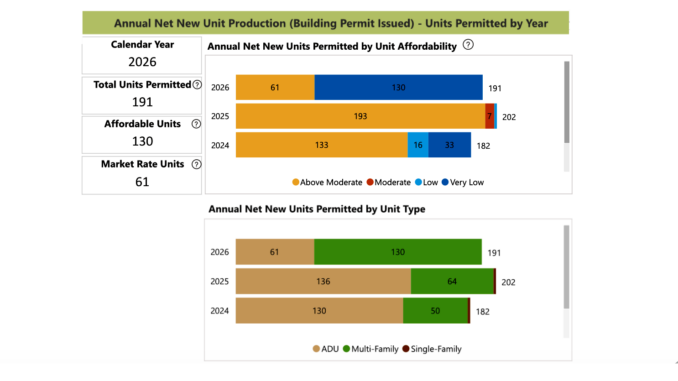
The city has issued permits for 811 new housing units so far in the 2023-31 period, or 13% of the quota.
Reasons for the increase
ABAG said previously that the Bay Area’s housing quota jumped because the state started including existing housing shortages, rather than just additional housing needed in the future. The state also had to factor in overcrowded households, those paying more than 30% of their income for housing and a minimum vacancy rate of 5%.
For the next planning cycle, a few factors could boost the Bay Area housing quota even higher, said Darin Ranelletti with ABAG’s regional planning program.
For one, the state will now factor in the housing needs of homeless people when it calculates the region’s housing quota. And the state will compare the Bay Area’s rate of overcrowding and people spending a large share of their income on housing to national averages, rather than to figures in similar regions.
“Due to changes in state law … the regional number for the Bay Area may in fact be larger than last cycle,” Ranelletti said. “ABAG and local jurisdictions should be prepared for an even larger (regional quota) which could result in larger allocations to local jurisdictions.”
After receiving the regional housing quota from the state, ABAG forms a committee and works out a formula for dividing the regional quota among cities and counties.
New state laws have given ABAG climate-change-related factors to consider when assigning quotas. Those include evacuation route capacity, wildfire risk and sea-level rise.
If one city’s quota is reduced due to climate factors, those housing units will be assigned elsewhere in the region, noted Ramos, the ABAG president.
“That doesn’t mean the number’s less,” Ramos said. “That means it’s going somewhere else.”
The state Housing and Community Development department is expected to issue its new housing quota for the Bay Area in early 2028. ABAG will start working on its method for dividing the regional quota next year.
Even though not much is happening yet in regard to housing quotas for the next planning cycle, Ranelletti said ABAG is giving a preview now because the quotas are a hot topic.
The penalty for cities
Some city representatives who attended the ABAG meeting wondered what happens if a city doesn’t make enough progress toward meeting its housing quota during the planning cycle.
Ranelletti said if that’s the case, developers can use a streamlined process for multi-family housing projects that include affordable housing.
If a city has fallen behind on its quota for lower-income and above-moderate-income housing, a housing project must include 10% affordable units to qualify for the streamlining.
If the city is behind on its lower-income housing quota, but not its above-moderate-income quota, a housing project must include 50% affordable units to be eligible.
The streamlining provisions were included in Senate Bill 35 by Sen. Scott Wiener in 2017. In 2023, another Wiener bill, SB 423, extended the sunset date for SB 35 for 10 years, until Jan. 1, 2036.
Absolutely disgusting that ABAG and MTC — 2 bodies withOUT elected representatives can do so much to ruin this area with outdated quotas they bar us from reconsidering for 8 years even while the economy is changing so drastically.
Do we get quota reductions when Oracle lays off 21,000 workers, when Meta lays off 10,000, etc etc?
Of course not. This makes no sense when builders want to add monstrosities like what’s planned for the Sunset site with a hotel, more offices, lots more offices, a shopping center etc etc that will dump tens of thousands of new cars onto roads and provide pathetically few “affordable” housing units.
But it’s a great time to be a developer or a developer-paid politician spouting meaningless platitutes about how minorities want to live in studio apartments and no one wants/needs cars to get to work because everyone — kids, grandmas, emergency vehicles etc etc — should be biking.
In agreement with this comment.
RHNA has been worthless. Despite a near-tripling of housing targets, actual state housing production didn’t move; in fact, it’s remained unchanged for a decade. Now ABAG’s response, faced with the failure of delusional targets and mandates to produce housing? Delusional targets and mandates. The definition of insanity.
ABAG, MTC and HCD don’t understand housing. Yet the cost to Californians of their thick stacks of analysis untethered to reality, plus hundreds of cities duly producing equally meaningless compliance plans, laws and documentation, has surely reached the billions. Apologists will argue “well, we need the housing.” But there is no housing; only waste, expense, and pointless drama.
As the Becerra administration digs out from years of Newsom budget chicanery, ABAG, MTC and HCD should be early targets for automation. AI can deliver equal quality of work to ABAG/MTC/HCD staff, cost much less, and produce fewer hallucinations.
Congratulations go to Scott Weiner who believes that every suburban town should look like Manhattan. Most cities don’t have the available land to put significant additional housing without having a serious negative impact on single family residential neighborhoods. Of course the irony is the more land taken for multifamily housing, the more valuable the existing single family homes become. Perhaps we need a remedial course in economics taught to the clowns in Sacramento and the lackies at ABAG
As the article makes clear, it is the state that assigns the housing quotas for the region, not MTC or ABAG. ABAG then has the unenviable job of determining how to distribute those units among the cities and counties.
Residents who would like changes to these state mandates should contact their local legislators
Contacting local legislators like Mark Berman has been a frustrating waste of time for years when he finally agreed to participate in a Zoom meeting attended by 250+ people.
He had 2 answers to all the questions asked: he can’t be expected to pay attention to details and thus didn’t know how he’d vote and to contact his legislative aide.
The very next day he voted for the bills about which he’d pleaded ignorance and none of the Zoom participants ever got a response from his aide.
Pat, it really would be more effective if our leaders tried to get responses.
Talking to Marc Berman is a waste of time. You can’t get him on the phone. When he holds town hall meetings, he seems not to listen to people, and the next day votes the opposite of what his constituents wanted. He’s a real problem. But as an incumbent, we’re not going to get rid of him until he hits term limits in 2028. Hopefully we won’t get somebody else who is so out-of-touch with his constituents, but it doesn’t look good. I hear the two people running are Vicki Veenker and Ellen “You can’t tow me” Kamai. They don’t care what the people want. They just want to climb the ladder in Sacramento. Veenker will probably win because of Kamai’s tow truck scandal. But neither of them represents real change.
The politicians will start listening to us, when we start voting them out of office. But, as usual, as long as they have a “D” after their names, everyone re-elects them and that is the problem. So sad that we are seeing the destruction of the suburbs as we know it. SB-9, SB-10, SB-79 and all of the ADU laws that turn single family homes in to duplexes and tri-plexes, with no additional off-street parking if within a half a mile of public transportation.
THIS is the real problem. People like Marc Berman don’t even bother to campaign. He could set someone’s lawn on fire and they would still vote for him, and he knows it.
You misconstrue.
The blasé-customer-service “not my department, go talk to that other department” response may or may not be appropriate for a political issue, but I am not talking policy. Some here are, but I am not.
My criticism isn’t the decision that housing relief justifies janky projects and billions spent on bureaucracy; it’s that government — including MTC and ABAG — promised everybody the former in exchange for the latter but never delivered it, and is already set to repeat that failure. It’s not about politics but competence. A statewide policy position on housing relief vs project quality may not be the jurisdiction of local officials, but calling out the emperor naked absolutely is. Most voters are not wonks. A top-to-bottom political culture of government insiders not objecting to government failure is a huge part of why California’s biggest problems haven’t been solved.
For ABAG and MTC not to push back on up-the-chain incompetence, not to shine the spotlight and demand “look, your approach doesn’t work, you need to try something different,” but instead to meekly pass down that serial incompetence with a shrug, is bad work. Outsource it.
2 elections ago there was a million dollar difference in campaign donations to Berman and his opponent Lydia Kou with something like a 60% gap in voter support. At the last election that gap had shrunk to 20%, a trend consistent with throughout the entire Bay Area and which the local Democrats refuse to acknowledge.
Given the Trump Administration’s track record, that’s some accomplishments and I joke that the GOP must be donating heavily to Berman and his tone-deaf buddies.
One question for Berman: Where did you get the cash to buy that house in Menlo Park? You make 138k in the legislature, your wife has a government job that doesn’t pay that much. But to pay a $1 million mortgage you need to make $6500 a month. Where are you getting the extra money? Shouldn’t the source of that income appear on your Form 700?