
BY BRADEN CARRTWRIGHT
Daily Post Staff Writer
Palo Alto officials say the San Francisco Public Utilities Commission is hoarding water based on unrealistic drought projections, driving up rates and killing salmon.
“This is a very serious problem. Very serious,” Councilman Ed Lauing said last Monday. “If it’s not stopped, this could cause severe rate hikes in water, and that is not what this council wants.”
Utsav Gupta, a member of the city’s Utilities Advisory Commission, raised the alarm about the SFPUC planning rates based on a drought that hasn’t happened in 1,100 years, according to tree-ring data. Other agencies like Valley Water and the East Bay Municipal Utility District plan for a repeat of the worst drought on record from 1987 to 1992, but the SFPUC uses an unprecedented and severe 8.5-year drought, Gupta said in a letter to council.
SFPUC a water wholesaler
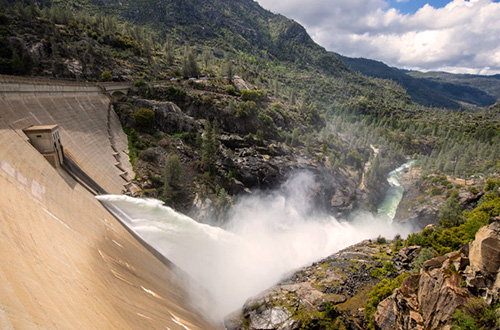
The SFPUC sells water to cities and water districts throughout the Bay Area from eight reservoirs near Yosemite. Palo Alto buys about 7% of the water, or about 9.5 million gallons per day.
As an example of hoarding, Gupta pointed to the SFPUC declaring a water shortage emergency in November 2021. The SFPUC asked customers to conserve water despite having more than 303.9 billion gallons — four years worth of water — in its reservoirs, Gupta said.
“Then when the rains come back, that water all gets spilled,” former Mayor Peter Drekmeier told the Utilities Advisory Commission on May 6. “And people wonder, ‘Wait a minute, why were we conserving so much?’”
Drekmeier is the policy director for the Yosemite Rivers Alliance, a nonprofit that wants the SFPUC to follow a plan to release more water into the San Francisco Bay-Delta for salmon to survive.
The SFPUC’s “irrational fear of water shortages” has already led to rate increases, like a 5% drought surcharge from April 2022 to May 2023, Drekmeier said in a letter to council on June 4.
The SFPUC released an infrastructure plan in February 2024 that laid out $4 to $10 billion in projects, such as recycled water plants and reservoir expansions.
These projects will unnecessarily drive up rates, and the increased costs will make residents and businesses use less water, Drekmeier said.
‘Death spiral’
“This is known as a death spiral,” he said. “As prices increase, sales decline and prices must increase even further.”
Palo Alto is one of 26 cities and water districts in the Bay Area Water Supply and Conservation Agency, or BAWSCA. BAWSCA represents two-thirds of the SFPUC’s water sales and includes Stanford, CalWater, Redwood City, Menlo Park, East Palo Alto and Mountain View.
Vice Mayor Greer Stone has been Palo Alto’s representative on BAWSCA for the last three years, and he’s been trying to get BAWSCA to stop rubber-stamping the SFPUC’s drought projections. But SFPUC is a monopoly, and BAWSCA’s leverage is limited, Stone said on Monday.
Stone said he’s been trying to build relationships and gain “soft power,” and the city of Menlo Park has been a good partner.
Residents are supportive of Stone’s efforts. Some wanted council to go further by updating the city’s water shortage contingency plan with statements pushing back on the SFPUC’s drought projections.
“Rates going through the roof and starving the Bay of promised water for no good reason are the result of this modeling,” Ventura resident Becky Sanders said at the meeting.
“It is vital for our city to push back as much as possible, Evergreen Park resident Terry Holzmer said.
Council approved the five-year water shortage contingency plan as written, despite the misgivings over the SFPUC’s drought projections.
The plan is due to the state’s Department of Water Resources by July 1, so Utilities Director Alan Kurotori said Monday’s meeting was too late to make changes.
Council added a disclaimer: “This is not an endorsement or concurrence in those analyses, and the city reserves its right to object to those analyses in other fora.”
Council will have a study session to discuss water after its summer break.
How much water does PA hold in allocation? 16 MGD? And they’re using, what, 10 MGD? Why is PA sitting on 6 MGD?
Thanks for publishing such a revealing and astonishing article. Great investigative journalism. We already pay too much for water, and the SFPUC hoarding 8.5 years of water against all scientific data, causing tremendous harm to the entire Yosemite watershed, is unconscionable. Five years is plenty. Any more is not worth the cost of the damage to the environment.
Peter Drekmeier is an invaluable water resource for us in the Bay Area.
There’s something fishy about this, and it isn’t just the dead salmon resulting from the SFPUC’s water hoarding. Their own finance people project much lower demand than their other staff use to justify all these expensive recycled water and reservoir expansion projects. I want council to do more to protect Palo Alto water customers and the river-delta-bay ecosystem.
Thank you for focusing on this ecological water issue. This is indeed a policy needing to be told.
Ignorantly, I wonder why they aren’t sending this excess water down to replenish the valley’s watertable which is falling drastically.
Peter Drekmeier is right in noting how the SFPUC’s water hoarding is based upon something that hasn’t happened in over a thousand of years but will end up costing ratepayers thousands. And let’s not forget the thousands and thousands of salmon the SFPUC has decided to veto (along with fishing jobs and overall water system health).
While Drekmeier is too polite to say so directly, I’ll say it: The SFPUC water hoarding is just plain dumb.
So glad to see the cities weighing in o n the side of reason.
Please continue to shine a light on this very concerning issue.
The SFPUC IS hoarding water, and it is costing all of us year after year. Thank you for this important information. People need to be aware of California’s water situation and that the Delta is failing and that no more water can be taken out of the Delta for ANYTHING.
The SFPUC’s anti-ratepayer and anti-environmental approach to managing the Tuolumne is one reason California’s salmon fishing industry is fighting for survival. The SFPUC is in a better position than most water agencies to provide reliable water supplies while helping to restore our rivers. But most SFPUC customers would be surprised to learn that the SFPUC is one of the urban water agencies that are most hostile to protecting the health of California’s rivers.
Thanks to all for exposing this. Any hope for rolling back the latest round of rate hikes?
We should all be grateful to Peter Drekmeier for his persistent battle to out the SFPUC’s fantasy design drought as a failure, yet one that often leads to disastrously low water with subsequent Chinook endangerment in San Joaquin Valley rivers, and will inevitably lead to needless rate increases for Peninsula customers such as citizens of Palo Alto.
And to Becky Sanders and Utsav Gupta, “a member of the city’s Utilities Advisory Commission, raised the alarm about the SFPUC planning rates based on a drought that hasn’t happened in 1,100 years.”
It is high time that other members of BAWSCA (Bay Area cities that purchase most of their water from SFPUC) join Palo Alto in demanding that the Commission address the problem of rate hikes and water hoarding. For too long, Bay Area cities have simply rubberstamped SFPUC’s decisions. Thank you, PA Daily Post, for bringing this issue to our attention. SFPUC needs to use science, not irrational fears of a Biblical drought, in establishing sane water policies. Otherwise, we will see the slow death of the Bay/Delta ecosystem, salmon die off, unhealthy algae in the Delta, and skyrocketing water rates.