
BY ELAINE GOODMAN
Daily Post Correspondent
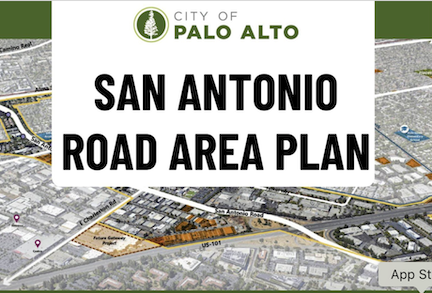
The city of Palo Alto is inviting residents to weigh in on a plan to add thousands of homes to the San Antonio Road area, along with parks, new retail, and improvements for bicyclists and pedestrians.
The plan for the 275-acre area is called the San Antonio Road area plan. Depending on building heights and densities the city decides to allow, the plan could include 3,900 to 7,000 new housing units. The area now has 384 homes.
The city’s Parks and Recreation Commission will discuss the plan tomorrow, followed by a presentation to the Planning and Transportation Commission on Wednesday, March 25. The plan will then go to City Council for a study session on April 6.
Meanwhile, residents can participate in a city survey on the plan at https://communityfeedback.opengov.com/portals/paloalto/Issue_14871.
The deadline for responses is March 29.
Survey questions include whether new development should be residential only or include offices; how tall new buildings should be; and whether developers of new offices should be required to provide community benefits such as parks.
“Build more homes, allow taller buildings,” one survey respondent wrote.
Another resident said new housing should be mixed with retail to help make up for retail the city has lost. The heavy traffic on San Antonio Road will be even worse with more housing, the resident said, and “so it would be great to (have) grocery, general shopping, pharmacy, restaurants near the new housing.”
The survey also asks about removing parking from San Antonio Road to create separated paths for bicyclists and pedestrians.
“It is important to allow for some parking,” another respondent wrote. “It is not necessary to have separate lanes for bikes and pedestrians. There just aren’t many of either.”
The plan is still in its early stages. Completion is expected in early 2028.
The city has been eyeing the San Antonio Road area as a prime location to add more housing that’s needed to meet state housing quotas. The area is peppered with small office or industrial buildings with the potential to be redeveloped at higher densities.
A major question for the city is how much new office space versus homes should be in the area after it’s redeveloped.
The 275-acre plan area is broken down into zones or “sub-areas.” There are four sub-areas that the city thinks have the most potential for redevelopment: the Central San Antonio, South Fabian, North Fabian, and CTI zones. CTI is shorthand for the area along Commercial and Transport streets and Industrial Avenue.
In contrast, some other zones within the San Antonio Road plan area are already built out with little chance for redevelopment. Those include the Green Meadow neighborhood, the Greenhouse condominium complex and the South San Antonio Road area.
The North Fabian zone includes the 24-acre Maxar factory site, which the property owner is looking to sell, according to a report to the Planning Commission.
The site could be redeveloped exclusively with homes. Another option would be using about 5 acres of the site closest to highway 101 for research and development space, with the remainder for homes. The city could require park space and retail to serve the new residents.
For the CTI sub-area, the city is envisioning a new high-density neighborhood with parks and retail. The idea would be to connect the new neighborhood to a large mixed-use development that’s been proposed just to the south in Mountain View.
The Central San Antonio sub-area, along San Antonio Road between East Charleston Road and Byron Street, already has several housing projects in the pipeline that would be six to eight stories tall. And other sites, such as the Magnussen Toyota property, are likely to be redeveloped, the city said.
Robert Cain, principal planner for Palo Alto, told the city’s Human Relations Commission last week that a goal for the San Antonio plan is to provide new housing for all income levels. He acknowledged that the new development would have impacts to schools that the school districts would have to address.
Another issue, Cain said, is making sure residents of the new development don’t feel disconnected from the rest of the city.
“Going from 400 to 4,000 (housing units) is a big change,” Cain said. “And those new residents are going to need a lot of other things to make it feel like they are living in a real neighborhood, but also feel like they’re living in Palo Alto, and they’re not receiving a different level of experience than other residents of Palo Alto.”
Good. With 3,900 to 7,000 new homes, PA will be done.
How logical our “leaders” are prioritorizing the safety of these new bicyclists and pedestrians instead of emergency vehicles much of south PA has been without a single fire engine since BEFORE the pandemic — a situation they’re now planning to make even more dangerous if they decide to close Churchill to prevent more suicides after rewarding the 2 PAUSD superintendents almost $1,000,000 to leave with one serving only 22 days.
San Antonio Road is already in gridlock most of the time. At some point you’ll have to forget about going anywhere.
This looks like it will wreck the neighborhood where i’ve been living for the past 12 years. Some developer must have paid ENORMOUS bribes!
So I guess the new buzz words “Global Warming” and “Rising Seas” is only used when needed ? How about returning the land to native grass fields instead of housing? Like the salt ponds being returned to native marsh. Be cheaper than the flood control taxes future generations will get hit with. By not building, as long as we have low crime and good schools(keep your fingers crossed), our real estate will go up, not down.