
BY ELAINE GOODMAN
Daily Post Correspondent
The man who was convicted of murdering Mountain View resident Kathleen Noble in 1989 might soon be released from prison, more than two decades after his 2002 conviction.
A two-person parole board panel held a hearing on Thursday for Mark Mepham Hensley, 56, and found him suitable to be released on parole. The decision now will go through an administrative review process, and then to Gov. Gavin Newsom, who can approve or reverse it.
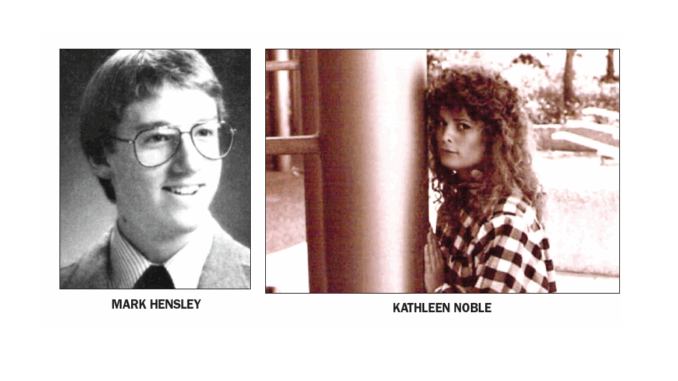
A San Mateo County jury in 2002 found Hensley guilty of first-degree murder in the death of Noble, who was his roommate in a Mountain View apartment. Prosecutors said Hensley’s motive was that he wanted a romantic relationship with Noble, but the 23-year-old wasn’t interested. The two worked together at Syva Electronics in Mountain View.
Prosecutors said Hensley bludgeoned Noble to death at their apartment on Feb. 25, 1989. Noble’s body was found in the front passenger seat of her Datsun parked in East Palo Alto eight days later.
The case, which went unsolved for 10 years, has drawn widespread attention and was featured on the Oxygen network.
After his jury trial, Hensley took the case to the state Court of Appeal, which in 2004 upheld the conviction but reduced the crime to second degree murder, finding that it wasn’t premeditated. The California Supreme Court denied a request to review the case.
Sentence reduced
Following the appellate court decision, Hensley’s initial sentence of 25 years to life in state prison was reduced to 15 years to life. That meant Hensley was required to serve a minimum of 15 years but could try for parole after that.
At his first parole hearing in October 2009, Hensley was denied parole for 15 years. In 2018, he was denied parole for five years, and for three years at a 2023 hearing.
The review on Thursday at San Quentin State Prison was Hensley’s fourth parole hearing.
San Mateo County District Attorney Steve Wagstaffe said his staff attended the hearing and argued against parole.
“We don’t feel he’s gained that insight into what he did and why he did it,” Wagstaffe told the Post.
Three of Noble’s family members — two brothers and a sister — also attended and strongly opposed Hensley’s release, according to Wagstaffe.
But the panel took into account that Hensley has participated in prison programs and hasn’t broken any rules recently, Wagstaffe said. They also factored in the state’s youthful offender law, which instructs parole boards to consider the lack of maturity of those who committed crimes when they were younger than 26. Hensley was 19 at the time of the murder.
Another factor for the parole panel was the state’s elder parole law, which gives special consideration to offenders 50 or older who have been in prison for 20 years or more.
Wagstaffe said he planned to send a letter to Gov. Gavin Newsom arguing against Hensley’s release.
How parole hearings work
During a parole hearing, the panel determines whether an inmate poses an unreasonable risk of danger to society if released.
Parole hearings are conducted by a parole board commissioner, who is appointed by the governor and confirmed by the state Senate Rules Committee, and a deputy commissioner, who is a state employee.
According to Wagstaffe, the parole board panel for Hensley’s hearing consisted of Commissioner Neil Schneider and Deputy Commissioner Amanda Neal. Schneider was first appointed by Gov. Jerry Brown and Newsom reappointed him. He’s a former Sacramento Police Department captain.
Two suspects
Following Noble’s death, police had two prime suspects: Hensley and Noble’s boyfriend of about two years, Richard Schaeffer, according to news reports. Noble and Schaeffer had gone out the night of Feb. 24, 1989, planning to attend a party, but Noble left after they had an argument, according to court filings.
Police were swamped with other homicides at the time and Noble’s case languished. On the 10-year anniversary of her death, Noble’s family asked San Mateo County Sheriff Don Horsley to reopen the case, and the sheriff agreed. Further investigation led to the arrest of Hensley, who had moved to the East Coast.