
BY BRADEN CARTWRIGHT
Daily Post Staff Writer
A pile of dirt and sand has built up in the San Francisquito Creek by Highway 101, complicating years-long flood control efforts.
“Recent higher flows in the creek have not moved this mound at all, and now there’s vegetation growing on it. So we think it’s pretty stuck there,” Project Manager Deanean Ni told the board of the San Francisquito Creek Joint Powers Authority on Thursday (April 24).
The sediment mound raises the creek’s elevation by about seven inches and doesn’t present an immediate flood risk, Executive Director Margaret Bruce said.
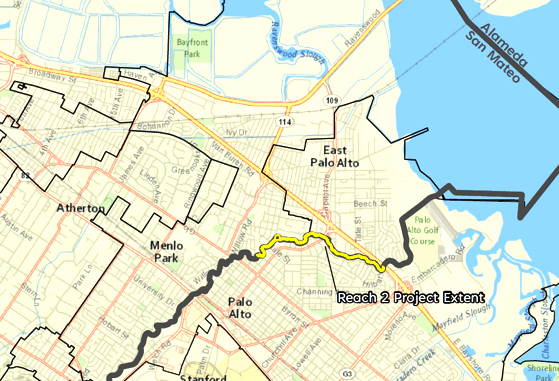
But the mound will be a factor in flood control efforts further upstream, where the creek authority and a consultant are exploring ways to widen the channel to hold more water during a storm.
The build-up happened on Caltrans property by West Bayshore Road during large storms in 2022 and 2023, Ni said.
Caltrans can remove the sediment itself, or the creek authority can get a permit from Caltrans to enter the property, Ni said.
Caltrans would take at least eight years to do the work and has said this area isn’t a priority, Ni said.
Valley Water said removing the sediment would cost $1.6 million to $2 million because the area is never dry and hard to access, Bruce said.
A shovel-ready project
Palo Alto Councilman Greer Stone balked at the cost.
“I would offer to spend a year with a shovel and bucket for $1 million, and I’ll do it myself. That’s incredible,” Stone said at Thursday’s meeting.
In the meantime, creek authority employees will monitor the buildup with a camera and on-site visits. The nonprofit Grassroots Ecology will hand-remove plants and trash on the mound before the rainy season, Ni said.
Environmentalist Jerry Hearn said Stanford should keep an eye on what happens with the sediment.
The university is working on a plan to flush Searsville Lake upstream by putting a tunnel at the base of its dam.
Sediment buildup has reduced the reservoir’s capacity by 90% and its depth from 60 feet to 10 feet, Stanford’s Director of Water Resources Tom Zigterman told the creek authority in January 2023.
It will take up to eight years to flush the sediment out of Searsville Lake, and about a million cubic yards of sediment will be sent downstream, Zigterman said.
Ni estimated the mound by Highway 101 was roughly 10,000 cubic yards.
Areas where the creek flattens out or where the water naturally swirls will get build-ups of sediment, Bruce said.
“It’s a natural process,” she said.
Replacing the bridges
The Newell Road Bridge and the Pope-Chaucer Bridge need to be replaced before the Searsville Lake is flushed.
The city of Palo Alto is looking for a contractor to replace the Newell Road Bridge, City Manager Ed Shikada said at a press conference on Thursday.
The project would start this summer and take about a year and a half to complete, according to the city.
East Palo Alto Councilman Ruben Abrica said he wants to have a neighborhood party to bid farewell to the Newell Road Bridge, which was built in 1911.
“Imagining all the people who have gone across there in over a century, and their little spirits are probably around with the creek and wondering what’s going on,” said Abrica, who lives nearby.
“It’s up to Palo Alto, but on the East Palo Alto side, we’re ready for a party,” he said.
“I’ll bring cookies,” Bruce said.
After the Newell Road Bridge is replaced, the creek authority will work on widening the creek and removing the Pope-Chaucer Bridge between Palo Alto and Menlo Park.
WRA Environmental Consultants has finished a report on options for increasing the creek’s capacity that will be presented to the board on May 28, followed by the community meetings on June 4, 5 and 11.
The board will pick a preferred plan for creek widening at its June board meeting so the creek authority can do an environmental review and discuss funding with its five-member agencies: Menlo Park, Palo Alto, East Palo Alto, San Mateo County’s OneShoreline and Valley Water.
Maybe it’s not a problem
Crescent Park resident Tom Rindfleisch said the creek authority shouldn’t worry about the sediment build-up by Highway 101. Replacing the bridges will allow more water to go downstream that could wash the sediment away depending on the magnitude, turbulence and length of the flow, he said.