
BY DANIEL SCHRAGER
Daily Post Staff Writer
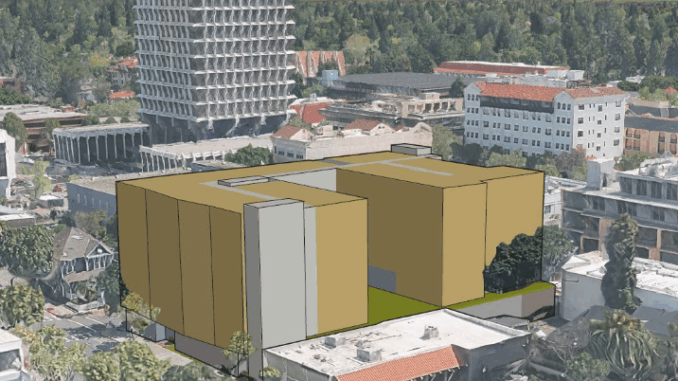
Palo Alto City Council favors a 72-apartment design for a subsidized housing development planned for the parking lot on the corner of Kipling Street and Lytton Avenue.
Council was presented with three options for the project last night (Oct. 22), which is being developed by Alta Housing, with members of the council expressing support for a six-story, 72-apartment option.
Councilman Greer Stone said he preferred the proposal to the other options – a five-story, 54-apartment design and a six-story, 68-apartment one – because it would house more people and offers more family housing, which he called a “desperate need” in the city.
Stone was concerned about the size of the development, which replaces the parking lot behind downtown’s 7-Eleven, and suggested looking into a smaller design as long as it preserved the number of units. The project faces a streamlined review process, with only one Architectural Review Board meeting, but Councilman Pat Burt expressed concern that could inadequately address concerns about the development’s size.
“I am concerned about the massing on Kipling and if there (is) a way to be able to provide some reasonable step-backs that doesn’t really cost us much on units, that would be great,” Stone said.
With a total cost a total of $78.3 million, council’s preferred option was the most expensive of the three. The city plans to contribute $5.5 million, $76,000 per unit, which it expects to finance through a low-interest loan. Alta says it needs an additional $2.27 million to complete the project and will look for additional funding sources.
Alta has proposed three options to fill the funding gap, according to City Manager Ed Shikada’s report: requesting money from the county, going through the Housing Accelerator Fund, a nonprofit lender, or adding higher-income homes to the project to qualify for a statewide program that encourages mixed-income housing.
The county would likely be able to contribute the last bit of money, Alta’s Vice President of Real Estate Development Carlos Castellanos said.
“The idea of the gap was to show that we have other alternative sources that we would be looking at instead of the county,” Castellanos said. “But the county would be a one-stop place to cover that slightly over 2 million gap. It’s definitely a manageable amount that we would be looking at other sources as well to fill that in case there’s any situation where the county couldn’t come up with that.”
Council had concerns about trying to qualify for the mixed-income funding, which requires the development to provide housing suitable for residents making between 30% and 120% of the area’s median income when the project’s current range is 30% to 60%, but some members expressed interest in exploring the idea further.
“I think the mixed-income program is interesting because we do need mixed-income housing and that could lead to better outcomes for residents, having economic diversity,” Councilman George Lu said. “But I am really concerned about what we might give up in terms of affordability.”
Alta assured council that, while the project qualified for streamlined review, it isn’t mandatory and council could opt for additional reviews.
Alta is expected to host a community meeting to receive feedback between now and the end of the year. All three community members who spoke during the public comment portion of the meeting strongly supported the project. After that, it will submit its initial application before going before the ARB in early 2026 and back to council for a final decision in April or May.
“We’re a long way away and these are just drawings and all that,” Mayor Ed Lauing said. “But we’re all committed to do this. We all know how crucial it is. This project looks, I think, terrific and in the right place.”
A group of downtown business owners sued the city over the plan earlier this year, saying that replacing the parking lot with housing will hurt business. The city says that its plan to build a six-story parking garage on the corner of Waverley Street and Hamilton Avenue will replace the lost parking spots.
Thank you to all seven members of the Palo Alto City Council, for last night supporting plans to build 72 new affordable homes in downtown Palo Alto! It is great to see our city’s consensus behind government spending to build homes for lower-income people in the middle of our city.
$1.1m per door for tiny apartments is NOT affordable housing. Once this goes up, the city will be subsidizing each unit to the tune of $3K or $5K per month. I wish they’d do the same for me. For this kind of money, we could build housing in, eh, Mississippi, put people in paid-off homes with yards, and give them monthly stipends of $3K.
Some people oppose new homes in Palo Alto because, by spending public funds to assist lower-income residents, the government isn’t doing “the same for me”.
How many units are slated for seniors, most of whom are lower-income?
This is a ridiculous waste of governmental resources
What is wasteful about government spending money to subsidize construction of new homes, near jobs and mass transit, that are set aside for people who earn less than the area median income and who pay lower-than-market-rate rent?
Thank you for publicizing this proposed project.
High rise, high density housing is not good for the environment or public health – physical or mental. And as such, is piss-poor public policy.
Stone needs to be voted out asap.